Sunday, July 02, 2006
Trains, Planes, and Dalai Lamas
Well, thanks to China Tibet now has two of the three. Maybe they will get the third someday, but I digress. The completion of the Qinghai-Tibet railroad and the Chinese reaction to it causes a few thoughts about history and its misuse. The Chinese are excited about this railroad and how it shows that Tibet is better under China than by itself. First off I should say I am no Free Tibet-er. One of the basic rules of geopolitics is that might makes right. China is more powerful than Tibet, so if they want to occupy it, develop it, and move in ethnic Hans, that’s their right. So long as it does not conflict with any of our interests, or the interests of any other Great Powers at least. What I find interesting is that the Chinese reaction when they are doing the colonizing, developing, and modifying of another peoples is quite a bit different than their reaction to others attempting to do the same in China. It should just be remembered that it was equally their right for the British or Japanese to attempt to do the same in China when they were more powerful. After all, the Japanese and British made many of the same arguments about helping a poor backward people that China does today about helping Tibet. Indeed, until recently many of China's best factories were the ones the Japanese built in Manchuria in the 1930's. There is no point criticizing the Chinese today for their current behavior, much less the Europeans and Japanese for their behavior a century ago (though the Chinese do that non-stop). Of course the Chinese can carry as many chips on their shoulders as they want, but it doesn’t mean we have to indulge them.


Saturday, July 01, 2006
Is the West misreading Putin?
Liberals can insert a "Bush reading Putin's soul" joke here.
Now that that is out of some people's systems, on to the topic in question. Russia’s President Vladimir Putin has had what appears to be an extremely bizarre foreign policy. Russia has traditionally been pulled in three directions, west, east, and south. The allure of the West is the wealth and technology it possesses, but at best Russia is only one of the Great Powers (often less). The East offers Russia a world where she is not the poorest most backwards member, but the great distance and massive population of Asia limits Russia’s influence. Only when looking south is Russia unquestionably the greatest, but that’s not saying much and Russia knows it. Typical Russian foreign policy would be to bounce between areas, only focusing long enough to achieve a few goals, maintain a favorable situation and then move off in another direction. The main goal was to never become consumed entirely by one region since Russia (except during a few periods) could never hope to compete in all of them at the same time.
As such, it would be expected that Russia would continue this general foreign policy. At first it appeared as though Putin was doing just that. He would work with the West, get a few brownie points, and then do the same with China, with a few moves towards working with the Arab world against the U.S. in between. Lately though, Putin seems to be aligning Russia ever more deeply and permanently with China (here's just one example), which is somewhat confusing according to this view. There seems to be two common theories as to what Putin is doing. The first says he is just buying off China for now, until Russia can recover and be better prepared to deal with China. The second theory is that America’s foreign policy is viewed as such a threat to Russia’s position in the world that he must ally with China to limit America’s influence after which he can move away from China.
For the most part I have agreed with the first theory, though Putin seems to be moving so far into China’s camp that it seems to me that it will be nigh on impossible to escape China’s clutches in the future. Putin has set Russia on a path that is so anti-Western in general and anti-American in particular that it is difficult to see how Russia can ever come back. Here's a third theory to explain Putin's behavior, what if he never intends for Russia to come back? Again, even in the best of times Russia is only one of the Great Powers and these are no where near the best of times. Excluding nuclear weapons (which you may as well since between normal nations they play little role in geopolitics), Russia has declined precipitously since 1990. In 1990 Moscow controlled 5% of the world’s population, 11% of its GDP, and 38% of defense spending. Today Moscow has fallen to 2.2% of population, 1.8% of GDP, and somewhere between 2% and 4% of global military spending. If Russia were to try to be a part of the West, it would barely qualify as the weakest of the Great Powers and then only because of sympathy from the West. Further, Europe cannot provide Russia with any serious military support and also poses no serious military threat. The major threat facing Russia today is the Islamists to the south and the Chinese to the east. Russia barely has the power to face one of these threats much less both. Should Russia ally with Europe, there is no hope for future aid should Russia face a war to the south or east. By working with China, Russia prevents a threat from developing in the east. This would allow Russia to focus on the Muslims to the south who also pose a more serious internal threat due to Russia’s large Muslim minority. Whether China intends to allow Russia to remain an equal in the future is open to question. However, Russia may not have much of a choice. If they do not keep China friendly there is no chance of dealing with both China and the Islamists. Russia is in such bad straights this is probably their only hope. Better to serve a Chinese boss than a Muslim master.
Here is a more detailed post about Russia's foreign policy actions. Note that the arms exports to China are specifically not the kind of weapons China would need for a Siberian war. This post is a good explanation of the overall geopolitical benefits that China and Russia gain from their partnership.
The trouble with Euros
The people that is. One of the focuses of this blog is the necessity for the United States to adjust to a changing world. The biggest of these global changes is the unprecedented peace-time decline of continental Europe. Since our foreign policy priority has been Europe and our main allies European for the last century or so, this will require some changes in the way we think. It is of course difficult since no one alive today can remember anything different. Examples of Europe’s decline are its declining share of population, economic output, etc. which can be seen here and in the manufacturing post a couple posts below. It is also hampered by the inability of its major two countries, Germany and France, to deploy military power overseas in a big way. Probably the major cause of their future geopolitical impotence is failure to prevent or to cope with their hordes of unassimilated immigrants. Even though Europe is still capable of some support, the only direction Europe is heading in the long-term is down; not something to which we should get too attached.
The Fab Four Roundup
This is a recap of the 4 posts about the new alliances we need for the future. The key nations for us are Japan, India, and Australia. Sadly, Britain is not in that list as they are drifting ever closer to the E.U. (the EU Referendum Blog does a good job reporting that). It does not seem as though the drift can be arrested, so I do not think they will play as big a role with us in the future as they have in the past. We have worked together as a group before in several cases. Together, and alone, we helped the 2004 tsunami victims as a group long before the U.N. ever got involved. We are also the key members of the anti-proliferation and anti-piracy coalitions. As a group, they are critical to us and each other as they surround the Asian half of the World Island. This, not NATO, is the key alliance for us.
Thursday, June 29, 2006
Why developed nations are still the industrial nations
Some financial analysts have taken to arguing that the developed nations of the world should be considered “post-industrial”. Their line of reasoning is that since America’s economy is only around 22% industry compared to say South Korea at 40% or Brazil’s 39% we are no longer as industrialized as these countries. Also, they talk endlessly about manufacturing jobs leaving the U.S. or Europe for East Asia or Latin America. Due to these factors, they say, we should be considered “post-industrial”. I do not believe this to be the case as I think they are focusing on the wrong indicators.
The best statistic to look at when considering the level of industrialization of a nation is not manufacturing’s share of GDP or number of manufacturing jobs, but manufacturing per person. A simple scenario explains why; in it Tom earns $5,000 a year from accounting work and $20,000 from other sources, while John earns $2,000 from accounting and $2,000 from other sources. Who would you determine to be more of an accountant? If you focus on accounting’s share of income then John at 50% is clearly the bigger accountant. However, when looked at by accounting per person, Tom obviously does more accounting than John. The same applies for the reason why the number of jobs does not matter; who cares if Tom has 2 workers making the $5,000 while John uses 5 workers to make $2,000? When adjusted for manufacturing output per person, the following table shows how it stacks up: (manufacturing output is in billions, manufacturing per capita is in thousands, and growth is from 1996, all stats are from the CIA World Factbook or Economagic.com, I also use a 5 year average for currencies, so Europe's output is slightly lower and Japan's higher than a straight current currency conversion would yield)

The best statistic to look at when considering the level of industrialization of a nation is not manufacturing’s share of GDP or number of manufacturing jobs, but manufacturing per person. A simple scenario explains why; in it Tom earns $5,000 a year from accounting work and $20,000 from other sources, while John earns $2,000 from accounting and $2,000 from other sources. Who would you determine to be more of an accountant? If you focus on accounting’s share of income then John at 50% is clearly the bigger accountant. However, when looked at by accounting per person, Tom obviously does more accounting than John. The same applies for the reason why the number of jobs does not matter; who cares if Tom has 2 workers making the $5,000 while John uses 5 workers to make $2,000? When adjusted for manufacturing output per person, the following table shows how it stacks up: (manufacturing output is in billions, manufacturing per capita is in thousands, and growth is from 1996, all stats are from the CIA World Factbook or Economagic.com, I also use a 5 year average for currencies, so Europe's output is slightly lower and Japan's higher than a straight current currency conversion would yield)

As can be seen, despite everything you hear about China’s manufacturing destroying the U.S. industrial base, we still produce nearly 13 times as much industrial output per person as China. We also produce almost 5 times as much as the world’s average. We have the third highest per capita manufacturing of the bigger countries, behind only Japan and Canada. To counter the argument that we are de-industrializing, I also included the growth of these various countries over the last 10 years. The U.S. actually grew faster than the world average during this period, 18.3% vs. 12.9%. There are several reasons for that since our growth was only average. Japan's output (third highest in the world) barely grew, and non-Japan/China East Asia was slammed by the 1998 economic crises. That's why Korea underperformed overall and Indonesia's production declined significantly. Western Europe and Latin America (check out Mexico, so much for that giant sucking sound) also underperformed last decade. To be fair to us, we also had to deal with the 2000-2001 recession that saw our industrial production decline 8% before recovering in 2003 and growing 12.5% since then.
While there are some real issues in continental Western Europe with industrial output (only 4.8% per capita growth!), they are still 4 times higher than the world’s average per capita output. The reason China's growth is so high is that it is coming off of an extremely low base of $335 per capita in 1996. In the last 10 years we have increased our output by almost $1,460 per American where as the Chinese have increased theirs by $405 per person. China's growth will inevitably slow as they become more industrial (or when their environment gives under the intense pollution). Also, I would expect that like the Soviets, the Chinese overstate their output to some extent. The last point about this chart is that it shows again how the world’s power structure is shifting. Manufacturing is only one part of a nation’s power, but it is linked to economic performance which in turn determines defense spending and population development. The regions performing best are first non-Japan East Asia, then India, and third the Anglo-sphere. These are the regions that will shape the future; we had better prepare for it.
As a side note, last years per capita growth rates were America 2%, W Europe 0.1%, E Europe ~4%, Japan 1.3%, China 8.3%, India 7%, non-Japan/China East Asia ~5%, Latin America ~2%., and the World ~2%.
Supreme Folly
The Supreme Court ruling on the Hamdan case that captured terrorists are subject to at least some of the Geneva Conventions is simply appalling. Andy McCarthy covers the problems with this ruling (prior to the actual ruling even) exceptionally well here. I agree that this is a power grab by the court, though not being a lawyer I cannot really argue the ins and outs as he can. Even so, there are several non-legal points this ruling brings up.
First, this is a perfect example of why I do not believe we will be able to stop the chaos that is spreading throughout the world (as written here). How are we to defeat terrorism in the long run when the highest court of the greatest nation on the planet cannot see a terrorist as a terrorist? Fighting evil requires some amount of dirty activity. We cannot win by being nice and humane to the most evil men we face. Machiavelli argues that to bring peace and stability to the world, you must be half man, half beast. The reason is that there will always be men in the world who are all beast and who cannot be defeated by humane men. By being entirely humane, you merely pave the way for their victory. If we keep going down the path we are going we will soon find out how true that is.
Secondly, on the Geneva Convention, those arguing that we should grant its protections to terrorists because we do not want our troops being mistreated are severely misguided as to its purpose. Its purpose is to guarantee that soldiers who follow the rules of war are somewhat protected if captured. As a punishment, those who do not follow the rules are not protected. The rules of war make it more difficult to fight, so if we give everyone Geneva Convention protection regardless of whether they follow the rules, then why should anyone follow them? For example, during World War II, we often shot surrendering Germans because they, or their unit, had not followed the rules (such as S.S., concentration camp guards, Germans who would shoot immediately before surrendering, etc.). As an aside, despite our fealty to the convention, when have our captured soldiers been treated according to the rules anyways?
The only good that can come from this outrageous ruling is if it galvanizes the Republican base to ensure the Republicans pick the next few Supreme Court nominees. It is obvious this ruling is bad as anytime Hillary Clinton, Nancy Pelosi, and Harry Reid are all ecstatic (as they are following this ruling) something that is not good has just happened to our country. As for the Supreme Court's behavior, I think it was summed up best by Richard Nixon’s head in the T.V. series Futurama, “Well I know someplace where the Constitution doesn’t count for diddley-squat, the Supreme Court!” So true and so sad.
Tuesday, June 27, 2006
The Rock of Formosa
 Taiwan is an interesting case of U.S. foreign policy. On the one side stands a small wealthy democratic island and on the other the would be Asian hegemon. At its most basic, we are confronted with a choice between pleasing the more powerful country versus defending the freedom of a small country. Rather than focus on the much discussed arguments over the morality or "legality" of either position (I would obviously prefer defending the small democratic nation), I will instead focus on the geographic and military reasons for defending Taiwan against China. Essentially, this is a straight balance of power analysis of the situation.
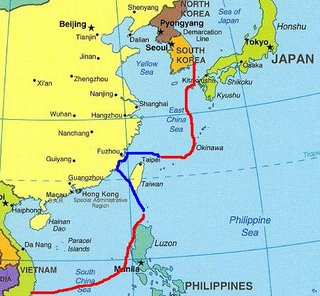
There is probably no more important reason to defend Taiwan than plain geography. The island of Taiwan is a major constrictive influence on China’s ability to project power in East Asia. The map above crudely demonstrates this effect. The red lines represent where China is hemmed in by nations other than Taiwan. The blue line shows where China is blocked by Taiwan alone. Losing Taiwan to China would have many deleterious results for U.S. strategy. As can be seen, China is currently prevented from having reliable access to blue water. Without Taiwan, the Chinese fleet (PLAN) would have direct access to the great ocean of the world. The U.S. and Japanese navies would be placed in the unenviable position of hunting down major Chinese surface ships across the vast Pacific Ocean. The Chinese would further be free to maneuver, combine, and divide their major fleets as they see fit in a time of war. Presently the Chinese are forced to divide their navy into two essentially independent fleets north and south of Taiwan. With warplanes and missiles on Taiwan it would be extremely risky for them to maneuver their fleet in the Taiwan Strait. The Chinese navy would thus start any war divided and halfway to being conquered. The reverse is also true; a Chinese Taiwan would form a protective bubble over the central part of the western Pacific that would be dangerous for the U.S. Navy to enter. The American fleet would be forced to either operate too far away to support operations or accept higher casualties. Lastly, Taiwan is an excellent location from which to launch air and missile attacks on China. It is the closest piece of land to China we would have, and is midway between Shanghai and Hong Kong.
The main military reason to defend Taiwan, aside from geography-influenced ones, is attritional. Classic attritional warfare is taking a geographic feature cheaply that the enemy must pay dearly to retake. One example of this is Southern General Longstreet’s desire to disengage and move around the Union army at Gettysburg to take a position between it and Washington, thus forcing the Federals to pay the high price of attacking the Confederates instead of the other way around. The Chinese have so indoctrinated themselves in the belief that Taiwan must be restored at any price, that they are, well, willing to pay any price to take it. Militarily then, Taiwan is a rock against which we can break the Chinese military. Even in a best case scenario, an invasion and occupation of Taiwan would be extremely costly to the Chinese military. Of course, the goal would be to prevent a successful result for China, but whether successful or not, we would be in a far better position versus China after they have blown themselves in their effort to retake Taiwan.
The Taiwan situation seems to me to be very similar to a prior contested island, Heligoland. Heligoland is a small island in the North Sea off the German coast. It had been a British territory since 1807 but Kaiser Wilhelm had given Britain a free hand in several East African kingdoms in exchange for the island in 1890. Though it appeared at the time that the British had received the better deal (one German critic groused that the Kaiser had “given away the coat for a button”), by World War I it was clear the Germans had. Heligoland proved invaluable for the German High Seas Fleet by forming a bubble in the southeastern corner of the North Sea that was inaccessible to the Royal Navy. The German fleet could make darting attacks from this secure area and then race back when caught by superior British forces. Had the British still possessed Heligoland in 1914, it is unlikely the Germans could have operated their fleet for long. British spotters and cruisers would have kept constant track of German movement allowing the British to be quickly destroy them if they attempted any action. The Germans possessing Heligoland was one factor that led them to believe the British would not risk their fleet and Empire to blockade Germany; a dangerous assumption of British intentions. It is likely that a China who controlled Taiwan would also assume that the United States would not risk her fleet and global preeminence in a confrontation over East Asian affairs.
The one weakness that we must concern ourselves with is the Taiwanese people. They seem to believe that we will simply save them from any Chinese attack, so no reason to prepare to defend themselves. They spend a pathetic 2.4% on defense, less than half of what they should spend. They have yet to agree to the major arms package President Bush offered them in 2001. Their military is only now beginning to think about reforming to face a 21st Century attack. Though they are still valuable to us, we are simply not going to blast the Chinese out of the mountain caves of Taiwan to liberate the island. Also, the amount China must pay to take the island is directly linked to how prepared the Taiwanese are to defend their island. Clearly, in any conflict we want the price to be as high as is possible. It is arguable that supporting Taiwan increases the odds of war with China. I do not agree with that, but even if it is true, it is better to have a greater chance of a war that is in our favor, than a lower chance of a war in China’s favor.
Saturday, June 24, 2006
Why we should all love Australia
Friday, June 23, 2006
Defeat a la France
As touched on in my previous post, I very much dislike the mainstream media and left-wing in our country (and abroad). The latest revelations about the secret terror fund tracking program and the cheerleading from the left are yet more examples of why I have no regard for either of them. The damage to U.S. national security is obvious and covered at length elsewhere, such as at the National Review. In addition to this, I am also concerned about the parallels between the behavior of the modern left in the face of this enemy, and the behavior of another nation under threat. Prior to the Franco-Prussian War, the French almost went out of their way to ensure they were defeated by the Prussians. Granted, France stood little chance of victory against a united Germany, but their rapid and humiliating collapse was only made possible by their weakness of spirit. I read the following passage from J.F.C. Fuller’s excellent A Military History of the Western World: Volume III and it has always stuck with me as an example of how a good nation destroys itself. It is from the French military attache in Berlin in early 1870.
“What, on the contrary, do we see in France? A Chamber that boasts itself as representing the people and which is its reflection, so far as levity and inconsistency are concerned… whose patriotism consists of spiteful recrimination or premeditated malice; who hide their incapacity and impotence under flowers of rhetoric, who pretend that they alone are anxious for the well being of the country, and who, to gain a factious popularity, dispute with the Government over one soldier, one franc… they seek to weaken France, they betray her into the hands of her most formidable enemy… a Press always vain and empty, whose leading journals descant on the most important subjects without in the least comprehending them, seeking to serve parties, not France… France has laughed at everything; the most venerable things are no longer respected; virtue, family, love of country, honor, religion, are all offered as fit subjects of ridicule to a frivolous and skeptical generation… Are not there things palpable signs of real decay?”
The highlighted sections in particular could have been written today about the mainstream media and the left here. It is further noted by the Prussian Chief of the General Staff Count von Moltke that the Prussians had little difficulty planning operations against the French since the Paris press kept nothing secret. Many on the left argue that since the terrorists know we are looking at their finances, revealing the terror fund tracking program, does not damage national security. Guess what? Von Moltke knew the French armies were maneuvering in the Champagne region to relieve the fortress of Metz. What was so damaging to France was that the press reported where and how the French armies were planning to relieve Metz. What is so damaging to America is the press, enabled by liberal defeaticrats in the federal bureaucracy, is reporting where and how we are tracking terrorists.
After reading about France's self-defeat, I always thought that at least we in America would never see such behavior. Sure in peace-time the left may gripe, the press may be willfully incompetent, traditional values are challenged, but never in a time of war. I know how frustrating it is to see the media gleefully expose every anti-terror program they can, to listen to the lefties claim they "support the troops" while criticizing everything our soldiers do, and to watch as the two work together to see that Bush is destroyed whatever the cost to the country they tell us they love. We can take heart in our modern situation because the similar internal decay represented by the left and the media is not a majority phenomenon in our great country. We conservatives and patriots who are not filled with “spiteful recrimination or premeditated malice” must take it upon ourselves work twice as hard supporting our troops and anti-terror efforts. We must provide twice as much moral support for our nation. We must try twice as hard to make sure the Democrats who would see France’s mistakes repeated here today are not voted into power. As it was noted by a military theorist after the war, “victory remains with the nation which holds ascendancy in science and moral force.” In this struggle, we will always hold ascendancy in science; it is our duty to strive twice as hard to cover the rot of the left and guarantee that America always holds ascendancy in moral force.
The Equivalency Game

One of the major reasons I long ago gave up on the mainstream media is their inability to understand the differences between the U.S. and our enemies. The recent torture and mutilation of two American soldiers is case in point. Where is the outrage in the media at this very clear barbaric violation of the Geneva rights of our soldiers? To the extent it is mentioned, it is claimed to be tit-for-tat, with tat being the unspeakable horror of making an Iraqi prisoner wear panties for a head dressing. Since the media cannot tell the difference, here is a game devised (or at least it's the first place I heard about it) by radio talk show host Glenn Beck that determines whether something is equivalent.
There are two lines and you must decide to get in one. If you can easily pick one then they are not equivalent, if you cannot, then they are.
First Line: You have to get naked, put panties on your head, wear a dog leash, and get on all fours while a hillbilly chick holds the leash and takes pictures.
Second Line: You will be brutally tortured, after which a dull machete will be utilized to cut off your head while the Arabs around you chant “Allah Akbar” and film it.
Answer: First line, not equivalent.
First Line: You will be interrogated by means including sleep depravation, being made to stand next to an AC for long periods, having to hear John Kerry spend a week trying to explain the simplicity of his Iraq plan, and maybe even having a female guard get a little “too” close.
Second Line: You will be strapped to a wall in a terrorist safe house for several weeks, starved, beaten, burned, electrocuted, and otherwise tortured.
Answer: First Line, not equivalent.
First Line: You will be shipped to a Soviet Gulag where you will be starved, beaten, and either worked to death or shot.
Second Line: You will be shipped to a Nazi concentration camp where you will be starved, beaten, and either worked to death or gassed.
Answer: Neither, equivalent.
First Line: You will be shipped to Guantanamo Bay, where you will be fed three squares a day, given religious articles and time, and be otherwise treated well so long as you behave.
Second Line: The Gulag or concentration camp again.
Answer: First Line, not equivalent.
First Line: You will move to whatever the latest leftwing country is considered a paradise by the media and the left, be it Cuba, Venezuela, Russia, France, etc.
Second Line: You will live in the United States of America.
Answer: Second Line, not equivalent (as can be seen by how long the real life second line is compared to the first).
Thursday, June 22, 2006
Alliances for the new Century Part 4 – Australia
 In keeping with the global power shift to the Far East, our most important Anglo ally is becoming Australia. They play a similar role to Britain, being a staunchly loyal and capable base off of Southeast Asia. Australia is not necessarily a powerhouse nation with only 20.3 million people, an economy of $640 billion, and a military budget of $17.8 billion. They rank around 15th in global power, or in the range of South Korea and Spain. What makes Australia so important is her location, excellent (if smallish) military, and relative power superiority in Southeast Asia.
I do not mean to sound belittling when I say Australia is mostly valuable for her location. The extreme difference in power between the United States and every other country in the world (with the possible exception of Japan) means that the most important asset of any of our allies is their location. There are many regional and global benefits to Australia’s location. Bases in Northern Australian (such as at Darwin) are great locations from which to launch operations throughout terrorist infected Southeast Asia. Australia’s location is also at the corner of the "V" formed by the ocean off the southern and eastern sides of Asia. As this map shows:
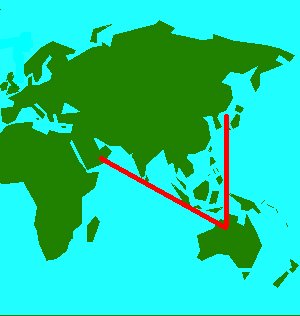
This means forces deployed there would be able to deploy as far a field as the Mideast, South Asia, and Northeast Asia in a reasonable amount of time. Add to this the central role in global spying and intelligence gathering Australia plays (as the Echelon program attests), and it is clear that Australia is a very valuable ally for all the most important regions.
A point that cannot be overlooked when examining Australia is the fact that her military is one of the few remaining militaries that can conduct offensive operations with us (in stark contrast to say, France and Germany). Although Australia only has 53,000 soldiers, they are amongst the best funded in the world at $335,000 per soldier. Much of the $17.8 billion defense budget is going to ensuring that Australia can, after falling behind a little, continue to work closely with the U.S. Billions upon billions are being spent to purchase Aegis destroyers, amphibious warships (essentially light aircraft carriers), F-35, and possibly F-22, fighter planes, large transport and refueling planes, and M1 tanks. Though the numbers are small compared to the U.S., 3 Aegis warships vs. 84, 100 F-35’s vs. ~2,800, 59 M1’s vs. ~1,600, they would be a valuable addition to any operation. In fact, compared to other countries in the world, this amount of deployable power is far above that of many much more powerful nations, much less those of Southeast Asia.
Australia is, unlike India, already very close to the U.S. We have an alliance through the ANZUS Treaty, Australia participates in the National Missile Defense program, they took part in both the Iraq War and occupation, and we have joint intelligence gathering and sharing. Our focus should be more on improving our alliance with a nation that is both ideally located and one of the last nations to be capable of operating with us militarily. As with Japan and India, this is exactly what the Bush administration has been doing. Of greatest significance, Bush has upgraded our alliance to the same level as Great Britain, a true honor. The President has made Australia one of the few countries with a free trade agreement with the U.S. (given how hard it is to get an FTA through Congress you could say that is a true honor also). We should also continue to not overreact to any ties between Australia and China. If there is any trouble in the future with China, Australia will side with us. There is no need angering them by trying to stop business deals between them and China now. I do not believe furthering our ties with Australia have conflicted with any of our European alliances for now. However, Australia is so important to us and the future power politics of Asia that we cannot let Europe come between us.
Wednesday, June 21, 2006
Debt Myth 1 - Bush is drowning us in debt
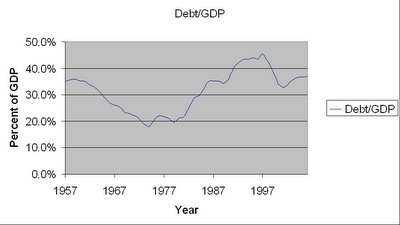
This is the first of a series about the national debt of the U.S.; it’s a short one that deals with recent trends. One of the more powerful attacks on the Bush Administration from both sides is that the national debt has exploded and threatens our very future. On the face of it seems to be a reasonable statement. Since 2001 the public debt of the U.S. has risen from $3,339 billion to (approx.) $4,910 billion, an increase of $1,571 billion or 47%. However, against this it needs to be remembered that the GDP of the US has also risen from $10,172 billion to (approx.) $13,300 billion or 30.8% growth. As such the most important indicator of national indebtedness, the Debt:GDP ratio, has budged only slightly. When President Bush took office it stood at 32.8% and is now at 36.9%. This represents a 12.5% increase; though 92% of it came during Bush’s first three years and only 8% in the last two years. This mega increase most surely had increased our interest rates to unbearable levels as predicted by Clintonomics right? Only in Bizarro world, which I know that's why lefties would believe it to be true. Actually, the average interest rate for marketable debt has fallen from 5.82% in 2001 to 4.693% today. The situation with overall debt involves even bigger and scarier numbers, but I do not see why people insist that Social Security borrowings are debt, they do not have to, and most likely will not, be repaid. Actually, should new debt be issued to pay the Social Security borrowings then that will simply create real debt in place of fake debt (sort of like giving your kid brother monopoly money for real dollars). Conversely, if taxes were raised to pay them then the debt ratio would rise as the economy would be smaller.
This graph shows the mild rise and level of debt currently enjoyed by the U.S. (note for any chest beating libs out there, the debt to GDP ratio increased 8.1% under Clinton until 1998, 4 years after the Republicans took control of Congress, debt interest rates also rose from 6.374% to 6.631%).
Economic info can be found here, and debt/interest rate info here.
This graph shows the mild rise and level of debt currently enjoyed by the U.S. (note for any chest beating libs out there, the debt to GDP ratio increased 8.1% under Clinton until 1998, 4 years after the Republicans took control of Congress, debt interest rates also rose from 6.374% to 6.631%).
Economic info can be found here, and debt/interest rate info here.
Tuesday, June 20, 2006
No Ko No Go
I just have a few points on North Korea now that Kim Jong-il has managed to get attention again by threatening to launch an ICBM capable of hitting the U.S. First, despite the Democrats wild-eyed cries for Bush to do anything besides deal with Iraq (well now Iran), there is not much the U.S can do with North Korea except make the situation worse. There are two ways to deal with foreign problems, diplomacy or force, and neither is a serious option for the U.S. with North Korea.
Diplomacy - For diplomacy to work, we have to have all the regional powers working with us. In the case of North Korea, only Japan is really supportive, but for historical reasons there is not much they can do. South Korea is neutral but moving slowly towards a more pro-North policy (think Sunshine). The major problem is the Chinese. They support North Korea diplomatically and by providing just enough food and fuel to keep the regime in power. Since there is no unified diplomatic front, and since China provides Kim with just enough to survive, there is no possibility of resolving the issue diplomatically at this time.
Military - While we have various military options for stopping North Korea, without the support of South Korea none of them are practical. South Korea will not support any as they all risk a war with North Korea which would be very expensive in lives, property, and money; none of which a South Korean economy still recovering from 1998 can handle. Further, any war would almost assuredly end with the collapse of North Korea and re-unification. Sounds good, but the South Koreans really do not want it because they don’t have the money or inclination to bring North Korea up to their level (compare to the problems Germany had, East Germany was ¼ the population of the West and ½ the income, North Korea is ½ the population of the South and around 1/15 the income).
Since it is too late to improve the situation, all we can do now is not make the situation any worse. We can avoid pass mistakes such as giving North Korean regime food and fuel aid that has allowed them to prolong their time in power. It was also probably a good idea to not have given them the nuclear technology that made it easier to develop nuclear weapons. All we are left with now is to continue building up missile defenses, prepare to give Japan or South Korea nuclear weapons, continue our pull out from South Korean so that fewer Americans die should the North Koreans start a war at the time of their own choosing, and keep up the anti-proliferation patrols around North Korea. Due to the mistakes of the Clinton Administration in dealing with this issue, we have little hope of starving them out or possibly forging a verifiable agreement. Essentially all we can can do is protect ourselves and make South Korea and China pay most of the price since they have prevented us from doing anything before they aquired nukes and ballistic missiles.
Tuesday, June 13, 2006
Deep are the wounds that civil strife inflicts - Marcus Lucanus
In light of the British strategist's comments about the threat posed by unassimilated and hostile immigrant groups in Europe, I thought it important to note why it matters despite the fact that they are not near a majority. Some would argue that it does not matter if they are not a majority because Europe is democratic. That would be true to an extent if the immigrant communities were not hostile and prone to violence. Even if they were not violent they would still be very influential in the democratic process since they would be seen as a rapidly growing unified voting bloc on the margins; just look at how much attention the Hispanics get here in the U.S and they are only around 6-7% of voters.
What is important when determining how much trouble such immigrant communities could cause is not overall population ratios but ratios of young men willing to fight. After all, it matters not that a country challenged by 2 million young men has 11 million people if 10 million are old women and only 1 million young men. For example, let’s say in 2020 the immigrant population of France has hit 20% of the total population (no one is certain of the exact demographic makeup of France but it is probably close). Since the immigrant birthrate is far higher than the native French rate (possibly three times as high but again no one knows for sure) they could represent 30-40% of the young men in France at that time though we will go with 35%. While Frenchmen would still be a majority there is a second aspect to consider, those willing to fight. This poll, from Britain admittedly, showed that only 19% of young men are willing to fight for their country regardless of the reason. Another 57% are willing to fight if they agree with the cause, though I am not certain how many would consider suppressing racial minorities, no matter how odious they are, to be a just cause. Assuming that the situation is similar in France and that half believe it is a just cause, then the 65% of young Frenchmen becomes about 31%. Also assuming that all immigrant men are willing to fight, they would outnumber the number of Frenchies willing to fight 35-31.
The sad reality is that in the end bullets count for more than votes. Even should the ratios favor the Europeans the immigrants could still cause quite a problem. Look at Northern Ireland where the British had to keep 20+ thousand soldiers for 40 years to deal with 400,000 Catholics. Can the French find 600,000 men to deal with 12 million Muslims? Does it even matter when the entire country is like Northern Ireland circa 1970? How would the Muslim countries react to their co-religionists revolt? If they decided to support them, could Europe in its wounded state resist effectively? After all, the Romans could keep out the barbarians even at their end (see the Battle of Chalons), it was the combination of civil war and barbarian revolts from immigrant (foederati) tribes that finished Rome. This is why, as the British strategist pointed out, the Europeans should be more concerned about their immigrant communities even though they will not be a majority anytime soon.
America's lost window
It is becoming increasingly clear that the United States will not make any more major attempts to rebuild failed states. All that we are likely to see in the future are some mopping up operations such as whacking the Iranians and maybe the Somali Islamic Courts. The American left and many around the world will no doubt rejoice at this outcome even though it is not good for anyone except the new-age autocrats around the world.
The situation we faced was quite similar to the situation Britain faced after the Napoleonic Wars. They used their window to expand the British Empire and establish the constitutional rule of law to which much of the world embraces, or at the least pays lip service, to this day. They accelerated their campaigns to eliminate slavery and piracy around the world and began developing many regions of the world economically. As their window came to end with American growth, French recovery, German unification, and Russian expansion they fell back to doing their best to keep the world stable by maintaining the balance of power.
Our historic window of opportunity to better the world opened up in 1990. The first President Bush, though he did not have much time to do anything, seemed to think it was the perfect opportunity to declare success and freeze the world in place. President Clinton frittered away 8 years on micro issues, bombing the Serbs whenever the chance arose, and navel-gazing at the bubble economy. The second President Bush originally did not plan anything more than Clinton except for some sort of closer union amongst the American nations. 9/11 changed this for a time, but for whatever reason (*cough* Powell *cough*) the immense momentum of April 2003 was never followed up. To keep the left and their anti-American friends around the globe happy, we forswore anymore regime changes. This has simply given the initiative to the Jihadists who have taken as much advantage of it as they can. Certainly the visceral opposition of the American left and media played a role in ensuring no further attempts were made after Bush’s cabinet was reshuffled (eliminating some of the deadweight) following the 2004 election.
Whatever the cause (and I do put some of the blame on Bush), we are now in a position where the strength shown by overthrowing Saddam has turned into a grave weakness as now no dictator even remotely fears that we will do it again. Combined with the rise of the Beijing-Moscow Axis as an alternate source of support instead of the U.S., we will find it extremely difficult if not impossible to ever reform another failed state into a functioning nation. As we have recently found, oppressive dictators around the world are increasingly ignoring us and our calls for increased freedom, human rights, and transparency. They are turning to Russia and China for reform-free support and investment thereby preventing any peaceful reformations. In short, our window for helping people around the world improve their lives is over. We are now returning to the balance of power and realist foreign policy of the past. I only hope the left is happy with this result. They have succeeded in limiting Bush’s policies while limiting the freedom, hopes, and aspirations of billions around the globe. An equal trade in their book I’m sure.
Monday, June 12, 2006
Alliances for the New Century Part 3 - India
 Probably the single most important country that will determine the shape of future events is India. At the moment India is not a particularly powerful country, but that is likely to drastically change in the coming decades. India has a massive population of nearly 1.1 billion but an economy of only $720 billion and defense expenditures of $19 billion. Overall, by my reckoning they are the 9th most powerful country in the world. It is not their current ranking that is important, but their future one. India is not at the moment allied with any country and is currently developing relations with both the U.S. and China. India's potential in the future to either help solve the world's problems or add to them that makes India a vital nation for our foreign policy to move closer to us.
When approached rationally, it makes perfect sense for India to ally with the United States. At the most basic, America is the richest most powerful democracy and India is the most populous. We are both products of the British Empire with many of the same democratic traditions and policies. Due to our strategic positions we are essentially maritime powers though we do both have the need for a somewhat stronger army than a typical island nation. The rise of powerful autocracies like China and Russia, and the rise of militant Islam are threats to both of us (if somewhat more so for India since they are closer). The Indians are focusing their development on hi-tech and medical fields which would make us an excellent fit for a free trade agreement. It would seem that shorn of the emotions that so often dominate human interactions India would have no problems allying with us, but there are problems.
The main challenge of India is that it has a tradition of socialist anti-American politics in the Congress Party. While they are making some progress in moderating their politics, the fact is that old habits die hard. Unless major changes in thinking occur in the Congress Party, we cannot expect a deep alliance if they are in power. This is a holdover from the Cold War Non-Alignment ideology of the Indian political class when hatred of American capitalism and “imperialism” was the rule. We also need to understand that the Indians may simply not want to pay the price of keeping the world stable. It is not an easy or enviable job. We need to be very concerned though that India does not get hoodwinked by the Beijing-Moscow Axis into believing that it could play a role in the glorious destruction of the American “Empire”. India would never be more than a vassal state in China’s eyes and the more they understand that the better. Another point of concern is that India is almost entirely dependant on energy imports to meet its needs. India is therefore susceptible to a live and let live and let the U.S. handle any crazies mentality with regards to the Islamic states it depends on for energy.
Our policies with India must reflect these realities. Of critical importance is the nuclear energy agreement that President Bush signed with India. This deal is good at all levels. It gives India a moral boost, increases U.S. exports to India, provides India with a large amount of non-oil energy, and opens the way to future deals. We should let the Indians know that the era of the U.S. being able to shoulder the burden of solving all of the world’s problems is coming to an end. If they do not want the crazies disrupting their stability, they will have to help us. Allying with China would definitely be alluring for the Indians, especially as the Chinese will say whatever it takes to achieve it. We will have to combat this tendency constantly in the future. One way to do it is to make it clear to the Indians that we are not looking for a fight with China, only preparing for one should the Chinese start it. The Indians also have to understand that the more nations that will unite against Chinese aggression, the less likely it is that any of them will have to fight China. We should push a free trade agreement with India and encourage it to become the major market for U.S. and Japanese exporters so that neither of us becomes dependant on the Chinese market and India becomes more intertwined with the democratic world.
It is essentially a certainty that sometime in the next 20 years India will overtake China in population. It is a possibility that India will overtake China economically (though I would not put money on it) based on a comparison between India/China in the 21st Century and Britain/France of the 17th & 18th Centuries. Even if the Indians don’t manage that, they will still likely grow at a rapid clip in the next 20 years. When combined with India’s rising defense budget and large military, this means India will wield much more power and influence in the future. We have to do everything we can to see that India is pro-U.S. at this time. President Bush is doing this despite the objections of the American left who cannot stand to see their prior arms control agreements and European friends ignored. We must make sure that the future’s three most powerful democracies (including Japan) stand together to confront the world’s many, many problems. If we fail in this mission, we will possibly be left holding the lines of the mid-Atlantic and Straits of Tsushima.
It's AD 476 all over again
The top strategist for the British military recently made a splash by saying that we are facing a situation eerily similar to the one facing the Western Roman Empire at its end. The article can be found here. His speech touches on several of my beliefs about world affairs. Firstly, rather than compare the U.S. alone to the Roman Empire (a mistaken analogy in my view), it is better to compare Western Civilization as a whole to the Roman Empire. In this case the old half of the West, Europe, would be the Western Roman Empire, and the newer more powerful half of the West, America (plus Canada and Australia if you like), would be the Eastern Roman Empire. The speech also involves another one of my beliefs that much of the world is collapsing and we need to do what we can to limit its effect on us and on whomever else wants to help us fight it. The post before this one discusses my view of the international system as a whole, and the two before that are parts 1 & 2 of a series on the alliances needed to combat the future challenges we will face.
I would highly recommend reading the entire article yourself but I’ll mention a few of his points. Firstly, he compares Europe today, though not the U.S., to the Western Roman Empire near its downfall,
"future migrations would be comparable to the Goths and Vandals while north African "barbary" pirates could be attacking yachts and beaches in the Mediterranean within 10 years. Europe, including Britain, could be undermined by large immigrant groups with little allegiance to their host countries — a "reverse colonisation" as Parry described it. These groups would stay connected to their homelands by the internet and cheap flights. The idea of assimilation was becoming redundant, he said."
This is one reason why we shouldn’t expect anything more from Europe in our alliances (I write about another reason here). He goes on to say that the world power structure is rapidly shifting and will be a challenge to the U.S. (he doesn’t mention Europe, though I’m guessing it is because like me he thinks Europe will be fighting just for survival). The article says,
“He pinpoints 2012 to 2018 as the time when the current global power structure is likely to crumble. Rising nations such as China, India, Brazil and Iran will challenge America’s sole superpower status.”
Aside from including Iran in the list of countries capable of challenging the United States, this is exactly my point about the new global order. We need to do everything to keep Japan as a full ally, keep India at the least neutral if not allied, and do everything possible to keep Brazil from succumbing to anti-American socialist virus spreading throughout Latin America. Lastly, I would point to his belief that far from abating, wars will possibly explode in the near future,
“The competition for resources, Parry argues, may lead to a return to "industrial warfare" as countries with large and growing male populations mobilise armies, even including cavalry, while acquiring high-technology weaponry from the West.“
I expect this also and write here about the need to resist the temptation to declare an end to history and go to sleep. Since Europe will be lucky just to hold its own against its rising immigrant communities, we are the ones who must prepare to carry the burden of civilization during this time. At the very least, like the Byzantines, we need to be ready to simply keep the flame of civilization burning. It may well be all we can do.
The Problem with the International System
A continuing theme of this blog is that while the world is changing, there is nothing surprising or unhistorical about it. One of these changes that is manifesting itself, should we choose to pay attention, is the end of the universal nation-state. It is a dogma of international relations that everyone must be in a nation. To be a member of the U.N., I.A.E.A., W.T.O., or N.A.T.O. you must be a nation. What happens inside a nation is considered no one else's business; see the left’s absurd defense of Saddam’s right to kill hundred’s of thousands of his own people versus Bush’s “crime” of killing a few tens of thousands of another nation’s people. To the extent that the loosening of the international system is recognized, it is considered some brave new world the likes of which history has never before seen. Both of these beliefs are wrong.
We are used to dealing in a world that consists of European, American, and a few Asian nations. These nations could be expected to mostly follow the rules of international discourse, respect treaties (except in times of belligerency), and enforce these rules on their citizens. Today’s international structure is a legacy of this world. However, it was founded before the European empires came to an end. The vast majority of countries today are former European colonies. They are accorded the same international recognition that their former colonial masters have, despite the fact that many are nations in name only and many others refuse to follow the rules of nation-to-nation intercourse. Why are countries like Haiti considered real nations when they cannot provide food or water to their people and the “President” can only move around under heavy U.S. guard? Why do we rely on Indonesia to guard the vital Straits of Malacca from pirates when they cannot prevent piracy in their own waters? Why do we keep making deals with the Islamic Republic of Iran when they have shown on many occasions that they consider themselves above the international system, able to whatever they want wherever they want? The crux of the problem is we are respecting the sovereignty of those who do not deserve it. Changing this would require a complete re-working of the international system into three categories of nations, real nations, bad nations, and non-nations. We simply cannot begin to tackle the problems of terrorism, crime, and piracy until we stop respecting the sovereignty of some “nations”. I understand this would be difficult and would cause many problems, but we are only beginning to see the much greater problems that continuing the old system entails.
As for the second belief, it is also nonsense to think that history has never seen this before. I know that the left with its minimal knowledge may believe that history forever moves forward to their ultimate victory and utopian world, but that is not how it works. History is replete with examples of the civilization/collapse cycle. It is obvious that many regions of the world are already in a state of collapse. Sub-Saharan Africa dropping from 25% Europe’s income level to 5% in a single generation is the best known example of this situation. What is less well seen is that many other regions are on their way to collapse. These regions include the Middle East, North Africa, parts of Latin America and Southeast Asia, and possibly further down the road, Western Europe and China. The evidence of this decay is everywhere, from terrorism to drug cartels to piracy. While in new form, these are nothing new. In times past they would have been raiders, slavers, smugglers, pirates, and other assorted barbarians. They are operating the same way today as they did in the past by using either collapsed nations or nations that do not follow the rules as their base. Like a plague they are currently spreading from their dead hosts to weak hosts. I do not believe in the end there is anyway to stop it; we can only hope to limit its impact. The reason is that these things happen for a reason, civilizational fatigue. This is very evident in Western Europe and in blue-state America. President Bush attempted to push back by taking two prominent failed states, Afghanistan and Iraq, and trying to make civilized nations out of them. However, it is becoming increasingly clear that the West simply does not have the belief in itself to see them through to the end, much less continue the process in other failed states. Unless we stop pretending that all nations are equal members of the international arena and that this is something new we have never dealt with before, we cannot begin to stop these problems before they become so great they will overwhelm even Europe.
Saturday, June 10, 2006
Alliances for the new Century Part 2 – Japan
 As the world changes around us, where are America’s future interests and potential allies? In a word, Asia. Therefore, first and foremost amongst our newly important allies is Japan. Though Japan is in a similar downward spiral as Europe, they exercise little of their power today, so if they use any in the future it will be more than they do today. By all measures Japan is very powerful country with an economy of $4.8 trillion, a population of 127 million, and a military budget of $45 billion. She is the second most powerful nation in the world, and will stay in the top 4 for the foreseeable future. Japan is absolutely critical to us for multiple geopolitical, economic, and military reasons.
Clearly a nation the size of Japan carries a lot of heft around the world and especially in East Asia. It is very useful to have a second voice at times, the more so the more powerful that voice is. Our main geopolitical challenge in East Asia is obviously China. Our general goal is to form an alliance of countries surrounding China so as to limit her ability for trouble making. The Japanese are the most important part of that ring. Not only because they are by far the most powerful member of that group, but also because they can reach out to the other members. For example, after we sign a trade or technology deal with India the Japanese can follow us and sign similar deals to further sweeten the pot. In many cases, due to Japan’s closer proximity, they can offer a better deal that we can. Japan can also work more closely with nations, such as Vietnam or Laos, which are difficult for us to deal with. All of this also applies outside of East Asia. Japan is rich and strong enough to have influence in Africa or Latin America in a way other countries like say South Korea or Taiwan cannot. This includes the U.N. where Japan is a useful member and second largest contributor. Combined with our contribution, we make a team that the U.N. cannot operate without. These are useful attributes especially combined with Japan's wealth.
That Japan is a very wealthy country is well known. At $36,700 they are the only large country with a per-capita income near our $41,600. Not only that, but Japan is a well known nation of savers. They will save over $1.3 trillion this year while investing just under $1.2 trillion inside Japan. As they age, they need a better yet safe place to invest their money than Japan since it is oversaturated with investment. We need a source of large amounts of capital to invest in our ever growing country and economy. We’ll only save about $2 trillion this year while needing around $2.6 trillion for investment. What better combination for the future than the biggest saving country and the biggest investment country? We are also major trading partners with over $210 billion in trade last year. To further encourage this trade there is even talk of a U.S.-Japan Free Trade Agreement, but it is admittedly a long way off. However, it would do much to advance our alliance. In addition to the hundred billion in excess savings available for overseas investment, Japan provides around $9 billion in foreign aid per year. The geopolitical aspect of this is obvious.
Along with the diplomatic and economic reasons, Japan is a valuable ally from the military standpoint as well. Japan’s military budget is one of the largest in the world and has much room to grow in the future. With a budget of $45 billion and 240,000 soldiers, the Japanese have a good spending per soldier ratio of $188,000. They have focused on funding a small force that is almost trained and equipped to our standards. This allows for easy co-operation. It also allows for future expansion. Japan needs protection in their unruly neighborhood and we need an access point to and support in the very same neighborhood. We have recently made many strides in regards to our military relationship. We have agreed to a new defense treaty that resolves the longstanding issue of the Marines on Okinawa and has Japan take a great role in East Asian operations. They are also the largest partner in our missile defense program. The Japanese have agreed that a Chinese invasion of Taiwan is matter of national security. Ultimately, as China becomes a bigger issue in East Asia, we need a powerful military in the region that other countries trust will always stand up for them. Sadly, we do not have the best reputation for standing by allies (which the media driven panic over Iraq is doing nothing to assuage) and many East Asian nations suspect that we will sell them out to China in the end. They would not worry about a powerful and confidant Japan selling them out since Japan has no where to go should they do that.
Given the changes in the global power structure, it is critical that the U.S. government recognize and act on them. One of the changes is that Japan is now the most critical future ally we have and any responsible administration would place her above all others. That is exactly what President Bush is doing. We have become closer to Japan than at any time in our history (Except maybe in the decade after World War 2). So long as we continue giving Japan the attention they deserve even though it may be at the expense of Europe, we can look forward to a long fruitful friendship.
Friday, June 09, 2006
Alliances for the new Century Part 1 - Europe's decline
Of the endless criticisms heaped upon President Bush, one of the main one is that he has “ruined our global alliances”. The primary evidence is the rage in Europe over America’s policies in the War on Terrorism. This is somewhat risible since Europe has always been a hotbed of anti-Americanism, and France’s opposition to our policies is hardly new. The only things new are that absent the threat of the Soviet Union the media and governments of many European countries are encouraging this anti-Americanism rather than fighting it and that Germany has sided with France against us. Nevertheless, does the world only consist of Europe as liberals think, and is Europe the only source of our alliances in the future?
The answer to both is obviously no. To the first half of the question, the Europeans are simply an ever less important part of the world. This is a major change for everyone to accept since Europe has been the center of the world for the last 500 years. All of the global struggles were between European powers with the ultimate goal of dominating Europe. In this regard, the Iraq War can be seen as the last all-European internal struggle when America and the five biggest European powers, Russia, Germany, Britain, France and Italy divided over the invasion of Iraq. The result was something that had never happened before and heralds a titanic shift in geopolitics, one half of Europe was simply steam rolled. Had Russia, Germany, and France ever allied in the last 500 years there is no way anyone could have gone against their wishes as the United States did. It is a very difficult world to adjust to; no one alive has ever even known someone who has lived in world in which Europe counted for little. The reason is simple, Europe’s population and economic output has been in a death spiral for the last 30 years with no signs of abating. The following table shows Europe's share of various world statistics. All in%
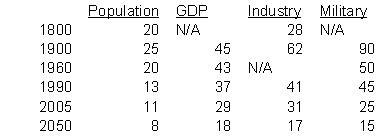
(Info up to 1990 is from Paul Kennedy’s The Rise and Fall of the Great Powers, 2005 and 2050 estimate are from various government websites such as the CIA World Factbook)
It is even worse when you consider only actual Europeans since around 8% of the continent’s population is non-European today. This decline is felt all around the world and not just relating to the War on Terror. France and Germany, two of the greatest European powers, are struggling to provide fewer than 2,000 soldiers to support the U.N. mission in the Congo. As Strategypage.com noted several years ago, for the first time in 400 years, no East Asian country has to take into account a European navy when making decisions. European “soft power” has come up short virtually everywhere is has been attempted. European capital is now just one of many sources of investment instead of the dominant share it had until recently.
Despite Europe’s rapid decline in world power and influence, it does not mean we should ignore them. It simply means we should no longer do everything possible to maintain our alliances with Europe if it involves risking our newer and more important alliances with countries like Japan, India, Australia, and Israel. For example, helping Japan get a permanent Security Council seat may annoy France and Russia, and helping India’s nuclear power industry may anger the greens throughout Europe, but they are things we must do. Unlike many conservatives who are angry over the perceived lack of support in Iraq from Europe (not true), I do not believe we should punish them. Our alliance has matured and without the Soviet Union they no longer feel any particularly strong bond to it. So be it, they are independent nations with every right to their own policies, and so are we. We should understand that and work with them in a much more business-like manner over issues of common concern. We should listen to their complaints and possibly act of them so long as it doesn’t affect our new alliances, and we should inform them when we object to their policies while realizing they don’t have to bow to our every whim. We are still friends who can often work together, just not the close friends who could always work together that we used to be.
The answer to both is obviously no. To the first half of the question, the Europeans are simply an ever less important part of the world. This is a major change for everyone to accept since Europe has been the center of the world for the last 500 years. All of the global struggles were between European powers with the ultimate goal of dominating Europe. In this regard, the Iraq War can be seen as the last all-European internal struggle when America and the five biggest European powers, Russia, Germany, Britain, France and Italy divided over the invasion of Iraq. The result was something that had never happened before and heralds a titanic shift in geopolitics, one half of Europe was simply steam rolled. Had Russia, Germany, and France ever allied in the last 500 years there is no way anyone could have gone against their wishes as the United States did. It is a very difficult world to adjust to; no one alive has ever even known someone who has lived in world in which Europe counted for little. The reason is simple, Europe’s population and economic output has been in a death spiral for the last 30 years with no signs of abating. The following table shows Europe's share of various world statistics. All in%
(Info up to 1990 is from Paul Kennedy’s The Rise and Fall of the Great Powers, 2005 and 2050 estimate are from various government websites such as the CIA World Factbook)
It is even worse when you consider only actual Europeans since around 8% of the continent’s population is non-European today. This decline is felt all around the world and not just relating to the War on Terror. France and Germany, two of the greatest European powers, are struggling to provide fewer than 2,000 soldiers to support the U.N. mission in the Congo. As Strategypage.com noted several years ago, for the first time in 400 years, no East Asian country has to take into account a European navy when making decisions. European “soft power” has come up short virtually everywhere is has been attempted. European capital is now just one of many sources of investment instead of the dominant share it had until recently.
Despite Europe’s rapid decline in world power and influence, it does not mean we should ignore them. It simply means we should no longer do everything possible to maintain our alliances with Europe if it involves risking our newer and more important alliances with countries like Japan, India, Australia, and Israel. For example, helping Japan get a permanent Security Council seat may annoy France and Russia, and helping India’s nuclear power industry may anger the greens throughout Europe, but they are things we must do. Unlike many conservatives who are angry over the perceived lack of support in Iraq from Europe (not true), I do not believe we should punish them. Our alliance has matured and without the Soviet Union they no longer feel any particularly strong bond to it. So be it, they are independent nations with every right to their own policies, and so are we. We should understand that and work with them in a much more business-like manner over issues of common concern. We should listen to their complaints and possibly act of them so long as it doesn’t affect our new alliances, and we should inform them when we object to their policies while realizing they don’t have to bow to our every whim. We are still friends who can often work together, just not the close friends who could always work together that we used to be.
Tuesday, June 06, 2006
Iran - The key to the World Island

(Blue - Pro-U.S., Red - Pro-U.S.S.R, Gray - Neutral)
Any analysis of geography will show that Iran is one of the most important countries in the game to dominate the World Island (well Eurasia really since Africa isn’t too important). This can be seen in the prominent role Persia played in the British-Russian Great Game of the 19th Century to dominate Central Asia. However, Iran’s prominence to modern geopolitics began with Iran’s role in the Cold War strategy of containment. This map shows approximately how the world was arranged in 1948 (I took a few liberties such as Spain which wasn’t technically part of NATO but would be soon). There are only three locations where the Soviet Union was not hemmed in by blue countries. At the Adriatic Sea where they faced Western European and American forces, at the North Pacific where they faced American and soon Japanese forces, and at the Iranian border where all that stood between the Soviet Union and her age old dream of a warm water port was a weak neutral nation.
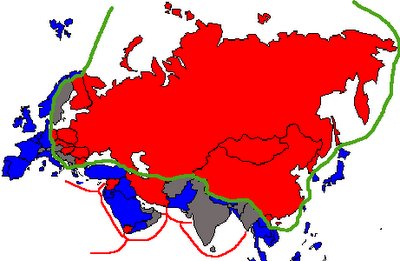 (Blue - Pro-U.S., Red - Pro-U.S.S.R, Gray - Neutral, Green Line - Containment Line, Red Lines - Russia's ability to move outside of containment, Iran is hypothetically Red in this map)
As the next map shows, Iran’s importance only grew with the 1948 victory of the Communists in China, the pervasiveness of the communist guerrillas in Vietnam, and the defection of Yugoslavia from the Cominform. A victory by the Communists in Iran or Vietnam would have pushed the line of containment further from the U.S.S.R. and away from any choke points such as the Baltic Sea or Sea of Japan. This would not only make it easier for the Soviets to reach farther a field with their aid, military, and influence but would also have been a headache for the U.S. Navy (as the map crudely shows). They would have faced the World War I Royal Navy’s difficulties of chasing down far flung enemy cruiser detachments all over the world while also concentrating in the main theater. As can be seen, not only has the line of containment been precariously stretched, it would have been broken all together had Iran gone communist. I believe this to be a major factor determining how the U.S. dealt with Mossadeq and North Vietnam.
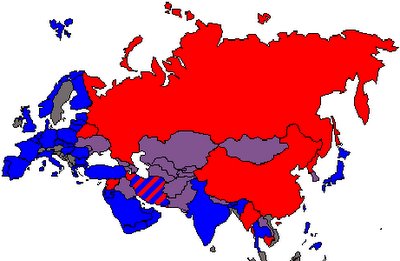 (Blue - Pro-U.S., Red - Pro-Russia/China, Gray - Neutral, Purple - Contested)
This brings us to modern times. Iran is again at the center of the geopolitical jostling between the world’s two major blocs. Since the fall of the Soviet Union, Russia has been trying to rebuild something of her former empire and has been moving ever closer to China to try to achieve some level of influence in the world. While the Beijing-Moscow alliance is not a solid alliance based on common interests, it is based on a single major interest, confronting and diminishing the United States. Also, the U.S. alliance structure is not as secure as it was during the Cold war, but it is largely based on shared democratic and free market values. Other than the Ukraine and a few Asian countries that mostly ring China, the major countries that are being fought over (non-violently for now of course) are the 7 Stans, the three Transcaucasian nations, and Iraq.
Each is important in its own right. The states of Central Asia are not only the font of much Islamic extremism, but also sit on massive reserves of oil that the world desperately needs. China wants them in her orbit to secure access to non-Middle Eastern oil, to prevent terrorism from spreading to the Uighurs of Sinkiang, and to keep the U.S. out of her backyard. Russia wants to make sure that Central Asian oil flows through Russia thereby giving them control of its export, and also to keep the U.S. out of their backyard and former empire. The United States wants to fight terrorism, ensure oil supplies, and surround China. The Transcaucasus is important primarily as a point of ingress and egress for Central Asia that is not controlled by the Russians or the Chinese; something we would prefer to keep and something they obviously would like to stop. Pakistan is important to us as an entry point for Afghanistan and for the fight against terrorism. The Chinese would like Pakistan in their orbit so they can use Gwadar as a naval base to escape the U.S ring and as a threat to India (who is moving closer to the U.S. and Japan). Lastly there is Iraq. Iraq is important to the U.S. for the fight against terrorism, as a sign of credibility, and to hopefully be model someday for the rest of the Middle East that would move it more in favor of our interests. The Chinese and Russians would prefer we lose credibility in Iraq, and that it fall back in the hands of an anti-American dictator. From Iraq the rest of the Sunni Middle East, most notably Saudi Arabia, can be challenged.
From the map it can be seen that there is one country that borders these three key areas, Iran. Should Iran formally sign up with the Beijing-Moscow axis then it would be very difficult for the U.S. to maintain a hold on the Stans, Transcaucasia, and Iraq. Pakistan could not be expected to stay pro-U.S. as we become closer to India and a pro-Russia/China Iran is sitting to their rear. As a long country with little strategic depth, Pakistan cannot have enemies on both sides and since India will always be an enemy that would leave them little choice. The Transcaucasian countries (most importantly Azerbaijan) would have a hard time dealing with a concerted effort by alliance members on both sides, especially since their trade and energy supplies come from these countries. With Pakistan, Azerbaijan, and Iran lost, it would be impossible to hold onto the energy rich Central Asian Stans. Iraq would be more tenable but it would still be much more difficult to see it to a successful conclusion. With this, Beijing and Moscow would not only have most of Asia and most fo the world's oil production under their sway, but it would be virtually impossible for us to break into it. Combined with China’s inroads in Africa, and a little more effort with the weak Western Europeans, we could be entirely cut off of the World Island with the exception of India, which due to the Himalayas may as well be considered a maritime power anyways. The key to this power struggle, as with the last, is Iran. We cannot allow it to become a nuclear armed power that shares Russia and China’s anti-American world view and owes them for their protection. If we do we face the loss of everything we have gained since 1990 in the former Soviet Republics, Iraq, and the Stans.
Is Russia behind the Iran crises?
The most important factor when considering if any power is behind a particular crises is who benefits most from it? This is more so if a certain power benefits from all outcomes. When analyzing the Iran crises it becomes clear that of all the powers involved, only one will benefit from all results, Russia. Russia derives economic and geopolitical benefits from Iran’s drive for nuclear technology no matter how it is resolved.
Economically, the Russians are earning a couple billion dollars a year selling nuclear technology and the weapons to protect it to Iran. This is not a significant sum for the Russian economy as a whole, but it is focused mostly in the depressed defense and nuclear sectors of Russia’s economy providing them with a vital boost. Even this is small potatoes compared to the amount of money Russia is making by the higher oil prices cause by Iran’s behavior. Russia is the second largest exporter of oil in the world so any disruptions would only further increase this windfall. The Russian government earns around $1.4 billion for every dollar oil prices are above their natural level. Currently it is estimated oil prices are over valued by $10-20 a barrel due to risk and speculation. This translates to $14-28 billion in extra revenue for Moscow (how much is due to Iran is of course unknown, though oil prices fluctuate up or down $2-5 depending on statements by Iran). Should things have to be resolved militarily and oil hits $100 a barrel, Moscow will be receiving almost $120 million a day in extra oil taxes. If things are settled diplomatically then Russia will continue selling billions in weapons and technology that the new regional power broker will need.
Russia also wins geopolitically regardless of the result. Right now Russia is reinforcing the fact that since the U.S. continues to go through the U.N. to fix problems, nothing can happen in the world without her. Should we have to go the military route then the Russians have killed 2 birds with one stone. We will have to expend further treasure and resources thereby reducing our ability to deal with other issues the Russians care about more, and we will have taken down a potential future threat to Russia. The downside for Russia is being viewed as not defending a client, but they have not done enough to be viewed as protecting Iran the way they did with Saddam. If things are “solved” diplomatically and Iran gets their nukes it is no major problem for Russia. Most importantly, we will have been shown to be impotent making it difficult for anyone around the world to trust us to stand up for them while the Russians will have displayed their ability to protect their clients that was ruined after the Iraq War. Although Iran would be free to become a threat to Russia, they would not be that serious since the regime would be indebted to Russia and Russia has no compunction about throwing nukes around in her own defense.
The next question after establishing that Russia is the only power with everything to gain and nothing to lose from the Iran crises is how are they driving it? The first manner is by selling the nuclear technology to Iran. Far better countries like Brazil spent decades trying and failed to develop a nuclear bomb before giving up. North Korea has spent who knows how long developing a bomb with unknown amounts of help from China and Russia and unknown success. Iran would scarcely have been much more successful by itself. After jump starting Iran’s nuclear program, the Russians next provided Iran with the means to credibly defend it against anyone except the U.S. and to raise the price for the U.S. considerably. They have sold Iran advanced anti-aircraft systems including possibly the S-300 to protect key sites, anti-ship missiles and diesel-electric submarines to allow for threats to the U.S. Navy and the straits of Hormuz, and licenses the RPG-7 to raise the price of any ground invasion. Despite the success of getting Russia to slow the sale of the S-300 to Iran, this is likely because the S-300 would largely prevent an Israeli attack and thus would cause Israel to strike soon. The longer it takes to resolve this crises the better for Russia. These weapons allow Iran to more safely develop a nuclear weapon since the U.S. must take into consideration the much higher price in lives, aircraft, and money to stop Iran; maybe to the point of preventing any action at all. Further encouraging Iran’s behavior, the Russians are using their U.N. Security Council veto to lead the Iranians into believing that since the U.N. can be trusted not to stop them, the U.S. won’t either (this was the same reason Saddam believed he could again get away with his shenanigans in 2002/03). They then play a key role in the diplomatic activity to make it appear as though they are willing to see the issue resolved keeping eyes averted from their own role in creating the crises. All in all, a brilliant move by Putin that we show no inclination of paying the price to stop.
Monday, June 05, 2006
The Bear Returns

Russia has returned to the international great game of geopolitics. Not at her former strength to be sure, but with greater power and influence than at any time in the last 16 years. They are exporting their weapons and technology with no regard as to who they will be used against, using their energy supplies as a cudgel, and are now rebuilding their military forces. How the West in general and the U.S. in particular deals with Russia will play a major role in how Russia plays the great game.
Like the French, the Russians act on the international scene with the express goal of furthering Russia’s interests. Firstly, people need to stop their moral shock and outrage that Russia is looking out only for Russia like it’s, as one State Department official put it, “the 19th Century”. There is nothing wrong with that. Just because we take regular hits to our international position to help out others or the world in general does not mean everyone else has to or will. For example, if Russia can help herself by aiding Iran and making it more difficult for us to stop them from going nuclear, why shouldn’t they? The only reason they shouldn’t is because we will punish them for it, and since we show no inclination of doing that, it is win-win for Russia.
The Russians have been advancing their interests around the globe with arms and technology exports since the fall of the Soviet Union. Although, they do this not in the positive sense of advancing Russia’s interests but rather in the negative sense of hindering the interests of Russia’s competitors. Most notably Russia is a major arms exporter to China. Some question why Russia would arm her most potent potential future enemy, but it is clear Russia is doing so to direct China at her main current competitor, the U.S. Russia has made billions off of arms exports to China but they are mainly in areas China needs to confront the U.S. not Russia. To fight the U.S. China needs submarines, anti-ship missiles, anti-aircraft missiles, fighter jets, torpedoes, the very things Russia is selling. To fight the Russians the Chinese need fighter-bombers, attack helicopters, tanks, infantry fighting vehicles, the very things Russia is not selling to China. Russia sold Saddam Hussein anti-aircraft missiles, command and communication equipment, and installed them for him. The top Russian army general even bragged in 2003 that the air defense network that Russia had built for Iraq would tear the U.S. Air Force apart (to his credit he dutifully ate his crow a few weeks later). To Iran the Russians are selling nuclear technology, air defense missiles and radars, and anti-tank missiles. The common thread that connects these particular arms sales are that they are not meant necessary to further Russia’s interests. These sales are meant to damage the interests of the U.S. since we either have to accede to China, Iran, Iraq, etc. having greater regional influence or pay the extra price fighting through their Russian supplied equipment to stop them. Either way, as we are diminished Russia improves relatively just by standing still. Again, so long as we do not make Russia pay a price for this behavior, why should they not do it?
The situation with Russia’s energy supplies is similar. Russia is using them in a geopolitical jujitsu move against Europe. The Russians know that Europe far eclipses them in all respects except nuclear weapons and energy reserves. So to get Europe to listen to Russia, they are threatening Europe’s energy supplies. Even though a cutoff of energy supplies would hurt Russia far more relatively than Europe, the fact the Russians are willing to risk it while the Euros are not means the Russians have the edge. With this one threat the Russians are elevated to Europe’s virtual co-equal when by all rights they are not. Also, by roiling the energy markets Russia drives up the price of her primary export earner. Is it any wonder they seem to be pushing Iran along, promising U.N. protection that Iran (like Saddam) thinks will protect them from the U.S. but won’t, all the while the Russians arm the Iranians with new weapons that give them the ability to make threats. The coming war does not affect Russia and yet makes them billions selling these things to Iran while keeping oil prices over $70 a barrel earning Russia $1.4 billion per dollar that oil is kept over its real price. The worst penalty this behavior has caused is a chiding from the U.S. Vice President that caused more grief for America than for it did for Russia.
These energy and arms sales moves are mostly passive and cost effective resistance by the Russians. To take a more active role in world affairs they need a military that is actually capable of something other than rotting away, suicide, and hazing. This is what we are about to see. Russia’s Defense Minister has announced that over the next 9 years, Russia will spend approximately $186 billion on weapons procurement. $21 billion a year does not sound like much, but it is almost double the $11 billion in arms to be purchased this year (which is itself a major increase over the last decade). Also, Russian arms are cheaper than ours so it will buy much more than it appears. While most of the $11 billion to be spent this year is going to the nuclear forces and the navy for new ships and submarines, the army is still getting enough to out purchase the U.S. Army in raw numbers despite our $18 billion procurement budget (plus $5 billion for the warplanes mentioned). The Russians are getting a lot of new equipment, including 30 new tanks (30 more than the U.S. Army is getting), 180 rebuilt tanks (60 more than the U.S. Army), 120 new IFV/APC’s (20 more), 500 rebuilt IFV/APC’s (400 more), ~300 SAM’s (200 more), 10 helicopter gunships (10 more), and 50 warplanes (4 less actually). Figuring that the Russian army/tactical air force budget will possibly quadruple over the next 9 years they will quickly have modern deployable forces, potentially as many as 100,000 soldiers. Such forces will be able to deploy to central Asia from Russia’s Tajikistan military base and throughout the Middle East from their new base in Syria. Such a capability could be used to greatly complicate matters for us.
Russia has always sold weapons to all comers, but her more recent use of energy resources as a weapon, and the recent and future military spending increases shows that Russia is again a power to be reckoned with. How the U.S. and the Europeans reckon with Russia is up to us. We can continue allowing Russia world influence on the cheap until a combination of a declining Europe and rising middle powers makes it difficult for us to operate effectively in the world, or we can begin to push back and make it not in Russia’s interests to act counter to us (how will be the topic of a future post). Admittedly this may lead to an escalating confrontation with Russia but it is one they will lose and one they therefore may choose not to engage in. We have passed the point of using an ounce to cure the problem of Russia, and are at a pound, should we do nothing it will soon take 16 pounds to deal with the problems Russia will cause around the world. Whatever the mal-effects for us, Putin is doing what is best for Russia to which I can only say bravo. I only hope he is just as good at looking out for Russia when we aren’t as accommodating.
Subscribe to:
Posts (Atom)