Thursday, July 24, 2008


Saturday, March 31, 2007
Iran Hostage Crisis - Day, ..., Far Too Many
Without further ado, it would appear the British sailors and marines are still hostages. This one crisis sums up so much of what’s wrong with the world today. Iran makes an armed attack against the military of a sovereign nation in the territorial waters of another nation and no one, not even the British, care about the violation of diplomatic standards (written about here). If we are not going to require countries live by the rules of civil intercourse, excepting times of war of course, then why should Iran restrict itself by following them? The British resort to diplomacy with a country that doesn’t respect diplomatic norms not because it’s the best choice but because the weak and unsupported British armed forces lack the ability to provide any other options. Once again we are seeing the ineffectiveness of our European allies in international affairs due to their unwillingness to invest the requisite resources to maintain credible military forces (and the British are atthe top of the heap even).
The Ayatollahs only understand force and without the threat of it hanging over their head they have no need to release the Britons until they get what they want from Blair. At the very least they want Britain humiliated. I know many modern post-history lefties think such emotional aspects of international relations no longer matter but they do which is why the Ayatollahs desire it. I do hope Blair holds firm despite a large portion of his countrymen being perfectly willing to trade humiliation for the servicemen. I also hope that Bush is in close consultation with Blair and is willing to help our ally with other options if need be. Diplomacy didn’t get the US hostages freed until President Reagan arrived with a clear willingness to use force to free them if necessary. If it requires the threat/application of American force then so be it, Britain has been a loyal ally and deserves such support.
I also haven’t notice more outrage over the treatment of the British servicemen, the woman in particular. Admittedly, I haven’t been able to follow the news too closely with school and all so I may have just missed it, but does no one else care that they are video taping them and forcing her to wear a headscarf? This behavior is especially egregious in this case since these were combatants who were actually following the laws of war and were illegally captured. Then again as the former Navy commander during the Falkland Wars commented, the hostage aspect of this mess, and probably the entire crisis, could have been avoided if British soldiers were allowed to use their weapons. The Iranians tried this game against American soldiers and only got a few dead Iranians for their trouble (they should have gotten more dead Iranians if you ask me but that’s another post).
Lastly though, Iain Murray over at the National Review notes “Blair has made me ashamed to be British this week. My only consolation is perhaps it will make the British people realize how utterly useless the U.N. is.” Only about 7% of Britons seem to agree with him on the first part. On the second, hehe, fat chance. Oh, and what are US Democrats doing at this moment? Well Speaker Pelosi is giving aid and support to the Syrians and powerful Representative Waxman is berating Sec. Rice over Joe Wilson’s trip to the Niger 5 years ago. Good to see Democrats have their priorities straight.
Monday, February 26, 2007
The Many Shades of Gray in the Iran Conflict
The first part of the show was an interview with Amir Taheri, an Iranian columnist. They discuss whether diplomacy is even possible with the current Iranian regime. Taheri, like me, does not believe it is. He bases his belief on the revolutionary nature of the Iranian regime that he says makes it implacable and unable to compromise like prior revolutionary states. I’ve written before (here and somewhat here) on why I think it is ludicrous to expect any diplomatic solution with Iran. Even though it is always an important element, I don’t focus as much on the human side of Iranian policy. Instead I base my view on a simple power politic calculation that is undoubtedly understood in Teheran. That calculation is that there is at this time nothing to be gained for the Iranian regime by compromising. In the language of the left, rejecting the white option of diplomacy means only the black option of war. Why the left insists on viewing the world in such black and white terms I don’t know, but there are a range of gray options from aggressive diplomacy to undeclared war between diplomacy and war. Taheri touches on this because anyone who says that we can’t negotiate with Iran is immediately tagged by the left as a warmonger,
This list of actions is a good start and entirely in line with the process of effecting regime change without a war. I would argue in addition that we should encourage Iran to become an ethno nation-state with the slogan “Persia for the Persians”. This would be simply a replay of the Reagan strategy for subverting the Soviet Union. Iran and the USSR are very similar in many regards. Both had/have global ambitions, both had/have terrible economies and had/have to rely on weakness in the West to allow their victories, both of their populations were/are only 51-53% of the core ethnicity but had/have 20-25% of their minorities of the same ethnic stock as the core, both were/are heavily dependant on oil exports. Against the Soviets our subversion campaigned consisted of economic action by collapsing the price of oil, the USSR’s primary export, engaging in an arms race that ruined the weak Soviet economy, fighting the Soviet invasion of Afghanistan through proxies (though I’d say with hindsight we went a bit too far in that regard), destabilizing the Soviet hold on their empire in Eastern Europe, being as ready as possible to defeat the USSR in a war, and ultimately encouraging the subject peoples of the Soviet Union to demand better treatment that led to the formation of a smaller “Russia for the Russians”. A similar strategy today would involve Taheri’s ideas above along with economic sanctions, fighting the Iranians in Iraq, destabilizing their hold on the Levant, being as ready as possible for an all out war, and perhaps encouraging the subject peoples in Iran to demand better treatment or independence. Of course the Mullahs could decide, unlike the Soviets, to drag the whole country down with them. If they do it is their decision, not ours, and the Iranian people will see it as such. If, contrary to all expectations, they do decide to deal and compromise then we will be able to do so from a position of strength and be able to demand a cessation of terrorism, the nuke program, Iran’s ambitions in the Middle East, more freedom for the Iranian people, and so forth in return for normalized relations.Gigot: And so the implications of that for U.S. policy have to be regime change? Is that your argument?
Taheri: Yes, it has to be a policy aimed at helping Iran to really become an ordinary nation-state and stopping the revolution. This doesn't mean, of course, invading Iran. Because as soon as you say that you can't talk to these Iran, people think that I am preaching an invasion and full-scale war. No. This is--the important thing is to realize that you cannot make a deal with this regime, because even if its leaders wanted to make a deal, they can't. They are--their DNA would not allow it. They are programmed not to make a compromise. Therefore, the long-term or midterm policy should be regime change. This could be achieved by supporting the Iranian opposition inside the country, by trying to reduce the price of oil, by helping the new emerging regional alliance against Khamenei's regime. There are lots of things one could do. And this is a very weak regime fundamentally. It has lost its revolutionary legitimacy inside Iran. It is trying to gain a new legitimacy, and it is really in a vulnerable position.
On the issue of a war with Iran, the left and media is not content to just say its either talks or war, they also say there is only one type of war possible, one like the Iraq War in 2003. Apparently, our only options to fight Iran are to mass half a million soldiers on Iran’s border and occupy the entire country. The Washington Post had an article (I thought by Anne Applebaum, but I can’t seem to find it) detailing all the reasons why we can’t invade and occupy all of Iran. Yes, they are 100% true. Without a major mobilization and massive increase in military spending, we do not have the capability to occupy a mountainous nation of 70 million competent people. That does not mean that is our only possible strategy. We never had the manpower to contemplate occupying all of the Soviet Union, and vice versa, but that didn’t stop war plans and preparations on both sides. The British and French had nowhere near the capacity to occupy the Russian Empire in 1854, they didn't let that stop them from fighting against Russian expansion into the Balkans. Lastly, the Prussians didn’t have the capability to occupy and enforce regime change on either Austria or France in 1866 and 1870 but they still formulated a war plan that achieved their aims without occupying either of those countries. What then would a US war with Iran look like? Something like the Kosovo War mixed with the Crimean War. The Kosovo War relied entirely on bombing Serbia until the leadership had had enough and overthrew Milosevic. The Crimean War involved a blockade of Russia, attacks on a few key ports, and the occupation of the Crimea Peninsula (to damage Russia’s position in the Black Sea area), and support for the Ottoman forces fighting the Russians in modern day Romania. A war with Iran would most likely consist of a powerful air campaign that would destroy Iranian infrastructure at a methodical pace, a full blockade of Iran with the seizure of key ports like Bandar Abbas, an invasion of oil producing and flat Khuzestan province, the destruction of any Iranian forces that attempt to attack outside of Iran, and possibly support for Kurdish, Baluchi, and other rebels fighting the Ayatollahs. The war would then continue until either the leadership overthrows Ahmadinejad and the Mullahs, the current leadership agrees to our demands, or Iran is weakened to such a degree that the campaign could be suspended.
The main point I’m trying to make here is that if diplomacy is rejected it does not automatically mean war, and if war does occur there are other ways of fighting it that do not include the unlikely or impossible. The left and the media will try to make it a case of if not A then B, and B is impossible so therefore it must be A. However, the world does not exist in such diametric tones. The Ayatollahs may see the world that way, but we can far more effectively advance peace, prosperity, and America’s interests by understanding that it is not.
Saturday, December 30, 2006
A Good Week that Ends a Bad Year
Saddam’s execution. This finally closes a dark chapter in Iraqi, Arab, and world history. No longer can the Sunnis hope and the Shiites/Kurds fear that the Democrats will reinstall Saddam "to make Iraq a better place to live". This has an unknown level of practicality since we have no idea if or how the Iraqi people will react to the releasing of Saddam's ever present grip on their lives. Nonetheless it is a moral victory that will at least remind the other brutal tyrants of the region that it can happen to them (even though we’ve given them every reason not to fear it).
Somalia. The Ethiopian military has thoroughly defeated the Islamic Courts Union in only a week’s time (I do declare they deserve a fourth cheer). Ethiopia has reminded us what a professional military can do to Islamist rabble militias when it is fully unleashed. Hopefully Washington and Jerusalem were watching and took notes. Whichever rotten government takes hold in Somalia next now knows not to work with the Islamists, unless they desire the same fate. Ethiopia has also placed itself in a postion to heavily influence the next government in the right direction since it owes its existence to Ethiopia. If Ethiopia takes advantage of this they can further teach the US and Israel the art of power politics we've forgotten.
Iran. According to The Wall Street Journal, Washington is beginning a campaign to push for tough non-UN economic sanctions on Iran. This follows the UN imposing a series of wrist slapping sanctions on Iran itself. I’m not sure why this new sanctions push would be any more successful than the last ones, but Washington is doing something for a change even if it is pathetically tiny. I shutter to think that I would consider this good news, but the Iran crises is being managed so badly by Washington that I’ll take what I can get these days.
Japan. This news story states that Japan recently researched the steps needed to develop nuclear weapons. If true this would mean Japan is finally throwing off the last vestiges of post-World War II de-normalization. A normal Japan is one of the most, if not the most, important requirements for a stable free world in the 21st Century (old post about it). The sooner they become “normal” the better, and from the looks of it we may not have long to wait. If confirmed and followed up on this would qualify as the best news of the year, but being unconfirmed it'll have to go at the bottom of the best news of the last week of 2006, one of its few good weeks.
Thursday, December 21, 2006
New Opportunities Present Themselves in Iran
The first option for Ahmedinejad in response to the election is to tone down his rhetoric and reverse some policies. This is the traditional route in Western democracies. Bill Clinton and George W Bush have both done it after their respective losses in Congressional elections. Although the Strategypage.com article linked to above mentions this as a likely outcome, I don’t think it is. Iran is not in any way shape or form a Western democracy. Ahmadinejad is in no way shape or form a Western democratic style leader. To a demagogue, the rejection of the people only doubles the desire the press on by any means necessary. If the people require a few more eggs must be broken to get to the omelet, then so be it.
I seriously doubt Ahmadinejad is reading up on Burke and Locke right now. Nevertheless, any opening by the Iranian government could allow real deals to be made with Teheran. That is deals that will ultimately undermine the theocracy like allowing trade unions, or a freer press, or the right to protest. The Ayatollahs would be very unlikely to agree, but it would resonate with the Iranian people who have just felt a little empowered by Ahmadinejad stepping back in the face of their votes. Even though the current government in Washington would never press for such deals doesn’t mean we couldn’t or shouldn’t.
Another option that Ahmadinejad could choose is to simply ignore the election results. In this case he’ll simply go on as before regardless of what the Iranian people wish. Nothing much would change if he did so except the growing anger of an already angry populace. This would continue the current muddle that we currently find ourselves. Unlike the other options where Iran makes our decision for us, in this situation we would have an Iranian government just repressive enough to prevent any peaceful subversion, an Iranian people not quite angry enough to take matters into their own hands, and an Iranian government not quite crazy enough for most Westerners to accept the need to take more forceful action against it.
The ultimate problem this poses for policy makers is that any course of action would preclude the other open possibilities. Military or economic action would likely eliminate the subversion option, the subversion option requires no military or economic action, etc. This leaves us simultaneously with the greatest number of options and least amount of will to choose one. Eventually, Ahmadinejad’s time would near an end which would move us to option 3 later rather than sooner.
The third route Ahmadinejad could take in light of the election results would be to accelerate his efforts. When you add to the picture that the Ayatollahs are trying to move up the next presidential election (Dec. 10 story) to get rid of Ahmadinejad as soon as possible, I think this one is entirely plausible though not the most likely. Assuming he actually believes it, he is on a quest to hasten the return of the 12th Imam. The Ayatollahs rule only until the 12th Imam returns, so who are they to stop his return by throwing out Ahmadinejad? While it is no means certain that Ahmadinejad would win a show down with the Ayatollahs, that doesn’t mean he knows that. Even if he does know that he can’t win it doesn’t mean he would simply stand down. It reminds me of a Biblical verse about the devil’s last days on earth before the end times,
“But woe to the earth and the sea, because the devil has gone down to you! He is filled with wrath, because he knows that his time is short."
Ahmadinejad could vent his wrath internally or externally. On the internal side he could attempt a coup and/or start a civil war. While his power base may not be as powerful on paper as the Ayataollahs, he could still make it bloody. Should the army stay neutral, the Pasdaran split, and the Basij support Ahmadinejad he would even have a good chance of winning. Should only the Basij support him he would still be in good shape despite its lack of training and weapons. He would have at least 1 million gunmen controlling the countryside against half a million or so not well trained or equipped regular soldiers. This would open too many opportunities to count for us. Especially if the army goes neutral we could support it and the people against both Ahmadinejad and the Ayatollahs. Or we could support the Ayatollahs in exchange for them giving up political power (but keeping their lives and wealth). If all else fails we could let the two sides exhaust each other and then put pressure on the victor to change. Should he start an external war then we can destroy the theocracy with it being clear to the Iranians that we didn’t start or ask for the war. Again this may even come later, when it becomes clear he won’t win the next election (his last one being because turnout was low overall but very high amongst his Basij supporters). Either way, If Ahmadinejad truly wants, as he claims, his “Allahdammerung”, then we’ll eventually have no choice but to give it to him.
Thursday, December 14, 2006
More Brilliance from the Foreign Policy Realists, Just Sell-Out the Jews
You’ve got to hand it to Syria and Iran, they are playing the so-called “sole superpower” like the weak willed fools we seem so intent on being. We could of course overthrow both governments in a matter of days. Unlike Iraq though, we wouldn’t be there to protect the former oppressors from the tender mercies of the people they for so long oppressed and they know this as well as we do. However, due to our idiotic actions over the last 3 years they no longer fear it. The summer of 2003 was our chance to hand down marching orders to the petty-dictators of the region. Instead, at the behest of the UN, Europe, and the State Department, we swore off anymore invasions. Through 2004 we still had to chance to use less forceful means (subversion, economic warfare, etc.) to convinve them to behave. Instead we chose to let the Euro-3 willfully swallow Iran's lies for us. Iran and Syria quickly realized their nightmare world was not coming to pass and so changed their tune. The result is the veritable “dictators gone wild” we are now seeing. Whereas in 2002 the dictators at least knew an invasion was a possibility, we’ve now convinced them it isn’t. So with the cat going back to sleep and refusing to wake up for anything, the mice are out to play, with suicide bombers, I.E.D.’s, ballistic missiles, and nuclear weapons. Now we are left with the options of paying them off until they again go too far and we must have a big war (the realist way), or start another smaller war.
I can’t for the life of me think of another moment in history when a country so powerful has behaved in such a pathetic way. At least Rome was gripped by civil war, and the British were exhausted from two world wars when they gave up their power and influence. Power abhors a vacuum, if we continue to refuse to exercise it, someone else not of our choosing or with our interests will. We can try to hide from the world all we want, but as the French and British found out in 1914 and 1939, and we discovered in 1917, 1941, 1950, and 2001, the world has a way of finding us whether we want it to or not. Only this time, with the other side fast becoming nuclear armed, we either won’t be able to reverse it like we did before, or the casualties fighting a pipsqueak nation like Iran will rival that of fighting Germany and Japan (the third, maybe second, and fifth greatest powers of their day). I’ve said it before and will say many times more, the world will keep on turning no matter how much we wish it to stop.
Saturday, December 09, 2006
Learning Nothing and Forgetting Nothing, the Realist Foreign Policy Comes to Iraq
The basic problem with this policy is that it assumes many things that are usually not true. Firstly it assumes that the offending country is interested in meeting and compromising on an issue. It next assumes that whatever countries are meant to be impressed by this display will actually be impressed and offer support after the offending nation rejects or refuses the advance. Essentially this means that these countries are willing and able to do something but are not doing anything merely because the offending nation has not been offered the chance to resolve the dispute diplomatically (the fact that the offending nation has not itself tried diplomacy doesn’t matter of course). Lastly it assumes that even should the offending nation show up and agree to stop its behavior for some carrots, that it will actually stop its behavior as it promises.
Due to its history of failure and its inaccurate understanding of the current situation we can fully expect such a policy to fail every bit as miserably today with Iran as it has in the past. Each of the above assumptions is wildly off in today’s standoff with Iran:
Iran wants a stable Iraq like the rest of us
This is only correct if you allow for Iran’s different definition of a “stable Iraq”. Sure they want it stable, under the Ayatollahs as a totalitarian Shiite government like Iran’s. This is obviously not what most of the world considers a “stable Iraq”. Iran is also damaging our geopolitical position and making it much more difficult for us to do anything about their nuclear program because of the continued violence. The violence is ensuring that no American government will initiate another preemptive war anytime soon. Thus it is in Iran’s long-term interests to see that things are as bad as possible as long as possible in Iraq to make sure this opinion reigns in the US for as long as possible. Why then would Iran help us form a stable Iraq that is in our interests and not their’s?
Europe, Russia, and China will finally accept the need to do something about Iran
Not likely. These powers do not support our efforts to stop Iran’s nuclear program and restoration of the Achaemenid Empire because they have no ability to do so and would lose too much in the process. Russia and China support Iran as part of their campaign to multi-polarize the world. Iran is working miracles for them in this regard so they are not going to support us no matter what. Europe will be no more capable of doing anything to stop Iran tomorrow as they are today. Except for the British (who aren’t in a position to help anyways), they have no projectable military power and won’t support sanctions since it would cost them business contracts with Iran. Iran imports almost $6 billion worth of goods from Germany, $3 billion from Italy, and $2.5 billion from France. None of those countries has seen much economic growth in the last 15 years, and none are willing to take an economic hit for us or the world. Europe further knows that if Iran does become a major threat, they can beg us to rescue them, and we’ll ride to their rescue as we have for the last 100 years. We are after all building missile defense sites to protect Europe from Iranian missiles free of charge in Poland.
Iran will accept a good offer and stop supporting the violence in Iraq
The first half of that statement is almost certainly true. If we offer Iran tribute to stop being bad they’d be idiots not to accept it. That doesn’t mean they will stop supporting violence. If we make a deal with them and they continue supporting the violence, then what? We have a deal with them Europe, China, and Russia will intone; we cannot risk wrecking the deal over such a trifle thing as Iran not living up to its end of the bargain. Rather than add impetus to the effort to stop Iran, all we will have done is pay off the Iranian government, give it credibility amongst the Iranian people, and further hamper any effort to head off the major storm coming down the road.
Even though a clear understanding of the situation and the interests of the powers involved would indicate the deal will not work and will only hurt us, there is also history to add to the argument against it. The Munich agreement would of course be the most glaring and devastating example of this. Hitler accepts a deal, doesn’t live up to it and everyone looks the other way. Israel has had countless similar deals with the Palestinians. Most notable was the Camp David Accords of 2000. Israel offered the Palestinians almost everything they want. Arafat not only walked away but soon after started the second intifada. Initially the diplomacy always crowd argued this was great for Israel since the Palestinians had shown that they were the true obstacles to peace. Despite this, world support for Israel lasted only as long as Israel did nothing about the suicide bombers attacking her civilians (that is to say a very short time indeed). I’m not even going to go through the 17 times we tried this with Saddam, including not once but twice prior to the 2003 invasion. Most relevant of all, what happened to world support for punishing Iran when it didn’t stop enriching uranium on August 31st? The idea was Iran would stop enriching or else. If they didn’t the world would supposedly see that Iran was the problem and support efforts to stop their nuclear program. Well, Iran didn’t stop and what was the world’s reaction?
Russia- said no to sanctions or any action; but they did regret Iran’s actions.
Europe- demanded…. more talks since 8 years is obviously to short a time to rush to impose visa sanctions on Iran’s leaders.
UN- nothing, not even a statement since it was the ambassador from Ghana’s last day, and as he told reporters, “give me a break.”
Why anyone believes the world’s reaction will be any different this time round is beyond me. Whether Iran simply refuses to talk or takes our tribute and continues supporting violence in Iraq, the result will be the same. Unless we accept, and accept soon, that Iraq does not exist in a vacuum, that our titular allies have neither the will nor the capability to do anything, and that Iran, Russia, and China have no interest in seeing us succeed in forming a stable mostly free/democratic Iraq, we will lose in Iraq and the price for us and the world will be incalculable. The realists’ motto appears to be, “Pounds for the cure tomorrow, not an ounce for prevention today”. However, guessing by last month's elections, it is how the American people want it, so it is how the world will get it.
I'd add liberal foreign policy in the title, but for liberals to have a foreign policy that learns nothing and forgets nothing, they'd, well, first have to have a foreign policy (and no, blaming America and Israel for everything, worshipping the UN, and extolling the virtues of oppressive anti-American Third World despots doesn't count as a foreign policy).
Sunday, December 03, 2006
The Foreseeable Unforeseen in Lebanon
Of course it was painfully obvious last summer that this would be the result of Israel not completing her mission in southern Lebanon. Also so apparent a kindergartner could have figured it out was that Hezbollah would receive lots of cash from Tehran after the fighting and would be helping the southern Lebanese before the bureaucrats at the US State Department and the UN had even signed the forms to schedule the meeting to arrange the conference to discuss sending aid. I’m not even going to start on how insane it was to think that a UN force supporting the Lebanese army was going to stop Hezbollah(4th paragraph) from rearming or operating in southern Lebanon. That no one in the foreign ministries of the West understood this is a sad testament to our inability in the West to understand the people and events that are making the world of our future.
To say that this is why Israel shouldn’t have fought Hezbollah to begin with is also terribly inaccurate. The only thing that boosts ones image more than a bloody victory is a bloodless one (think if France and Britain had fought over but ultimately acquiesced to Hitler’s Anschluss and re-occupying the Rheinland, sure Hitler’s stature would have been boosted but would the German people and army been as accepting of the Munich, Prague, Memel, and Polish Corridor gambles?). At least Lebanon is now aware of what Hezbollah brings to their future. Had Israel not fought, Hezbollah would have come off looking much more powerful (so powerful even the Israelis fear them) and it would have appeared that Hezbollah can deliver victories for Lebanon that the US backed government cannot. The reasoning in Lebanon would have been, why spark a civil war when Israel won’t do anything. Now they at least know if they don’t start a civil war to stop Hezbollah, the Israelis will return. Further, Hezbollah and Iran cannot simply be negotiated out of bellicosity by the Israelis. They want Israel exterminated and are willing to fight to achieve it. Whether Israel and the West like it or not, they will get their fight eventually. To paraphrase Winston Churchill, we can choose war or dishonor, if we choose dishonor we will get both. It’s well past time that we in the West wake up to this reality.
Friday, September 01, 2006
International community…what is it good for?
Where is the vaunted international community that agreed at the G8 meeting that this was Iran’s last chance? Russia has said no to sanctions or any action; but they do regret Iran’s actions. I'm sure we will also have their regrets when London, or New York, and Iran are radioactive parking lots, but I digress. Europe is demanding…. more talks since 8 years is obviously to short a time to rush to impose visa sanctions on Iran’s leaders. The U.N. didn’t even release a statement as it was the ambassador from Ghana’s last day, and as he told reporters, “give me a break.” What a surprise that the good people of Ghana who can’t provide enough food, clean water, or jobs for their own people think that a nuclear Iran isn’t the biggest threat to their country. What is surprising is that there are people who think such a country should be allowed to head what is supposedly the most important institution to the security and stability of the world.
Well so much for promises from the international community (but then Europe's promises aren't worth the paper they are written on as I wrote about here, and pretty much the same thing with the Russians and Chinese). None of this is helpful to a Bush Administration that is beginning to look a lot like Olmert’s in Israel. Bush accepted the challenge from Iran, losing the challenge through inactivity as he is on his way to doing will be worse for us and the world than never having accepted the challenge to begin with.
Sunday, August 27, 2006
Yet another in the seemingly endless series of lessons on the importance of deterrence
The cause of deterrence is simply the belief that any action against another nation will result in so massive a retaliation (yes, that means disproportionate retaliation) that it is not worth it to take the initial action, in this case kidnapping or killing a dozen Israeli soldiers. What we saw with Hezbollah was the effect of years of lefty weakness in Israel. This was supposed to inspire a willingness to compromise in the terrorists but as we saw (and as the right predicted) has only whipped up a willingness to push the envelope against Israel.
We can only hope that Hezbollah has learned its lesson this time. However, since it is still alive, in all likelihood all it has learned is the need for bigger rockets next time. More critically is the lesson that the other nations in the region have taken. Whatever the deterrence effect Israel may have had on terrorists, it hasn’t had any on the nations of the region. Iran now feels free to attack Romanian and Azerbaijani oil platforms, Syria is openly declaring hatred for Israel and the need to conquer the Golan, Egypt is establishing ties with Iran for the first time and some are pushing for an end to the peace treaty with Israel, and Turkey is continuing her move away from the “Phantom Alliance” and secularism and towards Islamism.
I know lefties hate acting tough, much less actually being tough, but in the real world it’s a lot cheaper and better for everyone to make 100 nations fear you will go to war than to have to go to war with even one nation. One would think that with history, even recent history like Iraq, showing the value of deterrence and making your enemy believe that you will go to war this would be obvious to everyone. Sadly, it isn’t and sadly we, like Israel, will pay the price for it again and again in the future.
Friday, August 11, 2006
Some suggested reading
Meanwhile over at the National Review there is a copy an article (here) that does a great job explaining the inevitability of war with Iran.
Both are concepts that I’ve been writing about for the last month (I know I should have written about them earlier, but my blog hasn’t even been around for 3 months yet). Nevertheless, since both of these writers are paid for their work their articles are both much longer than mine so they are both good reading.
Wednesday, July 19, 2006
“No one who believes he has anything to gain from war will be deterred by fear” - Hermocrates of Syracuse
The next thing to consider is what would Iran gain from a war with America and Israel? The answer is, of course, many things. The Islamic regime is intensely unpopular in Iran. Unlike many of the TV commentators, I don’t think it’s possible to know which way the Persian people will go in the event of a war. There are good arguments both ways, but Ahmadinejad probably believes they will come back to the regime in the event of a war. The first half of this article is a good summation of Ahmadinejad’s basic strategic beliefs. They boil down to Iran will reshape the Middle East into a new Islamic Achaemenid Empire, and either America will run away and accept this, or America will be fought and forced to accept it. Whatever happens in this world view, America will be laid low by Ahmadinejad the Great. War brings Ahmadinejad stability at home, empire abroad, and eternal glory. Who would let a trifle thing like war dissuade them?
Even when not including the messianic mission Ahmadinejad may believe he is on, there is more than enough to gain from war in his eyes to cause him to be unswayed by fear of what America may do. No amount of bluster or talks will stop Ahmadinejad from his appointed task. American threats are worth as much to him as Iranian promises are to us. He wants a war; nothing will keep him from getting it.
Sunday, July 16, 2006
Tehrano Delenda Est
The threat to Israel is obviously the greatest. A single nuclear bomb would wipe out most of the tiny country. The Israelis are also only a couple minute flight time from Iran. This would cause an extremely compressed timeframe for Israel to determine whether the missile is aimed at them, armed with a nuclear warhead, and necessitates a retaliatory nuclear strike. While the Israelis do have missile defense systems in place, they would leave precious little time to make a decision if they miss and would likely not impact the decision only the numbers killed. Israel would be placed one twitch on a hair trigger away from bringing down the entire Middle East. Given this it is obvious why Israel does not want Iran to have nukes. (Note: arguing Israel should give up her nukes is a non-starter, namely because they aren’t going to since they need those nukes to protect themselves from their enormous Arab neighbors).
The threat to us is more limited simply do to our size and distance from Iran. I would also expect Iran to go after Israel at the first opportunity before being ready to hit us. Even if Iran could not hit us and didn’t attack Israel they would still pose a major problem for us. Iran would become much more open about supporting terrorists and assisting them in attacks against us. It took 3,000 killed to get a Republican President to invade Afghanistan so a nuclear armed Iran would be largely safe from reprisals for such activity. We would be quickly forced out of Iraq and Afghanistan and most likely the rest of the Mideast and Central Asia. The way will have been shown for every other petty dictator to challenge the United States. Start a nuclear program (with Iranian help undoubtedly) and we will grovel until you have a bomb and pay tribute after you do. Our freedom of action in the world would be over along with what peace and stability we’ve been able to maintain.
The world economy as we know it would be unable to handle the risks a nuclear armed Iran involves. The world needs access to a stable source of oil. Part of the problem with the recent run up in oil prices is the need to factor in the risks of Iran’s 3 million barrels per day being taken off the market for up to a year along with several million Gulf barrels being taken off for a few months. Now every time there is a terrorists attack, oil prices jump $10 or so. What would happen if every time there is a terrorist attack, oil prices would have to factor in the risk of the entire Mideast’s oil production being permanently lost? Even worse, what would happen to oil prices after the entire Mideast’s oil production was permanently lost? There would also be disruptions to world trade as the U.S. Navy would not be able to protect the Straits of Malacca from a nuclear Burma, or the Red Sea from a nuclear Egypt, or the Panama Canal from a nuclear Venezuela, etc. Simply put, it would be extremely difficult for the world economy to function in such an environment.
There are people who believe that Iran only wants nukes to act as a deterrent to Israel and is therefore no real threat. The Israelis are not buying that line and for good reason. They have a much keener sense of history than most. They remember when the Nazis said they were going to kill all the Jews. Sure enough the Nazis tried to kill them all. Then they arrived in the Promised Land to the Arabs promising to drive them back into the sea. Shockingly, the Arabs tried to drive them into the sea. Now the Persians are threatening to wipe them off the map, and saying the loss of Iran is worth the loss of Israel. Due to history, the Israelis are not surprisingly trying to keep that capability out of Ahmadinejad’s hands. We cannot allow the quote about Hitler’s rise to be rewritten as “first they nuked the Jews and I didn’t stand up because I wasn’t a Jew…” We can’t keep making little Israel do our dirty work for us.
Some argue that since we let Israel have nukes we must let Iran have nukes; otherwise we would be the worst kind of person according to a liberal, a hypocrite. There is also the argument that we caused Iran to go nuclear by invading Iraq so this is our punishment for Bush’s sins. Both of these are completely unconstructive arguments. Iran having nukes is not a game, it’s not funny, it’s not something to cheer on as the Bushitler gets his comeuppance, and it’s not something to manipulate for partisan advantage. Millions of people’s lives are at stake, they are worth more than an extra person with a D next to their name in the Senate. While oil prices would go higher with an attack on Iran, if we let them develop their nuclear program we will face even greater price spikes on a regular and possibly permanent basis in the future. The only way to ensure none of these nightmarish futures come to pass is to do everything possible to keep Iran from having nuclear weapons. There is no other way, whatever the price Tehrano delenda est.
(Yes I was lazy this weekend and didn't get links to anyone making the idiotic arguments I referenced. However, if you would like to see someone make them just go into any Yahoo political chat room at any time.)
Thanks to AddeRabbi for the link and nice comments.
Saturday, July 15, 2006
The Damascus-Tehran Axis loses the initiative
The world’s current crop of dictators miscalculating like this is entirely historical. The most well known example of this is of course Nazi Germany prior to World War II. Hitler’s moves to scrap the Versailles Treaty, re-militarize the Rhineland, annex Austria, the Sudetenland, and Bohemia & Moravia were all gross overextensions that occurred due to the perception of weakness in France and Britain. Any one of them could have easily cost Hitler everything had France and/or Britain called him on a bluff. He would have lost any war at that time as the country and military were manifestly not prepared for to fight at that time. Even had he backed down without a war it would have destroyed the aura of invincibility that a dictator requires to remain in power. As everyone knows, the Allies didn’t call his bluff until it was too late.
An example of this tendency where the bluff was called is the world wide advances by the Soviet Union following the fall of Saigon. The Soviets not unsurprisingly sensed weakness in America after we abandoned an ally and for some unfathomable reason elected Jimmy Carter President. The Soviets expanded their influence into host of countries and regions, Ethiopia, Somalia, Lusiphone Africa, Central America, the Philippines, and Afghanistan. They established major naval bases at Camranh Bay in Vietnam and Beriberi in Somalia which, properly used, would have greatly complicated matters for the U.S. Navy. Jimmy Carter and his foreign policy team suffered from the notion that America was in terminal decline, the Communists could never be defeated, and that it was better to just let the Soviets expand than to try to stop them. Ronald Reagan was under no such illusion and fully understood that the Soviets had overreached. They had apparently come to believe Carter’s world view of a weak America and strong U.S.S.R. It was not long before Reagan disabused them of such beliefs. By the end of the 1980’s, the Soviets broke under the strain of trying to match America’s arms buildup while supporting their old Communist satellite regimes, and their new ones in Central America, Africa, and Afghanistan against America’s counter-pressure. The Soviets were forced to abandon the Sandinistas in Nicaragua, their bases in Grenada, Beriberi, and Camranh Bay, their puppet government in Kabul, their Eastern European satellites and lastly the Soviet Union. As a dictatorship, they couldn't survive the weakness we forced them to display by standing up to them.
We are facing the same situation today with Iran and Syria. The weakness and hesitation we have shown since the summer of 2003 is driving their present actions. Since that time our one good move has been to run Syria out of Lebanon following their assassination of the former Lebanese Prime Minister. Otherwise, we have done nothing of substance regarding Iran and Syria’s support of Iraqi insurgents and terrorists, Iran’s clear desire for a nuclear bomb, Iran and Syria’s support of Hezbollah and Hamas, etc. The Iranians have badly misstepped by having Hezbollah attack Israel at this time. Its not exactly apparent at the moment what the Iranians were hoping to gain by Hezbollah attacking Israel. Whatever it is (trying to distract Israel so they don't hit Iran's nuclear program would be my best guess), since Israel isn't responding in the typical meek manner of a Western democracy it is backfiring on Iran and Syria. It has given the Israelis a golden opportunity to deal with Hezbollah and remove that annoyance from their strategic calculations. Without the Syrians in Lebanon the Israelis can destroy Hezbollah without worry of regional war. It’ll take at most a matter of weeks and a major problem for Israel can be rectified. With the destruction of Hezbollah, Lebanon will finally be cleared and the Lebanese can start rebuilding their country (if they choose to). Syria and Iran will both take an enormous prestige hit for not being able to save their terrorist proxy in Lebanon from Israel. This can be used to our advantage to put pressure on the regimes themselves hopefully bringing them down peacefully. As with Hitler both dictators have large factions within their countries who are not quite as interested in risking all by challenging America and Israel. Or failing that we can use it to spark a war after the Hamas/Hezbollah threat is eliminated. It is better to have it when they are not prepared for one and before they have nukes. Or we can continue out current policy of "Please sir, I'd like some more" responses to Iran's provocations. Meanwhile, the opportunity we have within our grasp will slip away.
However we respond, we must remember that we are running out of time to deal with the Iranians before they are nuclear armed. Our present options are to do nothing (what were doing at the moment), fight a war only after they’ve gone “too far” and we must, or fight an early war before they have nukes. The first option will lead to a certain future of nuclear protected Iranian terrorism and oil price extortion with the possibility of a nuclear exchange wiping out the Middle East (to people worried about what effect any action we take will have on oil prices I ask, what do you think oil prices will be after Israel exercises her “Samson Option” and nukes the entire Mideast?). The second option will lead to an unbelievably destructive war with an almost definite nuclear exchange. The third option will lead to a war and higher oil prices but with next to no possibility of a nuclear exchange. So to recap, the outcomes of our choices include 1) nuclear exchange, 2) nuclear exchange, 3) no nuclear exchange. As bad as option 3 is, it’s the best of the lot. The choice is ours, will we allow Ahmadinejad to run a replay of Hitler’s Germany, become a modern day nuclear armed Barbary Pirate, or will we break him like we did Andropov’s Russia? Just because Ahmadinejad seems to believe the John Kerry, Nancy Pelosi, Howard Dean, Harry Reid, et al world view of a weak money-obsessed America cowed by the bluster of a petty dictator and a few cents extra for a gallon of gas doesn’t mean its any truer than when Jimmy Carter was serving the same kool-aid in the 70’s. We didn't drink it then, we shouldn't today.
Tuesday, June 06, 2006
Iran - The key to the World Island

(Blue - Pro-U.S., Red - Pro-U.S.S.R, Gray - Neutral)
Any analysis of geography will show that Iran is one of the most important countries in the game to dominate the World Island (well Eurasia really since Africa isn’t too important). This can be seen in the prominent role Persia played in the British-Russian Great Game of the 19th Century to dominate Central Asia. However, Iran’s prominence to modern geopolitics began with Iran’s role in the Cold War strategy of containment. This map shows approximately how the world was arranged in 1948 (I took a few liberties such as Spain which wasn’t technically part of NATO but would be soon). There are only three locations where the Soviet Union was not hemmed in by blue countries. At the Adriatic Sea where they faced Western European and American forces, at the North Pacific where they faced American and soon Japanese forces, and at the Iranian border where all that stood between the Soviet Union and her age old dream of a warm water port was a weak neutral nation.
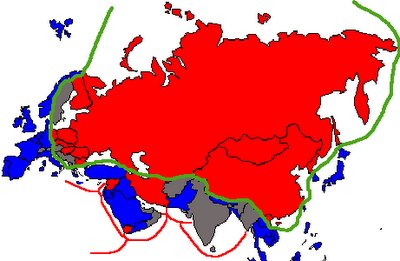 (Blue - Pro-U.S., Red - Pro-U.S.S.R, Gray - Neutral, Green Line - Containment Line, Red Lines - Russia's ability to move outside of containment, Iran is hypothetically Red in this map)
As the next map shows, Iran’s importance only grew with the 1948 victory of the Communists in China, the pervasiveness of the communist guerrillas in Vietnam, and the defection of Yugoslavia from the Cominform. A victory by the Communists in Iran or Vietnam would have pushed the line of containment further from the U.S.S.R. and away from any choke points such as the Baltic Sea or Sea of Japan. This would not only make it easier for the Soviets to reach farther a field with their aid, military, and influence but would also have been a headache for the U.S. Navy (as the map crudely shows). They would have faced the World War I Royal Navy’s difficulties of chasing down far flung enemy cruiser detachments all over the world while also concentrating in the main theater. As can be seen, not only has the line of containment been precariously stretched, it would have been broken all together had Iran gone communist. I believe this to be a major factor determining how the U.S. dealt with Mossadeq and North Vietnam.
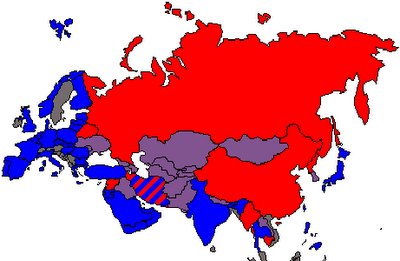 (Blue - Pro-U.S., Red - Pro-Russia/China, Gray - Neutral, Purple - Contested)
This brings us to modern times. Iran is again at the center of the geopolitical jostling between the world’s two major blocs. Since the fall of the Soviet Union, Russia has been trying to rebuild something of her former empire and has been moving ever closer to China to try to achieve some level of influence in the world. While the Beijing-Moscow alliance is not a solid alliance based on common interests, it is based on a single major interest, confronting and diminishing the United States. Also, the U.S. alliance structure is not as secure as it was during the Cold war, but it is largely based on shared democratic and free market values. Other than the Ukraine and a few Asian countries that mostly ring China, the major countries that are being fought over (non-violently for now of course) are the 7 Stans, the three Transcaucasian nations, and Iraq.
Each is important in its own right. The states of Central Asia are not only the font of much Islamic extremism, but also sit on massive reserves of oil that the world desperately needs. China wants them in her orbit to secure access to non-Middle Eastern oil, to prevent terrorism from spreading to the Uighurs of Sinkiang, and to keep the U.S. out of her backyard. Russia wants to make sure that Central Asian oil flows through Russia thereby giving them control of its export, and also to keep the U.S. out of their backyard and former empire. The United States wants to fight terrorism, ensure oil supplies, and surround China. The Transcaucasus is important primarily as a point of ingress and egress for Central Asia that is not controlled by the Russians or the Chinese; something we would prefer to keep and something they obviously would like to stop. Pakistan is important to us as an entry point for Afghanistan and for the fight against terrorism. The Chinese would like Pakistan in their orbit so they can use Gwadar as a naval base to escape the U.S ring and as a threat to India (who is moving closer to the U.S. and Japan). Lastly there is Iraq. Iraq is important to the U.S. for the fight against terrorism, as a sign of credibility, and to hopefully be model someday for the rest of the Middle East that would move it more in favor of our interests. The Chinese and Russians would prefer we lose credibility in Iraq, and that it fall back in the hands of an anti-American dictator. From Iraq the rest of the Sunni Middle East, most notably Saudi Arabia, can be challenged.
From the map it can be seen that there is one country that borders these three key areas, Iran. Should Iran formally sign up with the Beijing-Moscow axis then it would be very difficult for the U.S. to maintain a hold on the Stans, Transcaucasia, and Iraq. Pakistan could not be expected to stay pro-U.S. as we become closer to India and a pro-Russia/China Iran is sitting to their rear. As a long country with little strategic depth, Pakistan cannot have enemies on both sides and since India will always be an enemy that would leave them little choice. The Transcaucasian countries (most importantly Azerbaijan) would have a hard time dealing with a concerted effort by alliance members on both sides, especially since their trade and energy supplies come from these countries. With Pakistan, Azerbaijan, and Iran lost, it would be impossible to hold onto the energy rich Central Asian Stans. Iraq would be more tenable but it would still be much more difficult to see it to a successful conclusion. With this, Beijing and Moscow would not only have most of Asia and most fo the world's oil production under their sway, but it would be virtually impossible for us to break into it. Combined with China’s inroads in Africa, and a little more effort with the weak Western Europeans, we could be entirely cut off of the World Island with the exception of India, which due to the Himalayas may as well be considered a maritime power anyways. The key to this power struggle, as with the last, is Iran. We cannot allow it to become a nuclear armed power that shares Russia and China’s anti-American world view and owes them for their protection. If we do we face the loss of everything we have gained since 1990 in the former Soviet Republics, Iraq, and the Stans.
Is Russia behind the Iran crises?
Economically, the Russians are earning a couple billion dollars a year selling nuclear technology and the weapons to protect it to Iran. This is not a significant sum for the Russian economy as a whole, but it is focused mostly in the depressed defense and nuclear sectors of Russia’s economy providing them with a vital boost. Even this is small potatoes compared to the amount of money Russia is making by the higher oil prices cause by Iran’s behavior. Russia is the second largest exporter of oil in the world so any disruptions would only further increase this windfall. The Russian government earns around $1.4 billion for every dollar oil prices are above their natural level. Currently it is estimated oil prices are over valued by $10-20 a barrel due to risk and speculation. This translates to $14-28 billion in extra revenue for Moscow (how much is due to Iran is of course unknown, though oil prices fluctuate up or down $2-5 depending on statements by Iran). Should things have to be resolved militarily and oil hits $100 a barrel, Moscow will be receiving almost $120 million a day in extra oil taxes. If things are settled diplomatically then Russia will continue selling billions in weapons and technology that the new regional power broker will need.
Russia also wins geopolitically regardless of the result. Right now Russia is reinforcing the fact that since the U.S. continues to go through the U.N. to fix problems, nothing can happen in the world without her. Should we have to go the military route then the Russians have killed 2 birds with one stone. We will have to expend further treasure and resources thereby reducing our ability to deal with other issues the Russians care about more, and we will have taken down a potential future threat to Russia. The downside for Russia is being viewed as not defending a client, but they have not done enough to be viewed as protecting Iran the way they did with Saddam. If things are “solved” diplomatically and Iran gets their nukes it is no major problem for Russia. Most importantly, we will have been shown to be impotent making it difficult for anyone around the world to trust us to stand up for them while the Russians will have displayed their ability to protect their clients that was ruined after the Iraq War. Although Iran would be free to become a threat to Russia, they would not be that serious since the regime would be indebted to Russia and Russia has no compunction about throwing nukes around in her own defense.
The next question after establishing that Russia is the only power with everything to gain and nothing to lose from the Iran crises is how are they driving it? The first manner is by selling the nuclear technology to Iran. Far better countries like Brazil spent decades trying and failed to develop a nuclear bomb before giving up. North Korea has spent who knows how long developing a bomb with unknown amounts of help from China and Russia and unknown success. Iran would scarcely have been much more successful by itself. After jump starting Iran’s nuclear program, the Russians next provided Iran with the means to credibly defend it against anyone except the U.S. and to raise the price for the U.S. considerably. They have sold Iran advanced anti-aircraft systems including possibly the S-300 to protect key sites, anti-ship missiles and diesel-electric submarines to allow for threats to the U.S. Navy and the straits of Hormuz, and licenses the RPG-7 to raise the price of any ground invasion. Despite the success of getting Russia to slow the sale of the S-300 to Iran, this is likely because the S-300 would largely prevent an Israeli attack and thus would cause Israel to strike soon. The longer it takes to resolve this crises the better for Russia. These weapons allow Iran to more safely develop a nuclear weapon since the U.S. must take into consideration the much higher price in lives, aircraft, and money to stop Iran; maybe to the point of preventing any action at all. Further encouraging Iran’s behavior, the Russians are using their U.N. Security Council veto to lead the Iranians into believing that since the U.N. can be trusted not to stop them, the U.S. won’t either (this was the same reason Saddam believed he could again get away with his shenanigans in 2002/03). They then play a key role in the diplomatic activity to make it appear as though they are willing to see the issue resolved keeping eyes averted from their own role in creating the crises. All in all, a brilliant move by Putin that we show no inclination of paying the price to stop.