Showing posts with label China. Show all posts
Showing posts with label China. Show all posts
Thursday, July 24, 2008


Sunday, March 11, 2007
Russia, China, and the next Global Power Struggle
The last few weeks have shown more evidence that the current unipolar moment is ending. We are also seeing that the end of the evil Amerikkka’s hegemony won’t be the halcyon end of history imagined by many around the world. In international relations terms, we are simply seeing the end of a period of hegemonic stability that will be followed by a restructuring of the global power order (with all the associated conflicts, struggles, and wars). Though this seems to be surprising to the Washington foreign policy establishment, it of course shouldn’t be .
Much of the recent news centers on our old friend Russia. Vladimir Putin has most expertly returned Russia to the great power game. Signs of Russia’s return have been around for some time and is something I’ve written about frequently (about last year's military budget increase and general mischief, potentially driving the Iran crises, using hard ball tactics with Europe). Prior examples include supporting Iran’s nuclear defiance of the international community, slowly taking control of Europe through controlling its energy supplies, assassinating dissidents and nosey journalists, feeding China’s drive to the south (i.e. away from Siberia), and the general growth in Russia’s economy. The more recent examples include bellicose statements, a revision of Russia’s national security doctrine, and massive increases in military spending. Along with Russia, China is also making noises with her growing economy and even faster growing military budget.
The current bout of bellicosity began with Putin’s bizarre anti-America rant at the Munich conference of defense ministers. It was followed up with a Russian general threatening Poland and the Czech Republic over American anti-missile sites in those countries. Now the Russians have written this new aggressive attitude into their defense doctrine. The Russian Security Council has said the reason for this revision is that, “Armed forces are still being used as an important instrument in maintaining political and economic interests of states, and Russia cannot ignore these factors in developing its military doctrine." In effect, while criticizing the United States for using military force to protect her interests Russia is declaring the use of military force to protect Russia’s interests a necessity. This more active approach will apparently supplement Russia’s more passive-aggressive policies, such as arming Iran and Syria, to cause as many problems for the current great power(s). There is again nothing surprising or bad about this. It’s the way the world works, Russia is a revisionist power with a small sphere of influence so if she can gain a piece of our or others' sphere by causing chaos and problems around the world it’s a net gain.
Russia’s doctrines and statements would mean little if they were not backed up by a growing economy that supported a growing defense budget. Russia is not disappointing on either account. Since Putin ascended to power at the end of 1999, Russia’s economy has grown 23% a year in dollar terms, 7.5% in Purchasing Power Parity, and 11.5% in my own system of accounting for currency adjustment*. Even though it did come off a fairly low base this impressive growth has given Russia the first stable economy that can support a vigorous military in 20 years. As a result, Russia’s official military spending has grown even faster, over 28% a year in dollar terms to $32.4 billion (bottom of the story) and 13.5% in my system referenced above. When adding in the much larger non-official defense spending it means Russia has clearly surpassed Britain, France, and Japan’s $40-50 billion defense budgets and is firmly in third place globally. This is despite the fact that Russia’s economy is only 1/2 the size of Britain and France’s and 1/4 the size of Japan’s. The extra hundreds of billions will be put to good use forming a hi-tech modern Russian military over the coming decade that will be on hand to carry out Russia’s new doctrine of using military force when and necessary to further her interests around the globe.
The Chinese have been somewhat more circumspect as regards their public rhetoric and they haven’t yet formally switched over to a more aggressive posture. They are much more of a actions speak louder than words type nation so this isn’t surprising. Like the Russians they are also taking hostile actions, reorganizing their military into a more professional expeditionary force, and increasing their defense budget by leaps and bounds. Even more so than Russia, China’s economy and ability to support her military has advanced very quickly.
China has been taking ever more non-friendly actions over the years. In the last year alone they tested an anti-satellite missile that created a dangerous debris field for everyone’s satellites, had a submarine shadow a US carrier in international waters, and violated the territory of Japan with planes, ships, and subs in increasing numbers. Not the friendliest of actions but then being friendly to us or anyone isn’t China’s job. China’s army is reorganizing from a large conscript infantry based territorial defense force into a smaller professional mechanized offensive force. At the moment only a handful of units have been converted (3 corps with 12 brigades so far, though I can’t find the link for that). The navy is growing a bit slower at the moment as learning to build and man ships takes a bit of time, but China is doing just that and is preparing for a powerful blue-water fleet in the future. The air force is likewise switching from a poorly trained, obsolete, short range, light air defense force into a better trained, modern, long range, multi-role force. To make this transition to a force capable of projecting Chinese power and influence possible requires vast sums of money. And vast sums of money is what Beijing is providing the Chinese military forces. The latest year will see another double digit increase (17.8%) in official defense spending to $45 billion. As with Russia, the real figure is 2-3 times as high and is by far and away the second largest defense budget in the world. Due to China’s act first explain later policy we’ll realize the impact of this only after they make a move.
Individually, the power of China and Russia is still somewhat limited even though it is growing fast. However, they have reached a point where combined they have the power to resist US power in the world. Over just the last 7 years the economy of Russia and China has risen from 17% of the US’ to almost 30%. Their combined official military spending has reached $77 billion, 15% of the US, this year from $21 billion, 6.5%, in 2001 with the real figures again being 2-3 times higher. They are the new (well, new-old) powers on the international scene and will seek an international order that recognizes their place. We will, along with countries more threatened by Russia and China, attempt to maintain the current system. With their continued rapid economic growth, massive military spending increases, and reorganization of their militaries the Chinese and Russians will have the ability to force a world more amenable to their interests. The result is that the future will be as filled with conflict as the past (the last century exempted most likely). Especially should Democrats continue to gain at the national level and US power, influence, and military spending retrench in the coming years they may prove quite successful.
*I can't quite figure out how to put math symbols like sigma on here but the system is fairly simple, I just multiply the current year's exchange rate by 8, the prior year by 7, etc. and divide the result by 36 to get the adjusted exchange rate. It works fairly well by ironing out the massive gyrations in exchange rates and producing a more realistic dollar GDP value for most countries that still accounts for variations in currency values.
Much of the recent news centers on our old friend Russia. Vladimir Putin has most expertly returned Russia to the great power game. Signs of Russia’s return have been around for some time and is something I’ve written about frequently (about last year's military budget increase and general mischief, potentially driving the Iran crises, using hard ball tactics with Europe). Prior examples include supporting Iran’s nuclear defiance of the international community, slowly taking control of Europe through controlling its energy supplies, assassinating dissidents and nosey journalists, feeding China’s drive to the south (i.e. away from Siberia), and the general growth in Russia’s economy. The more recent examples include bellicose statements, a revision of Russia’s national security doctrine, and massive increases in military spending. Along with Russia, China is also making noises with her growing economy and even faster growing military budget.
The current bout of bellicosity began with Putin’s bizarre anti-America rant at the Munich conference of defense ministers. It was followed up with a Russian general threatening Poland and the Czech Republic over American anti-missile sites in those countries. Now the Russians have written this new aggressive attitude into their defense doctrine. The Russian Security Council has said the reason for this revision is that, “Armed forces are still being used as an important instrument in maintaining political and economic interests of states, and Russia cannot ignore these factors in developing its military doctrine." In effect, while criticizing the United States for using military force to protect her interests Russia is declaring the use of military force to protect Russia’s interests a necessity. This more active approach will apparently supplement Russia’s more passive-aggressive policies, such as arming Iran and Syria, to cause as many problems for the current great power(s). There is again nothing surprising or bad about this. It’s the way the world works, Russia is a revisionist power with a small sphere of influence so if she can gain a piece of our or others' sphere by causing chaos and problems around the world it’s a net gain.
Russia’s doctrines and statements would mean little if they were not backed up by a growing economy that supported a growing defense budget. Russia is not disappointing on either account. Since Putin ascended to power at the end of 1999, Russia’s economy has grown 23% a year in dollar terms, 7.5% in Purchasing Power Parity, and 11.5% in my own system of accounting for currency adjustment*. Even though it did come off a fairly low base this impressive growth has given Russia the first stable economy that can support a vigorous military in 20 years. As a result, Russia’s official military spending has grown even faster, over 28% a year in dollar terms to $32.4 billion (bottom of the story) and 13.5% in my system referenced above. When adding in the much larger non-official defense spending it means Russia has clearly surpassed Britain, France, and Japan’s $40-50 billion defense budgets and is firmly in third place globally. This is despite the fact that Russia’s economy is only 1/2 the size of Britain and France’s and 1/4 the size of Japan’s. The extra hundreds of billions will be put to good use forming a hi-tech modern Russian military over the coming decade that will be on hand to carry out Russia’s new doctrine of using military force when and necessary to further her interests around the globe.
The Chinese have been somewhat more circumspect as regards their public rhetoric and they haven’t yet formally switched over to a more aggressive posture. They are much more of a actions speak louder than words type nation so this isn’t surprising. Like the Russians they are also taking hostile actions, reorganizing their military into a more professional expeditionary force, and increasing their defense budget by leaps and bounds. Even more so than Russia, China’s economy and ability to support her military has advanced very quickly.
China has been taking ever more non-friendly actions over the years. In the last year alone they tested an anti-satellite missile that created a dangerous debris field for everyone’s satellites, had a submarine shadow a US carrier in international waters, and violated the territory of Japan with planes, ships, and subs in increasing numbers. Not the friendliest of actions but then being friendly to us or anyone isn’t China’s job. China’s army is reorganizing from a large conscript infantry based territorial defense force into a smaller professional mechanized offensive force. At the moment only a handful of units have been converted (3 corps with 12 brigades so far, though I can’t find the link for that). The navy is growing a bit slower at the moment as learning to build and man ships takes a bit of time, but China is doing just that and is preparing for a powerful blue-water fleet in the future. The air force is likewise switching from a poorly trained, obsolete, short range, light air defense force into a better trained, modern, long range, multi-role force. To make this transition to a force capable of projecting Chinese power and influence possible requires vast sums of money. And vast sums of money is what Beijing is providing the Chinese military forces. The latest year will see another double digit increase (17.8%) in official defense spending to $45 billion. As with Russia, the real figure is 2-3 times as high and is by far and away the second largest defense budget in the world. Due to China’s act first explain later policy we’ll realize the impact of this only after they make a move.
Individually, the power of China and Russia is still somewhat limited even though it is growing fast. However, they have reached a point where combined they have the power to resist US power in the world. Over just the last 7 years the economy of Russia and China has risen from 17% of the US’ to almost 30%. Their combined official military spending has reached $77 billion, 15% of the US, this year from $21 billion, 6.5%, in 2001 with the real figures again being 2-3 times higher. They are the new (well, new-old) powers on the international scene and will seek an international order that recognizes their place. We will, along with countries more threatened by Russia and China, attempt to maintain the current system. With their continued rapid economic growth, massive military spending increases, and reorganization of their militaries the Chinese and Russians will have the ability to force a world more amenable to their interests. The result is that the future will be as filled with conflict as the past (the last century exempted most likely). Especially should Democrats continue to gain at the national level and US power, influence, and military spending retrench in the coming years they may prove quite successful.
*I can't quite figure out how to put math symbols like sigma on here but the system is fairly simple, I just multiply the current year's exchange rate by 8, the prior year by 7, etc. and divide the result by 36 to get the adjusted exchange rate. It works fairly well by ironing out the massive gyrations in exchange rates and producing a more realistic dollar GDP value for most countries that still accounts for variations in currency values.
Friday, January 19, 2007
China Acts, America Whines, Something Isn't Right Here
The news that the Chinese have apparently successfully tested an anti-satellite weapon is an opportunity to mention something that bothers me about the US national security apparatus, its whiny responses to any challenge from other powers. My personal favorite being the State Department official who responded to Russia’s hardball energy politics a year ago by saying, “they’re acting like it’s the 19th Century.” I certainly hope they were able to find that official a ba-ba and a blankey quickly since Russia isn't playing by his rules. We’ve also seen it with the moaning over China’s rapidly increasing military budget, Russia helping Iran, North Korea, Iran, Syria, and others not wanting to join the “community of nations”, and so forth. Sadly, ther one of the few serious voices in US diplomacy is now former representative to the UN Bolton. Ah well, that's the price a US diplomat pays these days for not going along with the Democrat/State Dept. policy of coddling kleptocrats at the UN and murderous tyrants abroad.
The newest case obviously involves China developing the technology to shoot down satellites. The way a grown-up serious nation would deal with is by looking at 1) if we need that ability, 2) if yes then what is the possibility of a treaty banning it working with the power in question, 3) if yes to 1 and not likely to 2 (almost always the case) then can we in other ways make it not worth it to the power to possess these weapons, and lastly 4) regardless of the answer to 3, what counter-measures can we develop to the technology. Instead Washington seems to deal with international problems today by 1) whine, 2) cry to the UN or do nothing (same thing though the second is somewhat more dignified). Regarding the anti-sat we’ve quickly completed step 1 and are presumably well onto step 2. According to National Security Council spokesman Gordon Johndroe, “The United States believes China's development and testing of such weapons is inconsistent with the spirit of cooperation that both countries aspire to in the civil space area… We and other countries have expressed our concern to the Chinese."
This is an absurd statement because every weapon system is “inconsistent with the spirit of cooperation that both countries aspire” in any field. Our large fleet of warships and subs that is increasingly weighted towards the Pacific is not exactly in the “spirit of cooperation”; ditto for our expansion of facilities in Japan and Guam. Our anti-ballistic missile systems are designed specifically to limit China and other countries’ ability to threaten our forces with missiles, one of our major weaknesses. The anti-sat weapons are themselves meant to bring down our satellites that make us much more effective at destroying Chinese targets in a war. Yet again we are not being very consistent with the spirit of cooperation. It would seem obvious then that just as we want to make it as difficult for other powers to hurt our interests that China and others would likewise want to limit the ability of powers to harm their interests.
Yet for some reason it doesn’t seem to be obvious enough to Washington. The concept that nations behave in a way that benefits themselves and not necessarily the United States seems to be an alien one outside of the Pentagon. Maybe it’s because of the “kumbaya we are the world” trash they’ve taught in colleges for the last 40 years. Whatever the cause, the world’s super power needs to act like an adult and realize that isn’t wrong for countries to look out for their own interests first. If it conflicts with our interests then we need to make it not in their interest to continue with their behavior. Granted in this case we are likely doing something to counter (I hope) China's new anti-sat capability but we need to do it in a more dignified manner. Since perception matters as much as, if not more than, reality in power politics a superpower that whines like a little kid who isn’t getting his way is not long for superpower-dom. Since superpower transitions rarely go smoothly we will pay dearly in the future if we don’t start understanding this reality.
The newest case obviously involves China developing the technology to shoot down satellites. The way a grown-up serious nation would deal with is by looking at 1) if we need that ability, 2) if yes then what is the possibility of a treaty banning it working with the power in question, 3) if yes to 1 and not likely to 2 (almost always the case) then can we in other ways make it not worth it to the power to possess these weapons, and lastly 4) regardless of the answer to 3, what counter-measures can we develop to the technology. Instead Washington seems to deal with international problems today by 1) whine, 2) cry to the UN or do nothing (same thing though the second is somewhat more dignified). Regarding the anti-sat we’ve quickly completed step 1 and are presumably well onto step 2. According to National Security Council spokesman Gordon Johndroe, “The United States believes China's development and testing of such weapons is inconsistent with the spirit of cooperation that both countries aspire to in the civil space area… We and other countries have expressed our concern to the Chinese."
This is an absurd statement because every weapon system is “inconsistent with the spirit of cooperation that both countries aspire” in any field. Our large fleet of warships and subs that is increasingly weighted towards the Pacific is not exactly in the “spirit of cooperation”; ditto for our expansion of facilities in Japan and Guam. Our anti-ballistic missile systems are designed specifically to limit China and other countries’ ability to threaten our forces with missiles, one of our major weaknesses. The anti-sat weapons are themselves meant to bring down our satellites that make us much more effective at destroying Chinese targets in a war. Yet again we are not being very consistent with the spirit of cooperation. It would seem obvious then that just as we want to make it as difficult for other powers to hurt our interests that China and others would likewise want to limit the ability of powers to harm their interests.
Yet for some reason it doesn’t seem to be obvious enough to Washington. The concept that nations behave in a way that benefits themselves and not necessarily the United States seems to be an alien one outside of the Pentagon. Maybe it’s because of the “kumbaya we are the world” trash they’ve taught in colleges for the last 40 years. Whatever the cause, the world’s super power needs to act like an adult and realize that isn’t wrong for countries to look out for their own interests first. If it conflicts with our interests then we need to make it not in their interest to continue with their behavior. Granted in this case we are likely doing something to counter (I hope) China's new anti-sat capability but we need to do it in a more dignified manner. Since perception matters as much as, if not more than, reality in power politics a superpower that whines like a little kid who isn’t getting his way is not long for superpower-dom. Since superpower transitions rarely go smoothly we will pay dearly in the future if we don’t start understanding this reality.
Friday, January 05, 2007
Enter Hu Jin-Tirpitz and the Sino-American Naval Race
China’s President Hu Jintao recently gave a speech stating that, “The navy force should be strengthened and modernized... to serve the country and its people more effectively.” This doesn’t quite have the symbolic or real world impact of “a fleet second to none” or “a place in the sun” but it also isn’t something we can blithely ignore. Even though China will not be able to challenge the US and Japan on the seas for some time, they are preparing for that day. They are building modern ships, submarines, and power projection capabilities at a decent rate. This buildup will soon place China third in the world in modern and semi-modern vessels (2005: China-25 ships/19 subs, US-123/52, Japan-44/16, Russia-27/36 poorly maintained, UK-27/9, France-18/6, and India-17/13). This naval expansion is nothing new or evil. The Franco-English and Anglo-German naval races of years past were very similar in many respects. The players have changed but the game is the same. A new great power arises and discovers that a first-class great power requires a powerful fleet to protect its security. This powerful fleet invariably threatens the security of already existing great powers. At this point one of 4 things happen (example naval race from history, my guesstimate of it happening today):
1) Current great power accepts the hit to its security and gives up (Anglo-US, possible but not likely I would think/hope),
2) New great power does the same and gives up (US-USSR, not happening),
3) New great power doesn’t want to wait the 30 or so years it takes to build a powerful fleet, so they develop “risk theories” that they think allows them to mount an early challenge the current great power with the superior fleet (Anglo-German & US-Japan, most likely given China's actions and moves).
4) New great power does wait 30 years while it builds up its fleet (Anglo-Dutch, China's best choice, depends on if Beijing can hold off on Taiwan for the next 20 years, given that and the fact that this is somewhat rare historically I don't think it's too likely but we'll see).
It is very easy to dismiss China’s naval growth, as the Chinese would like us to, because it pales in comparison to the strength of the mighty US Navy. Also, there is the excellent Japanese navy to consider. However, China’s naval buildup should be closely observed and if need be countered for two reasons. Firstly China doesn’t need to match the American and Japanese navies ship for ship and crew for crew. China, like von Tirpitz’s Germany, understands that all they need to do is raise the risk of confronting China to an unacceptable level for us and Japan. This only requires close approximation and not full parity or superiority between the Chinese navy and the US Pacific Fleet and Japanese navy. The second reason follows from the fact that it will be the US Pacific Fleet and not the US Navy as China’s opponent. What this means is that while China’s entire navy will be used in a conflict, we will only be able to send a portion of ours due to global commitments and distance from our main ports. Unless we increase the size of our fleet we will have to steadily weaken ourselves elsewhere to provide the margin we need against China. Unfortunately, with the exception of India in the Indian Ocean, there are not many good nations to take our place in their region if we withdraw. Britain was forced to withdraw from the Americas and East Asia to deal with Germany in 1914. She at least was able to hand power over to like-minded countries. Although even with like-minded countries this would turn out badly for Britain since Japan turned violent with the Royal Navy absent.
The overall growth of the Chinese surface fleet does not at first glance look impressive. Its total strength is expected to grow from 19 destroyers and 40 frigates in 2000 to 28 destroyers and 42 frigates in 2015. However, all but one of the ships in 2000 was obsolescent and most would have been little more than target hulks for the US Navy in the event of a conflict. By 2005 China’s count of modern ships had grown to 6 destroyers and 2 frigates. This is expected to grow to 14 destroyers and 8 frigates by 2015. At the same time China is adding semi-modern vessels that could still pack a punch when paired with modern ships. This intermediate category will likely grow from 2 destroyers and 6 frigates to 3 destroyers and 14 frigates in 2015. At some point, globalsecurity.org says 2010 but others say after 2020, the Chinese fleet will receive its first aircraft carrier. It’s expected to be about half the size of a US carrier at around 48,000 tons displacement and 24 fighters. These estimates are from before Hintao’s speech calling for more navy funding so the real figures will likely be higher.
More critical to China’s ability to simply damage the US Navy severely enough that we won’t challenge them are submarines. In 2000, China actually possessed more attack subs than the US, though again most were obsolete (Chinese copies of Soviet copies of German WWII designs). Of China’s 64 attack subs in 2000, 5 were semi-modern nuclear attack subs (the Han-class) and 5 were modern conventional attack subs (Kilo-class and a Song-class). In 2005 China had 1 modern and 5 semi-modern nuclear attack subs, and 13 modern conventional attack subs. According to older estimates these numbers should be 6 modern and 5 semi-modern nuclear attack subs, and 29 modern conventional attack subs in 2015. The growth of the modern conventional attack sub force is perhaps the most worrisome aspect for the US Navy. Modern conventional attack subs are extraordinarily difficult to find and track. Japanese, Australian, and Swedish conventional subs regularly manage to get within strike distance of a US carrier in wargames without being discovered. Any thoughts that this was a feat that only well trained crews in the most advanced subs could perform were dispelled a few months ago when a Chinese sub trailed a US carrier from 5 miles away without being noticed. The fact that this incident took place near Okinawa further shows the greater ranges at which the Chinese sub force is capable of operating.
The Chinese are not focusing on glamorous new ships and subs while neglecting the more mundane aspects of naval power projection. Their amphibious fleet has undergone a radical improvement in its capabilities. Prior to 2000 most of China’s amphibious vessels were WWII American designs. The 26 large amphibious ships they had in 2000 could carry a max load of 15,600 soldiers (although they would carry less than that depending on the supplies they would need to take with them). In 2005 this has expanded to 33 ships with a 21,600 soldier capacity and will be at least 52 ships and 31,200 soldier capacity by 2015. No fleet can operate far from home without underway replenishment vessels accompanying them. This area of the Chinese navy will see its 2000 total of 3 ships and 34,200 tons of cargo capacity grow to 5 ships with a cargo capacity of 57,000 tons in the near future. There don’t appear to be any further plans for expansion beyond that, but again these are only estimates and something like a cargo vessel could be ordered up fairly quickly. Officially, this side of the navy modernization is chalked up to Taiwan. The ships are only needed to move soldiers and supplies for operations against the Taiwanese “separatists”. It shouldn’t take much mental power to realize that those ships will be just as capable of moving soldiers and supplies to other places.
Barring any disruptions from the Democrats gaining control of Congress, the US Navy is projected to grow from 123 ships and 52 subs to 161 ships and 50 subs. Due to our other global commitments it’ll be difficult to send more than half of our fleet to the western Pacific unless we wished to invite more trouble by reducing those commitments. Adding in the Japanese Navy, this would yield a force of approximately 100 ships and 40 subs today and 110 ships and 40 subs in 2015. Impressively larger that may be, but the ratio of ships will decline from 4:1 to 2.75:1 and of subs from 2:1 to 1:1. It has to be noted though that 22 of these new US ships are the smaller and less capable Littoral Combat Ships. Since the final design of the LCS hasn’t been determined yet, it’s difficult at this time to say if they would have much use against China. At the moment it would seem that they wouldn’t since they are mainly for operations in shallow waters against less capable countries like Iran or North Korea; but who knows until the design and procurement schedules are finalized. The effect of the US Navy’s 12 aircraft carriers is also somewhat difficult to gauge. On the one hand each has more theoretical firepower than just about any navy on the planet. On the other their anti-submarine capabilities are not proportional to their greater firepower and their prohibitive cost would likely cause them to see more limited usage than is normal (especially in light of the sub part). Exactly how much this would limit their tremendous firepower can only be known when the war happens.
Not to sound like a broken record, but the Chinese fleet is not going to be a force that can clear the oceans of US Navy ships anytime soon. The trouble is that it could still pose a major threat to the US Navy and the Pax Americana even in a smaller state. The problem is that the Chinese are not preparing for a stand up fight, and we would likely shirk from one anyways (their preferred result). Unlike Germany in their naval race, the Chinese understand that their sub force is their major threat. Admittedly, it will be much more difficult in war-time for a Chinese sub to get within 5 miles of a US carrier than it was last October. However, in less than a decade China will have at least 40 subs trying to do just that, not just one. The US Navy has been trying to develop new tactics to counter the new super-quiet conventional subs, but we of course don’t know if the Navy is having any success (a potentially hostile sub being able to shadow a carrier until the sub chose to reveal itself doesn't exactly inspire confidence).
These Chinese subs would be looking for one of the 4-8 carriers we send to the western Pacific. The more carriers we send does increase the odds of Chinese subs being found, but it would likely increase the odds of a carrier being sunk even more. With only a couple dozen each of subs and ships free the US Navy will be hard pressed to search the sea lanes across the breadth of the Pacific for them. Like the dreadnaughts of WWI, modern supercarriers are so prohibitively expensive and imbued with so much national pride that the loss of one would be a tremendous blow to America. Losing 2 or 3 would simply have unthinkable consequences to America’s position in the world.
The Chinese surface fleet would have its opportunities to do damage as well. While America’s carriers, along with around 30-50 escort ships, are desperately trying to avoid Chinese subs hundreds and maybe thousands of miles east of Taiwan, the surface ships of the Chinese navy would be well positioned for rapid sorties against smaller American/Japanese task forces. In this way they would play a role similar to Germany's Battlecruiser Squadron during WWI. The goal would be to sink enough American ships that we give up, regardless of how many ships and subs China loses. China also has various “assassins’ mace” weapons that they hope will be able to exploit weaknesses in the US Navy’s capabilities. These include weapons like lasers, anti-satellite devices, ballistic missiles capable of hitting a moving target, and so forth. What impact they would have is unknown. At the very least they would add to the US Navy’s worries and force the carriers to operate in an even more limited capacity. Most importantly is if the Chinese think these weapons will be tremendously effective. That’s all the more reason for them to create a situation where they could be.
However, this is not the scenario the Chinese wish to occur. Rather it is the scenario they hope America so fears that she won’t even dare to challenge them. Germany wagered in 1914 that Britain would rather keep her dreadnaughts and thus her empire than risk both to stop Germany’s goals in Europe, they were wrong. China is wagering that America would rather keep her supercarriers and maintain her position in the rest of the world than stop China’s moves in East Asia, I wish I could say they are wrong. However, the buckling of American resolve in Iraq under 3,000 dead in almost 4 years does not offer hope. How quickly will Americans be demanding and end to conflict and the return of cheap toys and kitchen appliances when 3,000 sailors go down with a carrier? America and Japan cannot rest easy even if the Chinese are not megalomaniacally willing to risk their small fleet by starting a war whose success depends on weak American resolve. Longer-term this initial fleet is providing China with industrial and military know-how that is necessary to build and operate a large fleet along with the experience they will require to actually fight the far more experienced US Navy. With their growing economy, ship building industry, and cadre of trained sailors, it would not be difficult for China to launch into a sudden massive shipbuilding program in the near future.
Either way, this is a development that should be closely watched and replied to by both the United States and Japan. Chinese protestations aside, it is not their declared intentions but their capabilities and our interests on which we must base our own policies. Aircraft carriers, underway replenishment ships, and vast numbers of modern conventional attack subs are not needed to conquer Taiwan, they are needed to fight the US and Japanese navies. At the least, they are preparing the capability to fight us, we must make sure we maintain and if need be expand ours.
Note: I consider a modern warship to be one with a) anti-aircraft capabilities beyond 10 miles, b) a close in weapons system to defend against missiles, c) either less than 20 years old or extensively upgraded in the last 20 years, d) capability in more than 2 areas (anti-air, anti-surface, anti-sub, and land attack). A semi-modern ship would be one that has at least 2 of the above. Subs are a little more difficult, but aside from the Chinese Han-class I consider the rest modern. The Han-class isn’t only because it’s a very noisy sub even by nuclear standards. The conventional subs show a clear break between older and modern designs in capability (as witnessed by the aforementioned Chinese Song-class exploit) so they are either counted or not.
1) Current great power accepts the hit to its security and gives up (Anglo-US, possible but not likely I would think/hope),
2) New great power does the same and gives up (US-USSR, not happening),
3) New great power doesn’t want to wait the 30 or so years it takes to build a powerful fleet, so they develop “risk theories” that they think allows them to mount an early challenge the current great power with the superior fleet (Anglo-German & US-Japan, most likely given China's actions and moves).
4) New great power does wait 30 years while it builds up its fleet (Anglo-Dutch, China's best choice, depends on if Beijing can hold off on Taiwan for the next 20 years, given that and the fact that this is somewhat rare historically I don't think it's too likely but we'll see).
It is very easy to dismiss China’s naval growth, as the Chinese would like us to, because it pales in comparison to the strength of the mighty US Navy. Also, there is the excellent Japanese navy to consider. However, China’s naval buildup should be closely observed and if need be countered for two reasons. Firstly China doesn’t need to match the American and Japanese navies ship for ship and crew for crew. China, like von Tirpitz’s Germany, understands that all they need to do is raise the risk of confronting China to an unacceptable level for us and Japan. This only requires close approximation and not full parity or superiority between the Chinese navy and the US Pacific Fleet and Japanese navy. The second reason follows from the fact that it will be the US Pacific Fleet and not the US Navy as China’s opponent. What this means is that while China’s entire navy will be used in a conflict, we will only be able to send a portion of ours due to global commitments and distance from our main ports. Unless we increase the size of our fleet we will have to steadily weaken ourselves elsewhere to provide the margin we need against China. Unfortunately, with the exception of India in the Indian Ocean, there are not many good nations to take our place in their region if we withdraw. Britain was forced to withdraw from the Americas and East Asia to deal with Germany in 1914. She at least was able to hand power over to like-minded countries. Although even with like-minded countries this would turn out badly for Britain since Japan turned violent with the Royal Navy absent.
The overall growth of the Chinese surface fleet does not at first glance look impressive. Its total strength is expected to grow from 19 destroyers and 40 frigates in 2000 to 28 destroyers and 42 frigates in 2015. However, all but one of the ships in 2000 was obsolescent and most would have been little more than target hulks for the US Navy in the event of a conflict. By 2005 China’s count of modern ships had grown to 6 destroyers and 2 frigates. This is expected to grow to 14 destroyers and 8 frigates by 2015. At the same time China is adding semi-modern vessels that could still pack a punch when paired with modern ships. This intermediate category will likely grow from 2 destroyers and 6 frigates to 3 destroyers and 14 frigates in 2015. At some point, globalsecurity.org says 2010 but others say after 2020, the Chinese fleet will receive its first aircraft carrier. It’s expected to be about half the size of a US carrier at around 48,000 tons displacement and 24 fighters. These estimates are from before Hintao’s speech calling for more navy funding so the real figures will likely be higher.
More critical to China’s ability to simply damage the US Navy severely enough that we won’t challenge them are submarines. In 2000, China actually possessed more attack subs than the US, though again most were obsolete (Chinese copies of Soviet copies of German WWII designs). Of China’s 64 attack subs in 2000, 5 were semi-modern nuclear attack subs (the Han-class) and 5 were modern conventional attack subs (Kilo-class and a Song-class). In 2005 China had 1 modern and 5 semi-modern nuclear attack subs, and 13 modern conventional attack subs. According to older estimates these numbers should be 6 modern and 5 semi-modern nuclear attack subs, and 29 modern conventional attack subs in 2015. The growth of the modern conventional attack sub force is perhaps the most worrisome aspect for the US Navy. Modern conventional attack subs are extraordinarily difficult to find and track. Japanese, Australian, and Swedish conventional subs regularly manage to get within strike distance of a US carrier in wargames without being discovered. Any thoughts that this was a feat that only well trained crews in the most advanced subs could perform were dispelled a few months ago when a Chinese sub trailed a US carrier from 5 miles away without being noticed. The fact that this incident took place near Okinawa further shows the greater ranges at which the Chinese sub force is capable of operating.
The Chinese are not focusing on glamorous new ships and subs while neglecting the more mundane aspects of naval power projection. Their amphibious fleet has undergone a radical improvement in its capabilities. Prior to 2000 most of China’s amphibious vessels were WWII American designs. The 26 large amphibious ships they had in 2000 could carry a max load of 15,600 soldiers (although they would carry less than that depending on the supplies they would need to take with them). In 2005 this has expanded to 33 ships with a 21,600 soldier capacity and will be at least 52 ships and 31,200 soldier capacity by 2015. No fleet can operate far from home without underway replenishment vessels accompanying them. This area of the Chinese navy will see its 2000 total of 3 ships and 34,200 tons of cargo capacity grow to 5 ships with a cargo capacity of 57,000 tons in the near future. There don’t appear to be any further plans for expansion beyond that, but again these are only estimates and something like a cargo vessel could be ordered up fairly quickly. Officially, this side of the navy modernization is chalked up to Taiwan. The ships are only needed to move soldiers and supplies for operations against the Taiwanese “separatists”. It shouldn’t take much mental power to realize that those ships will be just as capable of moving soldiers and supplies to other places.
Barring any disruptions from the Democrats gaining control of Congress, the US Navy is projected to grow from 123 ships and 52 subs to 161 ships and 50 subs. Due to our other global commitments it’ll be difficult to send more than half of our fleet to the western Pacific unless we wished to invite more trouble by reducing those commitments. Adding in the Japanese Navy, this would yield a force of approximately 100 ships and 40 subs today and 110 ships and 40 subs in 2015. Impressively larger that may be, but the ratio of ships will decline from 4:1 to 2.75:1 and of subs from 2:1 to 1:1. It has to be noted though that 22 of these new US ships are the smaller and less capable Littoral Combat Ships. Since the final design of the LCS hasn’t been determined yet, it’s difficult at this time to say if they would have much use against China. At the moment it would seem that they wouldn’t since they are mainly for operations in shallow waters against less capable countries like Iran or North Korea; but who knows until the design and procurement schedules are finalized. The effect of the US Navy’s 12 aircraft carriers is also somewhat difficult to gauge. On the one hand each has more theoretical firepower than just about any navy on the planet. On the other their anti-submarine capabilities are not proportional to their greater firepower and their prohibitive cost would likely cause them to see more limited usage than is normal (especially in light of the sub part). Exactly how much this would limit their tremendous firepower can only be known when the war happens.
Not to sound like a broken record, but the Chinese fleet is not going to be a force that can clear the oceans of US Navy ships anytime soon. The trouble is that it could still pose a major threat to the US Navy and the Pax Americana even in a smaller state. The problem is that the Chinese are not preparing for a stand up fight, and we would likely shirk from one anyways (their preferred result). Unlike Germany in their naval race, the Chinese understand that their sub force is their major threat. Admittedly, it will be much more difficult in war-time for a Chinese sub to get within 5 miles of a US carrier than it was last October. However, in less than a decade China will have at least 40 subs trying to do just that, not just one. The US Navy has been trying to develop new tactics to counter the new super-quiet conventional subs, but we of course don’t know if the Navy is having any success (a potentially hostile sub being able to shadow a carrier until the sub chose to reveal itself doesn't exactly inspire confidence).
These Chinese subs would be looking for one of the 4-8 carriers we send to the western Pacific. The more carriers we send does increase the odds of Chinese subs being found, but it would likely increase the odds of a carrier being sunk even more. With only a couple dozen each of subs and ships free the US Navy will be hard pressed to search the sea lanes across the breadth of the Pacific for them. Like the dreadnaughts of WWI, modern supercarriers are so prohibitively expensive and imbued with so much national pride that the loss of one would be a tremendous blow to America. Losing 2 or 3 would simply have unthinkable consequences to America’s position in the world.
The Chinese surface fleet would have its opportunities to do damage as well. While America’s carriers, along with around 30-50 escort ships, are desperately trying to avoid Chinese subs hundreds and maybe thousands of miles east of Taiwan, the surface ships of the Chinese navy would be well positioned for rapid sorties against smaller American/Japanese task forces. In this way they would play a role similar to Germany's Battlecruiser Squadron during WWI. The goal would be to sink enough American ships that we give up, regardless of how many ships and subs China loses. China also has various “assassins’ mace” weapons that they hope will be able to exploit weaknesses in the US Navy’s capabilities. These include weapons like lasers, anti-satellite devices, ballistic missiles capable of hitting a moving target, and so forth. What impact they would have is unknown. At the very least they would add to the US Navy’s worries and force the carriers to operate in an even more limited capacity. Most importantly is if the Chinese think these weapons will be tremendously effective. That’s all the more reason for them to create a situation where they could be.
However, this is not the scenario the Chinese wish to occur. Rather it is the scenario they hope America so fears that she won’t even dare to challenge them. Germany wagered in 1914 that Britain would rather keep her dreadnaughts and thus her empire than risk both to stop Germany’s goals in Europe, they were wrong. China is wagering that America would rather keep her supercarriers and maintain her position in the rest of the world than stop China’s moves in East Asia, I wish I could say they are wrong. However, the buckling of American resolve in Iraq under 3,000 dead in almost 4 years does not offer hope. How quickly will Americans be demanding and end to conflict and the return of cheap toys and kitchen appliances when 3,000 sailors go down with a carrier? America and Japan cannot rest easy even if the Chinese are not megalomaniacally willing to risk their small fleet by starting a war whose success depends on weak American resolve. Longer-term this initial fleet is providing China with industrial and military know-how that is necessary to build and operate a large fleet along with the experience they will require to actually fight the far more experienced US Navy. With their growing economy, ship building industry, and cadre of trained sailors, it would not be difficult for China to launch into a sudden massive shipbuilding program in the near future.
Either way, this is a development that should be closely watched and replied to by both the United States and Japan. Chinese protestations aside, it is not their declared intentions but their capabilities and our interests on which we must base our own policies. Aircraft carriers, underway replenishment ships, and vast numbers of modern conventional attack subs are not needed to conquer Taiwan, they are needed to fight the US and Japanese navies. At the least, they are preparing the capability to fight us, we must make sure we maintain and if need be expand ours.
Note: I consider a modern warship to be one with a) anti-aircraft capabilities beyond 10 miles, b) a close in weapons system to defend against missiles, c) either less than 20 years old or extensively upgraded in the last 20 years, d) capability in more than 2 areas (anti-air, anti-surface, anti-sub, and land attack). A semi-modern ship would be one that has at least 2 of the above. Subs are a little more difficult, but aside from the Chinese Han-class I consider the rest modern. The Han-class isn’t only because it’s a very noisy sub even by nuclear standards. The conventional subs show a clear break between older and modern designs in capability (as witnessed by the aforementioned Chinese Song-class exploit) so they are either counted or not.
Sunday, July 02, 2006
Trains, Planes, and Dalai Lamas
Well, thanks to China Tibet now has two of the three. Maybe they will get the third someday, but I digress. The completion of the Qinghai-Tibet railroad and the Chinese reaction to it causes a few thoughts about history and its misuse. The Chinese are excited about this railroad and how it shows that Tibet is better under China than by itself. First off I should say I am no Free Tibet-er. One of the basic rules of geopolitics is that might makes right. China is more powerful than Tibet, so if they want to occupy it, develop it, and move in ethnic Hans, that’s their right. So long as it does not conflict with any of our interests, or the interests of any other Great Powers at least. What I find interesting is that the Chinese reaction when they are doing the colonizing, developing, and modifying of another peoples is quite a bit different than their reaction to others attempting to do the same in China. It should just be remembered that it was equally their right for the British or Japanese to attempt to do the same in China when they were more powerful. After all, the Japanese and British made many of the same arguments about helping a poor backward people that China does today about helping Tibet. Indeed, until recently many of China's best factories were the ones the Japanese built in Manchuria in the 1930's. There is no point criticizing the Chinese today for their current behavior, much less the Europeans and Japanese for their behavior a century ago (though the Chinese do that non-stop). Of course the Chinese can carry as many chips on their shoulders as they want, but it doesn’t mean we have to indulge them.
Saturday, July 01, 2006
Is the West misreading Putin?
Liberals can insert a "Bush reading Putin's soul" joke here.
Now that that is out of some people's systems, on to the topic in question. Russia’s President Vladimir Putin has had what appears to be an extremely bizarre foreign policy. Russia has traditionally been pulled in three directions, west, east, and south. The allure of the West is the wealth and technology it possesses, but at best Russia is only one of the Great Powers (often less). The East offers Russia a world where she is not the poorest most backwards member, but the great distance and massive population of Asia limits Russia’s influence. Only when looking south is Russia unquestionably the greatest, but that’s not saying much and Russia knows it. Typical Russian foreign policy would be to bounce between areas, only focusing long enough to achieve a few goals, maintain a favorable situation and then move off in another direction. The main goal was to never become consumed entirely by one region since Russia (except during a few periods) could never hope to compete in all of them at the same time.
As such, it would be expected that Russia would continue this general foreign policy. At first it appeared as though Putin was doing just that. He would work with the West, get a few brownie points, and then do the same with China, with a few moves towards working with the Arab world against the U.S. in between. Lately though, Putin seems to be aligning Russia ever more deeply and permanently with China (here's just one example), which is somewhat confusing according to this view. There seems to be two common theories as to what Putin is doing. The first says he is just buying off China for now, until Russia can recover and be better prepared to deal with China. The second theory is that America’s foreign policy is viewed as such a threat to Russia’s position in the world that he must ally with China to limit America’s influence after which he can move away from China.
For the most part I have agreed with the first theory, though Putin seems to be moving so far into China’s camp that it seems to me that it will be nigh on impossible to escape China’s clutches in the future. Putin has set Russia on a path that is so anti-Western in general and anti-American in particular that it is difficult to see how Russia can ever come back. Here's a third theory to explain Putin's behavior, what if he never intends for Russia to come back? Again, even in the best of times Russia is only one of the Great Powers and these are no where near the best of times. Excluding nuclear weapons (which you may as well since between normal nations they play little role in geopolitics), Russia has declined precipitously since 1990. In 1990 Moscow controlled 5% of the world’s population, 11% of its GDP, and 38% of defense spending. Today Moscow has fallen to 2.2% of population, 1.8% of GDP, and somewhere between 2% and 4% of global military spending. If Russia were to try to be a part of the West, it would barely qualify as the weakest of the Great Powers and then only because of sympathy from the West. Further, Europe cannot provide Russia with any serious military support and also poses no serious military threat. The major threat facing Russia today is the Islamists to the south and the Chinese to the east. Russia barely has the power to face one of these threats much less both. Should Russia ally with Europe, there is no hope for future aid should Russia face a war to the south or east. By working with China, Russia prevents a threat from developing in the east. This would allow Russia to focus on the Muslims to the south who also pose a more serious internal threat due to Russia’s large Muslim minority. Whether China intends to allow Russia to remain an equal in the future is open to question. However, Russia may not have much of a choice. If they do not keep China friendly there is no chance of dealing with both China and the Islamists. Russia is in such bad straights this is probably their only hope. Better to serve a Chinese boss than a Muslim master.
Here is a more detailed post about Russia's foreign policy actions. Note that the arms exports to China are specifically not the kind of weapons China would need for a Siberian war. This post is a good explanation of the overall geopolitical benefits that China and Russia gain from their partnership.
Now that that is out of some people's systems, on to the topic in question. Russia’s President Vladimir Putin has had what appears to be an extremely bizarre foreign policy. Russia has traditionally been pulled in three directions, west, east, and south. The allure of the West is the wealth and technology it possesses, but at best Russia is only one of the Great Powers (often less). The East offers Russia a world where she is not the poorest most backwards member, but the great distance and massive population of Asia limits Russia’s influence. Only when looking south is Russia unquestionably the greatest, but that’s not saying much and Russia knows it. Typical Russian foreign policy would be to bounce between areas, only focusing long enough to achieve a few goals, maintain a favorable situation and then move off in another direction. The main goal was to never become consumed entirely by one region since Russia (except during a few periods) could never hope to compete in all of them at the same time.
As such, it would be expected that Russia would continue this general foreign policy. At first it appeared as though Putin was doing just that. He would work with the West, get a few brownie points, and then do the same with China, with a few moves towards working with the Arab world against the U.S. in between. Lately though, Putin seems to be aligning Russia ever more deeply and permanently with China (here's just one example), which is somewhat confusing according to this view. There seems to be two common theories as to what Putin is doing. The first says he is just buying off China for now, until Russia can recover and be better prepared to deal with China. The second theory is that America’s foreign policy is viewed as such a threat to Russia’s position in the world that he must ally with China to limit America’s influence after which he can move away from China.
For the most part I have agreed with the first theory, though Putin seems to be moving so far into China’s camp that it seems to me that it will be nigh on impossible to escape China’s clutches in the future. Putin has set Russia on a path that is so anti-Western in general and anti-American in particular that it is difficult to see how Russia can ever come back. Here's a third theory to explain Putin's behavior, what if he never intends for Russia to come back? Again, even in the best of times Russia is only one of the Great Powers and these are no where near the best of times. Excluding nuclear weapons (which you may as well since between normal nations they play little role in geopolitics), Russia has declined precipitously since 1990. In 1990 Moscow controlled 5% of the world’s population, 11% of its GDP, and 38% of defense spending. Today Moscow has fallen to 2.2% of population, 1.8% of GDP, and somewhere between 2% and 4% of global military spending. If Russia were to try to be a part of the West, it would barely qualify as the weakest of the Great Powers and then only because of sympathy from the West. Further, Europe cannot provide Russia with any serious military support and also poses no serious military threat. The major threat facing Russia today is the Islamists to the south and the Chinese to the east. Russia barely has the power to face one of these threats much less both. Should Russia ally with Europe, there is no hope for future aid should Russia face a war to the south or east. By working with China, Russia prevents a threat from developing in the east. This would allow Russia to focus on the Muslims to the south who also pose a more serious internal threat due to Russia’s large Muslim minority. Whether China intends to allow Russia to remain an equal in the future is open to question. However, Russia may not have much of a choice. If they do not keep China friendly there is no chance of dealing with both China and the Islamists. Russia is in such bad straights this is probably their only hope. Better to serve a Chinese boss than a Muslim master.
Here is a more detailed post about Russia's foreign policy actions. Note that the arms exports to China are specifically not the kind of weapons China would need for a Siberian war. This post is a good explanation of the overall geopolitical benefits that China and Russia gain from their partnership.
Tuesday, June 27, 2006
The Rock of Formosa
 Taiwan is an interesting case of U.S. foreign policy. On the one side stands a small wealthy democratic island and on the other the would be Asian hegemon. At its most basic, we are confronted with a choice between pleasing the more powerful country versus defending the freedom of a small country. Rather than focus on the much discussed arguments over the morality or "legality" of either position (I would obviously prefer defending the small democratic nation), I will instead focus on the geographic and military reasons for defending Taiwan against China. Essentially, this is a straight balance of power analysis of the situation.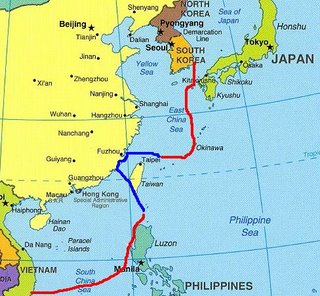
There is probably no more important reason to defend Taiwan than plain geography. The island of Taiwan is a major constrictive influence on China’s ability to project power in East Asia. The map above crudely demonstrates this effect. The red lines represent where China is hemmed in by nations other than Taiwan. The blue line shows where China is blocked by Taiwan alone. Losing Taiwan to China would have many deleterious results for U.S. strategy. As can be seen, China is currently prevented from having reliable access to blue water. Without Taiwan, the Chinese fleet (PLAN) would have direct access to the great ocean of the world. The U.S. and Japanese navies would be placed in the unenviable position of hunting down major Chinese surface ships across the vast Pacific Ocean. The Chinese would further be free to maneuver, combine, and divide their major fleets as they see fit in a time of war. Presently the Chinese are forced to divide their navy into two essentially independent fleets north and south of Taiwan. With warplanes and missiles on Taiwan it would be extremely risky for them to maneuver their fleet in the Taiwan Strait. The Chinese navy would thus start any war divided and halfway to being conquered. The reverse is also true; a Chinese Taiwan would form a protective bubble over the central part of the western Pacific that would be dangerous for the U.S. Navy to enter. The American fleet would be forced to either operate too far away to support operations or accept higher casualties. Lastly, Taiwan is an excellent location from which to launch air and missile attacks on China. It is the closest piece of land to China we would have, and is midway between Shanghai and Hong Kong.
The main military reason to defend Taiwan, aside from geography-influenced ones, is attritional. Classic attritional warfare is taking a geographic feature cheaply that the enemy must pay dearly to retake. One example of this is Southern General Longstreet’s desire to disengage and move around the Union army at Gettysburg to take a position between it and Washington, thus forcing the Federals to pay the high price of attacking the Confederates instead of the other way around. The Chinese have so indoctrinated themselves in the belief that Taiwan must be restored at any price, that they are, well, willing to pay any price to take it. Militarily then, Taiwan is a rock against which we can break the Chinese military. Even in a best case scenario, an invasion and occupation of Taiwan would be extremely costly to the Chinese military. Of course, the goal would be to prevent a successful result for China, but whether successful or not, we would be in a far better position versus China after they have blown themselves in their effort to retake Taiwan.
The Taiwan situation seems to me to be very similar to a prior contested island, Heligoland. Heligoland is a small island in the North Sea off the German coast. It had been a British territory since 1807 but Kaiser Wilhelm had given Britain a free hand in several East African kingdoms in exchange for the island in 1890. Though it appeared at the time that the British had received the better deal (one German critic groused that the Kaiser had “given away the coat for a button”), by World War I it was clear the Germans had. Heligoland proved invaluable for the German High Seas Fleet by forming a bubble in the southeastern corner of the North Sea that was inaccessible to the Royal Navy. The German fleet could make darting attacks from this secure area and then race back when caught by superior British forces. Had the British still possessed Heligoland in 1914, it is unlikely the Germans could have operated their fleet for long. British spotters and cruisers would have kept constant track of German movement allowing the British to be quickly destroy them if they attempted any action. The Germans possessing Heligoland was one factor that led them to believe the British would not risk their fleet and Empire to blockade Germany; a dangerous assumption of British intentions. It is likely that a China who controlled Taiwan would also assume that the United States would not risk her fleet and global preeminence in a confrontation over East Asian affairs.
The one weakness that we must concern ourselves with is the Taiwanese people. They seem to believe that we will simply save them from any Chinese attack, so no reason to prepare to defend themselves. They spend a pathetic 2.4% on defense, less than half of what they should spend. They have yet to agree to the major arms package President Bush offered them in 2001. Their military is only now beginning to think about reforming to face a 21st Century attack. Though they are still valuable to us, we are simply not going to blast the Chinese out of the mountain caves of Taiwan to liberate the island. Also, the amount China must pay to take the island is directly linked to how prepared the Taiwanese are to defend their island. Clearly, in any conflict we want the price to be as high as is possible. It is arguable that supporting Taiwan increases the odds of war with China. I do not agree with that, but even if it is true, it is better to have a greater chance of a war that is in our favor, than a lower chance of a war in China’s favor.
Subscribe to:
Posts (Atom)