Thursday, July 24, 2008


Sunday, March 11, 2007
Russia, China, and the next Global Power Struggle
Much of the recent news centers on our old friend Russia. Vladimir Putin has most expertly returned Russia to the great power game. Signs of Russia’s return have been around for some time and is something I’ve written about frequently (about last year's military budget increase and general mischief, potentially driving the Iran crises, using hard ball tactics with Europe). Prior examples include supporting Iran’s nuclear defiance of the international community, slowly taking control of Europe through controlling its energy supplies, assassinating dissidents and nosey journalists, feeding China’s drive to the south (i.e. away from Siberia), and the general growth in Russia’s economy. The more recent examples include bellicose statements, a revision of Russia’s national security doctrine, and massive increases in military spending. Along with Russia, China is also making noises with her growing economy and even faster growing military budget.
The current bout of bellicosity began with Putin’s bizarre anti-America rant at the Munich conference of defense ministers. It was followed up with a Russian general threatening Poland and the Czech Republic over American anti-missile sites in those countries. Now the Russians have written this new aggressive attitude into their defense doctrine. The Russian Security Council has said the reason for this revision is that, “Armed forces are still being used as an important instrument in maintaining political and economic interests of states, and Russia cannot ignore these factors in developing its military doctrine." In effect, while criticizing the United States for using military force to protect her interests Russia is declaring the use of military force to protect Russia’s interests a necessity. This more active approach will apparently supplement Russia’s more passive-aggressive policies, such as arming Iran and Syria, to cause as many problems for the current great power(s). There is again nothing surprising or bad about this. It’s the way the world works, Russia is a revisionist power with a small sphere of influence so if she can gain a piece of our or others' sphere by causing chaos and problems around the world it’s a net gain.
Russia’s doctrines and statements would mean little if they were not backed up by a growing economy that supported a growing defense budget. Russia is not disappointing on either account. Since Putin ascended to power at the end of 1999, Russia’s economy has grown 23% a year in dollar terms, 7.5% in Purchasing Power Parity, and 11.5% in my own system of accounting for currency adjustment*. Even though it did come off a fairly low base this impressive growth has given Russia the first stable economy that can support a vigorous military in 20 years. As a result, Russia’s official military spending has grown even faster, over 28% a year in dollar terms to $32.4 billion (bottom of the story) and 13.5% in my system referenced above. When adding in the much larger non-official defense spending it means Russia has clearly surpassed Britain, France, and Japan’s $40-50 billion defense budgets and is firmly in third place globally. This is despite the fact that Russia’s economy is only 1/2 the size of Britain and France’s and 1/4 the size of Japan’s. The extra hundreds of billions will be put to good use forming a hi-tech modern Russian military over the coming decade that will be on hand to carry out Russia’s new doctrine of using military force when and necessary to further her interests around the globe.
The Chinese have been somewhat more circumspect as regards their public rhetoric and they haven’t yet formally switched over to a more aggressive posture. They are much more of a actions speak louder than words type nation so this isn’t surprising. Like the Russians they are also taking hostile actions, reorganizing their military into a more professional expeditionary force, and increasing their defense budget by leaps and bounds. Even more so than Russia, China’s economy and ability to support her military has advanced very quickly.
China has been taking ever more non-friendly actions over the years. In the last year alone they tested an anti-satellite missile that created a dangerous debris field for everyone’s satellites, had a submarine shadow a US carrier in international waters, and violated the territory of Japan with planes, ships, and subs in increasing numbers. Not the friendliest of actions but then being friendly to us or anyone isn’t China’s job. China’s army is reorganizing from a large conscript infantry based territorial defense force into a smaller professional mechanized offensive force. At the moment only a handful of units have been converted (3 corps with 12 brigades so far, though I can’t find the link for that). The navy is growing a bit slower at the moment as learning to build and man ships takes a bit of time, but China is doing just that and is preparing for a powerful blue-water fleet in the future. The air force is likewise switching from a poorly trained, obsolete, short range, light air defense force into a better trained, modern, long range, multi-role force. To make this transition to a force capable of projecting Chinese power and influence possible requires vast sums of money. And vast sums of money is what Beijing is providing the Chinese military forces. The latest year will see another double digit increase (17.8%) in official defense spending to $45 billion. As with Russia, the real figure is 2-3 times as high and is by far and away the second largest defense budget in the world. Due to China’s act first explain later policy we’ll realize the impact of this only after they make a move.
Individually, the power of China and Russia is still somewhat limited even though it is growing fast. However, they have reached a point where combined they have the power to resist US power in the world. Over just the last 7 years the economy of Russia and China has risen from 17% of the US’ to almost 30%. Their combined official military spending has reached $77 billion, 15% of the US, this year from $21 billion, 6.5%, in 2001 with the real figures again being 2-3 times higher. They are the new (well, new-old) powers on the international scene and will seek an international order that recognizes their place. We will, along with countries more threatened by Russia and China, attempt to maintain the current system. With their continued rapid economic growth, massive military spending increases, and reorganization of their militaries the Chinese and Russians will have the ability to force a world more amenable to their interests. The result is that the future will be as filled with conflict as the past (the last century exempted most likely). Especially should Democrats continue to gain at the national level and US power, influence, and military spending retrench in the coming years they may prove quite successful.
*I can't quite figure out how to put math symbols like sigma on here but the system is fairly simple, I just multiply the current year's exchange rate by 8, the prior year by 7, etc. and divide the result by 36 to get the adjusted exchange rate. It works fairly well by ironing out the massive gyrations in exchange rates and producing a more realistic dollar GDP value for most countries that still accounts for variations in currency values.
Tuesday, December 19, 2006
Russia Continues to Win with 19th Century Tactics
This case in particular involves meat exports to Russia. Russia has banned meat imports from Europe on the pretext that the EU cannot protect against unsafe meat from Romania and Bulgaria. Russia is allowing meat imports from certain countries (Germany and Denmark so far) who Russia says will break EU policy and protect Russia from the scourge that is Romanian pork. However, since the countries that Russia is allowing to export meat are “friends of Russia”, and agriculture is a major sore spot in Europe, many suspect Russia is simply playing divide and conquer amongst the Euro states. Those EU members who do not want their precious agricultural sector hurt will have to tow the Russian line or see their agricultural exports go to another member who will.
Russia has also used energy exports as a weapon in international affairs. Most notably they did so by shutting off exports to punish Europe and the Ukraine for the defeat of the pro-Russian faction in the Ukrainian national elections. They have used the price of natural gas to punish former Soviet republics who want to leave Russia’s sphere-of-influence. The Poles are being punished for their anti-Moscow positions by having a new pipeline built along a more expensive route through the Baltic instead of overland through Poland.
I'm not even going to delve into Russia’s theft of foreign investments in Russian energy projects, the Kremlin’s assassination campaign against critics, and Moscow’s open support for anti-Western regimes. The Russians are advancing their interests in the world, punching well above their weight, and playing us as fools (and bravo to the Russians on all accounts). They are, as one State Department official said, “acting like it’s the 19th Century”. Of course such behavior is practiced by all countries towards non-normal (or rogue) nations, but part of the concept of the new-age globalized world is that such behavior is extinct amongst normal countries. We’re all supposed to trade freely, get rich together, and live happily ever after. As the above shows not all normal countries agree. Russia by her 21st Century behavior and Europe by their 21st Century acquiescence are showing that “19th Century” geopolitics are still around. One day we’ll also realize this, hopefully before the Beijing-Moscow Axis has won the current round of the Great Game.
Saturday, July 01, 2006
Is the West misreading Putin?
Now that that is out of some people's systems, on to the topic in question. Russia’s President Vladimir Putin has had what appears to be an extremely bizarre foreign policy. Russia has traditionally been pulled in three directions, west, east, and south. The allure of the West is the wealth and technology it possesses, but at best Russia is only one of the Great Powers (often less). The East offers Russia a world where she is not the poorest most backwards member, but the great distance and massive population of Asia limits Russia’s influence. Only when looking south is Russia unquestionably the greatest, but that’s not saying much and Russia knows it. Typical Russian foreign policy would be to bounce between areas, only focusing long enough to achieve a few goals, maintain a favorable situation and then move off in another direction. The main goal was to never become consumed entirely by one region since Russia (except during a few periods) could never hope to compete in all of them at the same time.
As such, it would be expected that Russia would continue this general foreign policy. At first it appeared as though Putin was doing just that. He would work with the West, get a few brownie points, and then do the same with China, with a few moves towards working with the Arab world against the U.S. in between. Lately though, Putin seems to be aligning Russia ever more deeply and permanently with China (here's just one example), which is somewhat confusing according to this view. There seems to be two common theories as to what Putin is doing. The first says he is just buying off China for now, until Russia can recover and be better prepared to deal with China. The second theory is that America’s foreign policy is viewed as such a threat to Russia’s position in the world that he must ally with China to limit America’s influence after which he can move away from China.
For the most part I have agreed with the first theory, though Putin seems to be moving so far into China’s camp that it seems to me that it will be nigh on impossible to escape China’s clutches in the future. Putin has set Russia on a path that is so anti-Western in general and anti-American in particular that it is difficult to see how Russia can ever come back. Here's a third theory to explain Putin's behavior, what if he never intends for Russia to come back? Again, even in the best of times Russia is only one of the Great Powers and these are no where near the best of times. Excluding nuclear weapons (which you may as well since between normal nations they play little role in geopolitics), Russia has declined precipitously since 1990. In 1990 Moscow controlled 5% of the world’s population, 11% of its GDP, and 38% of defense spending. Today Moscow has fallen to 2.2% of population, 1.8% of GDP, and somewhere between 2% and 4% of global military spending. If Russia were to try to be a part of the West, it would barely qualify as the weakest of the Great Powers and then only because of sympathy from the West. Further, Europe cannot provide Russia with any serious military support and also poses no serious military threat. The major threat facing Russia today is the Islamists to the south and the Chinese to the east. Russia barely has the power to face one of these threats much less both. Should Russia ally with Europe, there is no hope for future aid should Russia face a war to the south or east. By working with China, Russia prevents a threat from developing in the east. This would allow Russia to focus on the Muslims to the south who also pose a more serious internal threat due to Russia’s large Muslim minority. Whether China intends to allow Russia to remain an equal in the future is open to question. However, Russia may not have much of a choice. If they do not keep China friendly there is no chance of dealing with both China and the Islamists. Russia is in such bad straights this is probably their only hope. Better to serve a Chinese boss than a Muslim master.
Here is a more detailed post about Russia's foreign policy actions. Note that the arms exports to China are specifically not the kind of weapons China would need for a Siberian war. This post is a good explanation of the overall geopolitical benefits that China and Russia gain from their partnership.
Tuesday, June 06, 2006
Iran - The key to the World Island

(Blue - Pro-U.S., Red - Pro-U.S.S.R, Gray - Neutral)
Any analysis of geography will show that Iran is one of the most important countries in the game to dominate the World Island (well Eurasia really since Africa isn’t too important). This can be seen in the prominent role Persia played in the British-Russian Great Game of the 19th Century to dominate Central Asia. However, Iran’s prominence to modern geopolitics began with Iran’s role in the Cold War strategy of containment. This map shows approximately how the world was arranged in 1948 (I took a few liberties such as Spain which wasn’t technically part of NATO but would be soon). There are only three locations where the Soviet Union was not hemmed in by blue countries. At the Adriatic Sea where they faced Western European and American forces, at the North Pacific where they faced American and soon Japanese forces, and at the Iranian border where all that stood between the Soviet Union and her age old dream of a warm water port was a weak neutral nation.
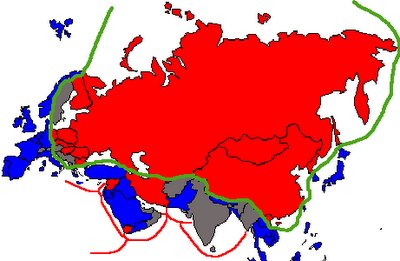 (Blue - Pro-U.S., Red - Pro-U.S.S.R, Gray - Neutral, Green Line - Containment Line, Red Lines - Russia's ability to move outside of containment, Iran is hypothetically Red in this map)
As the next map shows, Iran’s importance only grew with the 1948 victory of the Communists in China, the pervasiveness of the communist guerrillas in Vietnam, and the defection of Yugoslavia from the Cominform. A victory by the Communists in Iran or Vietnam would have pushed the line of containment further from the U.S.S.R. and away from any choke points such as the Baltic Sea or Sea of Japan. This would not only make it easier for the Soviets to reach farther a field with their aid, military, and influence but would also have been a headache for the U.S. Navy (as the map crudely shows). They would have faced the World War I Royal Navy’s difficulties of chasing down far flung enemy cruiser detachments all over the world while also concentrating in the main theater. As can be seen, not only has the line of containment been precariously stretched, it would have been broken all together had Iran gone communist. I believe this to be a major factor determining how the U.S. dealt with Mossadeq and North Vietnam.
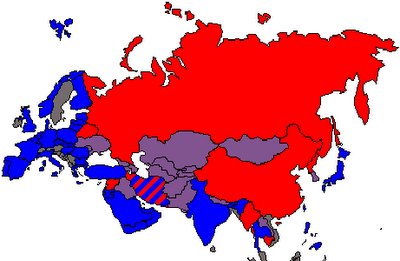 (Blue - Pro-U.S., Red - Pro-Russia/China, Gray - Neutral, Purple - Contested)
This brings us to modern times. Iran is again at the center of the geopolitical jostling between the world’s two major blocs. Since the fall of the Soviet Union, Russia has been trying to rebuild something of her former empire and has been moving ever closer to China to try to achieve some level of influence in the world. While the Beijing-Moscow alliance is not a solid alliance based on common interests, it is based on a single major interest, confronting and diminishing the United States. Also, the U.S. alliance structure is not as secure as it was during the Cold war, but it is largely based on shared democratic and free market values. Other than the Ukraine and a few Asian countries that mostly ring China, the major countries that are being fought over (non-violently for now of course) are the 7 Stans, the three Transcaucasian nations, and Iraq.
Each is important in its own right. The states of Central Asia are not only the font of much Islamic extremism, but also sit on massive reserves of oil that the world desperately needs. China wants them in her orbit to secure access to non-Middle Eastern oil, to prevent terrorism from spreading to the Uighurs of Sinkiang, and to keep the U.S. out of her backyard. Russia wants to make sure that Central Asian oil flows through Russia thereby giving them control of its export, and also to keep the U.S. out of their backyard and former empire. The United States wants to fight terrorism, ensure oil supplies, and surround China. The Transcaucasus is important primarily as a point of ingress and egress for Central Asia that is not controlled by the Russians or the Chinese; something we would prefer to keep and something they obviously would like to stop. Pakistan is important to us as an entry point for Afghanistan and for the fight against terrorism. The Chinese would like Pakistan in their orbit so they can use Gwadar as a naval base to escape the U.S ring and as a threat to India (who is moving closer to the U.S. and Japan). Lastly there is Iraq. Iraq is important to the U.S. for the fight against terrorism, as a sign of credibility, and to hopefully be model someday for the rest of the Middle East that would move it more in favor of our interests. The Chinese and Russians would prefer we lose credibility in Iraq, and that it fall back in the hands of an anti-American dictator. From Iraq the rest of the Sunni Middle East, most notably Saudi Arabia, can be challenged.
From the map it can be seen that there is one country that borders these three key areas, Iran. Should Iran formally sign up with the Beijing-Moscow axis then it would be very difficult for the U.S. to maintain a hold on the Stans, Transcaucasia, and Iraq. Pakistan could not be expected to stay pro-U.S. as we become closer to India and a pro-Russia/China Iran is sitting to their rear. As a long country with little strategic depth, Pakistan cannot have enemies on both sides and since India will always be an enemy that would leave them little choice. The Transcaucasian countries (most importantly Azerbaijan) would have a hard time dealing with a concerted effort by alliance members on both sides, especially since their trade and energy supplies come from these countries. With Pakistan, Azerbaijan, and Iran lost, it would be impossible to hold onto the energy rich Central Asian Stans. Iraq would be more tenable but it would still be much more difficult to see it to a successful conclusion. With this, Beijing and Moscow would not only have most of Asia and most fo the world's oil production under their sway, but it would be virtually impossible for us to break into it. Combined with China’s inroads in Africa, and a little more effort with the weak Western Europeans, we could be entirely cut off of the World Island with the exception of India, which due to the Himalayas may as well be considered a maritime power anyways. The key to this power struggle, as with the last, is Iran. We cannot allow it to become a nuclear armed power that shares Russia and China’s anti-American world view and owes them for their protection. If we do we face the loss of everything we have gained since 1990 in the former Soviet Republics, Iraq, and the Stans.
Is Russia behind the Iran crises?
Economically, the Russians are earning a couple billion dollars a year selling nuclear technology and the weapons to protect it to Iran. This is not a significant sum for the Russian economy as a whole, but it is focused mostly in the depressed defense and nuclear sectors of Russia’s economy providing them with a vital boost. Even this is small potatoes compared to the amount of money Russia is making by the higher oil prices cause by Iran’s behavior. Russia is the second largest exporter of oil in the world so any disruptions would only further increase this windfall. The Russian government earns around $1.4 billion for every dollar oil prices are above their natural level. Currently it is estimated oil prices are over valued by $10-20 a barrel due to risk and speculation. This translates to $14-28 billion in extra revenue for Moscow (how much is due to Iran is of course unknown, though oil prices fluctuate up or down $2-5 depending on statements by Iran). Should things have to be resolved militarily and oil hits $100 a barrel, Moscow will be receiving almost $120 million a day in extra oil taxes. If things are settled diplomatically then Russia will continue selling billions in weapons and technology that the new regional power broker will need.
Russia also wins geopolitically regardless of the result. Right now Russia is reinforcing the fact that since the U.S. continues to go through the U.N. to fix problems, nothing can happen in the world without her. Should we have to go the military route then the Russians have killed 2 birds with one stone. We will have to expend further treasure and resources thereby reducing our ability to deal with other issues the Russians care about more, and we will have taken down a potential future threat to Russia. The downside for Russia is being viewed as not defending a client, but they have not done enough to be viewed as protecting Iran the way they did with Saddam. If things are “solved” diplomatically and Iran gets their nukes it is no major problem for Russia. Most importantly, we will have been shown to be impotent making it difficult for anyone around the world to trust us to stand up for them while the Russians will have displayed their ability to protect their clients that was ruined after the Iraq War. Although Iran would be free to become a threat to Russia, they would not be that serious since the regime would be indebted to Russia and Russia has no compunction about throwing nukes around in her own defense.
The next question after establishing that Russia is the only power with everything to gain and nothing to lose from the Iran crises is how are they driving it? The first manner is by selling the nuclear technology to Iran. Far better countries like Brazil spent decades trying and failed to develop a nuclear bomb before giving up. North Korea has spent who knows how long developing a bomb with unknown amounts of help from China and Russia and unknown success. Iran would scarcely have been much more successful by itself. After jump starting Iran’s nuclear program, the Russians next provided Iran with the means to credibly defend it against anyone except the U.S. and to raise the price for the U.S. considerably. They have sold Iran advanced anti-aircraft systems including possibly the S-300 to protect key sites, anti-ship missiles and diesel-electric submarines to allow for threats to the U.S. Navy and the straits of Hormuz, and licenses the RPG-7 to raise the price of any ground invasion. Despite the success of getting Russia to slow the sale of the S-300 to Iran, this is likely because the S-300 would largely prevent an Israeli attack and thus would cause Israel to strike soon. The longer it takes to resolve this crises the better for Russia. These weapons allow Iran to more safely develop a nuclear weapon since the U.S. must take into consideration the much higher price in lives, aircraft, and money to stop Iran; maybe to the point of preventing any action at all. Further encouraging Iran’s behavior, the Russians are using their U.N. Security Council veto to lead the Iranians into believing that since the U.N. can be trusted not to stop them, the U.S. won’t either (this was the same reason Saddam believed he could again get away with his shenanigans in 2002/03). They then play a key role in the diplomatic activity to make it appear as though they are willing to see the issue resolved keeping eyes averted from their own role in creating the crises. All in all, a brilliant move by Putin that we show no inclination of paying the price to stop.
Monday, June 05, 2006
The Bear Returns

Russia has returned to the international great game of geopolitics. Not at her former strength to be sure, but with greater power and influence than at any time in the last 16 years. They are exporting their weapons and technology with no regard as to who they will be used against, using their energy supplies as a cudgel, and are now rebuilding their military forces. How the West in general and the U.S. in particular deals with Russia will play a major role in how Russia plays the great game.
Like the French, the Russians act on the international scene with the express goal of furthering Russia’s interests. Firstly, people need to stop their moral shock and outrage that Russia is looking out only for Russia like it’s, as one State Department official put it, “the 19th Century”. There is nothing wrong with that. Just because we take regular hits to our international position to help out others or the world in general does not mean everyone else has to or will. For example, if Russia can help herself by aiding Iran and making it more difficult for us to stop them from going nuclear, why shouldn’t they? The only reason they shouldn’t is because we will punish them for it, and since we show no inclination of doing that, it is win-win for Russia.
The Russians have been advancing their interests around the globe with arms and technology exports since the fall of the Soviet Union. Although, they do this not in the positive sense of advancing Russia’s interests but rather in the negative sense of hindering the interests of Russia’s competitors. Most notably Russia is a major arms exporter to China. Some question why Russia would arm her most potent potential future enemy, but it is clear Russia is doing so to direct China at her main current competitor, the U.S. Russia has made billions off of arms exports to China but they are mainly in areas China needs to confront the U.S. not Russia. To fight the U.S. China needs submarines, anti-ship missiles, anti-aircraft missiles, fighter jets, torpedoes, the very things Russia is selling. To fight the Russians the Chinese need fighter-bombers, attack helicopters, tanks, infantry fighting vehicles, the very things Russia is not selling to China. Russia sold Saddam Hussein anti-aircraft missiles, command and communication equipment, and installed them for him. The top Russian army general even bragged in 2003 that the air defense network that Russia had built for Iraq would tear the U.S. Air Force apart (to his credit he dutifully ate his crow a few weeks later). To Iran the Russians are selling nuclear technology, air defense missiles and radars, and anti-tank missiles. The common thread that connects these particular arms sales are that they are not meant necessary to further Russia’s interests. These sales are meant to damage the interests of the U.S. since we either have to accede to China, Iran, Iraq, etc. having greater regional influence or pay the extra price fighting through their Russian supplied equipment to stop them. Either way, as we are diminished Russia improves relatively just by standing still. Again, so long as we do not make Russia pay a price for this behavior, why should they not do it?
The situation with Russia’s energy supplies is similar. Russia is using them in a geopolitical jujitsu move against Europe. The Russians know that Europe far eclipses them in all respects except nuclear weapons and energy reserves. So to get Europe to listen to Russia, they are threatening Europe’s energy supplies. Even though a cutoff of energy supplies would hurt Russia far more relatively than Europe, the fact the Russians are willing to risk it while the Euros are not means the Russians have the edge. With this one threat the Russians are elevated to Europe’s virtual co-equal when by all rights they are not. Also, by roiling the energy markets Russia drives up the price of her primary export earner. Is it any wonder they seem to be pushing Iran along, promising U.N. protection that Iran (like Saddam) thinks will protect them from the U.S. but won’t, all the while the Russians arm the Iranians with new weapons that give them the ability to make threats. The coming war does not affect Russia and yet makes them billions selling these things to Iran while keeping oil prices over $70 a barrel earning Russia $1.4 billion per dollar that oil is kept over its real price. The worst penalty this behavior has caused is a chiding from the U.S. Vice President that caused more grief for America than for it did for Russia.
These energy and arms sales moves are mostly passive and cost effective resistance by the Russians. To take a more active role in world affairs they need a military that is actually capable of something other than rotting away, suicide, and hazing. This is what we are about to see. Russia’s Defense Minister has announced that over the next 9 years, Russia will spend approximately $186 billion on weapons procurement. $21 billion a year does not sound like much, but it is almost double the $11 billion in arms to be purchased this year (which is itself a major increase over the last decade). Also, Russian arms are cheaper than ours so it will buy much more than it appears. While most of the $11 billion to be spent this year is going to the nuclear forces and the navy for new ships and submarines, the army is still getting enough to out purchase the U.S. Army in raw numbers despite our $18 billion procurement budget (plus $5 billion for the warplanes mentioned). The Russians are getting a lot of new equipment, including 30 new tanks (30 more than the U.S. Army is getting), 180 rebuilt tanks (60 more than the U.S. Army), 120 new IFV/APC’s (20 more), 500 rebuilt IFV/APC’s (400 more), ~300 SAM’s (200 more), 10 helicopter gunships (10 more), and 50 warplanes (4 less actually). Figuring that the Russian army/tactical air force budget will possibly quadruple over the next 9 years they will quickly have modern deployable forces, potentially as many as 100,000 soldiers. Such forces will be able to deploy to central Asia from Russia’s Tajikistan military base and throughout the Middle East from their new base in Syria. Such a capability could be used to greatly complicate matters for us.
Russia has always sold weapons to all comers, but her more recent use of energy resources as a weapon, and the recent and future military spending increases shows that Russia is again a power to be reckoned with. How the U.S. and the Europeans reckon with Russia is up to us. We can continue allowing Russia world influence on the cheap until a combination of a declining Europe and rising middle powers makes it difficult for us to operate effectively in the world, or we can begin to push back and make it not in Russia’s interests to act counter to us (how will be the topic of a future post). Admittedly this may lead to an escalating confrontation with Russia but it is one they will lose and one they therefore may choose not to engage in. We have passed the point of using an ounce to cure the problem of Russia, and are at a pound, should we do nothing it will soon take 16 pounds to deal with the problems Russia will cause around the world. Whatever the mal-effects for us, Putin is doing what is best for Russia to which I can only say bravo. I only hope he is just as good at looking out for Russia when we aren’t as accommodating.