Showing posts with label Far East. Show all posts
Showing posts with label Far East. Show all posts
Thursday, July 24, 2008


Friday, January 05, 2007
Enter Hu Jin-Tirpitz and the Sino-American Naval Race
China’s President Hu Jintao recently gave a speech stating that, “The navy force should be strengthened and modernized... to serve the country and its people more effectively.” This doesn’t quite have the symbolic or real world impact of “a fleet second to none” or “a place in the sun” but it also isn’t something we can blithely ignore. Even though China will not be able to challenge the US and Japan on the seas for some time, they are preparing for that day. They are building modern ships, submarines, and power projection capabilities at a decent rate. This buildup will soon place China third in the world in modern and semi-modern vessels (2005: China-25 ships/19 subs, US-123/52, Japan-44/16, Russia-27/36 poorly maintained, UK-27/9, France-18/6, and India-17/13). This naval expansion is nothing new or evil. The Franco-English and Anglo-German naval races of years past were very similar in many respects. The players have changed but the game is the same. A new great power arises and discovers that a first-class great power requires a powerful fleet to protect its security. This powerful fleet invariably threatens the security of already existing great powers. At this point one of 4 things happen (example naval race from history, my guesstimate of it happening today):
1) Current great power accepts the hit to its security and gives up (Anglo-US, possible but not likely I would think/hope),
2) New great power does the same and gives up (US-USSR, not happening),
3) New great power doesn’t want to wait the 30 or so years it takes to build a powerful fleet, so they develop “risk theories” that they think allows them to mount an early challenge the current great power with the superior fleet (Anglo-German & US-Japan, most likely given China's actions and moves).
4) New great power does wait 30 years while it builds up its fleet (Anglo-Dutch, China's best choice, depends on if Beijing can hold off on Taiwan for the next 20 years, given that and the fact that this is somewhat rare historically I don't think it's too likely but we'll see).
It is very easy to dismiss China’s naval growth, as the Chinese would like us to, because it pales in comparison to the strength of the mighty US Navy. Also, there is the excellent Japanese navy to consider. However, China’s naval buildup should be closely observed and if need be countered for two reasons. Firstly China doesn’t need to match the American and Japanese navies ship for ship and crew for crew. China, like von Tirpitz’s Germany, understands that all they need to do is raise the risk of confronting China to an unacceptable level for us and Japan. This only requires close approximation and not full parity or superiority between the Chinese navy and the US Pacific Fleet and Japanese navy. The second reason follows from the fact that it will be the US Pacific Fleet and not the US Navy as China’s opponent. What this means is that while China’s entire navy will be used in a conflict, we will only be able to send a portion of ours due to global commitments and distance from our main ports. Unless we increase the size of our fleet we will have to steadily weaken ourselves elsewhere to provide the margin we need against China. Unfortunately, with the exception of India in the Indian Ocean, there are not many good nations to take our place in their region if we withdraw. Britain was forced to withdraw from the Americas and East Asia to deal with Germany in 1914. She at least was able to hand power over to like-minded countries. Although even with like-minded countries this would turn out badly for Britain since Japan turned violent with the Royal Navy absent.
The overall growth of the Chinese surface fleet does not at first glance look impressive. Its total strength is expected to grow from 19 destroyers and 40 frigates in 2000 to 28 destroyers and 42 frigates in 2015. However, all but one of the ships in 2000 was obsolescent and most would have been little more than target hulks for the US Navy in the event of a conflict. By 2005 China’s count of modern ships had grown to 6 destroyers and 2 frigates. This is expected to grow to 14 destroyers and 8 frigates by 2015. At the same time China is adding semi-modern vessels that could still pack a punch when paired with modern ships. This intermediate category will likely grow from 2 destroyers and 6 frigates to 3 destroyers and 14 frigates in 2015. At some point, globalsecurity.org says 2010 but others say after 2020, the Chinese fleet will receive its first aircraft carrier. It’s expected to be about half the size of a US carrier at around 48,000 tons displacement and 24 fighters. These estimates are from before Hintao’s speech calling for more navy funding so the real figures will likely be higher.
More critical to China’s ability to simply damage the US Navy severely enough that we won’t challenge them are submarines. In 2000, China actually possessed more attack subs than the US, though again most were obsolete (Chinese copies of Soviet copies of German WWII designs). Of China’s 64 attack subs in 2000, 5 were semi-modern nuclear attack subs (the Han-class) and 5 were modern conventional attack subs (Kilo-class and a Song-class). In 2005 China had 1 modern and 5 semi-modern nuclear attack subs, and 13 modern conventional attack subs. According to older estimates these numbers should be 6 modern and 5 semi-modern nuclear attack subs, and 29 modern conventional attack subs in 2015. The growth of the modern conventional attack sub force is perhaps the most worrisome aspect for the US Navy. Modern conventional attack subs are extraordinarily difficult to find and track. Japanese, Australian, and Swedish conventional subs regularly manage to get within strike distance of a US carrier in wargames without being discovered. Any thoughts that this was a feat that only well trained crews in the most advanced subs could perform were dispelled a few months ago when a Chinese sub trailed a US carrier from 5 miles away without being noticed. The fact that this incident took place near Okinawa further shows the greater ranges at which the Chinese sub force is capable of operating.
The Chinese are not focusing on glamorous new ships and subs while neglecting the more mundane aspects of naval power projection. Their amphibious fleet has undergone a radical improvement in its capabilities. Prior to 2000 most of China’s amphibious vessels were WWII American designs. The 26 large amphibious ships they had in 2000 could carry a max load of 15,600 soldiers (although they would carry less than that depending on the supplies they would need to take with them). In 2005 this has expanded to 33 ships with a 21,600 soldier capacity and will be at least 52 ships and 31,200 soldier capacity by 2015. No fleet can operate far from home without underway replenishment vessels accompanying them. This area of the Chinese navy will see its 2000 total of 3 ships and 34,200 tons of cargo capacity grow to 5 ships with a cargo capacity of 57,000 tons in the near future. There don’t appear to be any further plans for expansion beyond that, but again these are only estimates and something like a cargo vessel could be ordered up fairly quickly. Officially, this side of the navy modernization is chalked up to Taiwan. The ships are only needed to move soldiers and supplies for operations against the Taiwanese “separatists”. It shouldn’t take much mental power to realize that those ships will be just as capable of moving soldiers and supplies to other places.
Barring any disruptions from the Democrats gaining control of Congress, the US Navy is projected to grow from 123 ships and 52 subs to 161 ships and 50 subs. Due to our other global commitments it’ll be difficult to send more than half of our fleet to the western Pacific unless we wished to invite more trouble by reducing those commitments. Adding in the Japanese Navy, this would yield a force of approximately 100 ships and 40 subs today and 110 ships and 40 subs in 2015. Impressively larger that may be, but the ratio of ships will decline from 4:1 to 2.75:1 and of subs from 2:1 to 1:1. It has to be noted though that 22 of these new US ships are the smaller and less capable Littoral Combat Ships. Since the final design of the LCS hasn’t been determined yet, it’s difficult at this time to say if they would have much use against China. At the moment it would seem that they wouldn’t since they are mainly for operations in shallow waters against less capable countries like Iran or North Korea; but who knows until the design and procurement schedules are finalized. The effect of the US Navy’s 12 aircraft carriers is also somewhat difficult to gauge. On the one hand each has more theoretical firepower than just about any navy on the planet. On the other their anti-submarine capabilities are not proportional to their greater firepower and their prohibitive cost would likely cause them to see more limited usage than is normal (especially in light of the sub part). Exactly how much this would limit their tremendous firepower can only be known when the war happens.
Not to sound like a broken record, but the Chinese fleet is not going to be a force that can clear the oceans of US Navy ships anytime soon. The trouble is that it could still pose a major threat to the US Navy and the Pax Americana even in a smaller state. The problem is that the Chinese are not preparing for a stand up fight, and we would likely shirk from one anyways (their preferred result). Unlike Germany in their naval race, the Chinese understand that their sub force is their major threat. Admittedly, it will be much more difficult in war-time for a Chinese sub to get within 5 miles of a US carrier than it was last October. However, in less than a decade China will have at least 40 subs trying to do just that, not just one. The US Navy has been trying to develop new tactics to counter the new super-quiet conventional subs, but we of course don’t know if the Navy is having any success (a potentially hostile sub being able to shadow a carrier until the sub chose to reveal itself doesn't exactly inspire confidence).
These Chinese subs would be looking for one of the 4-8 carriers we send to the western Pacific. The more carriers we send does increase the odds of Chinese subs being found, but it would likely increase the odds of a carrier being sunk even more. With only a couple dozen each of subs and ships free the US Navy will be hard pressed to search the sea lanes across the breadth of the Pacific for them. Like the dreadnaughts of WWI, modern supercarriers are so prohibitively expensive and imbued with so much national pride that the loss of one would be a tremendous blow to America. Losing 2 or 3 would simply have unthinkable consequences to America’s position in the world.
The Chinese surface fleet would have its opportunities to do damage as well. While America’s carriers, along with around 30-50 escort ships, are desperately trying to avoid Chinese subs hundreds and maybe thousands of miles east of Taiwan, the surface ships of the Chinese navy would be well positioned for rapid sorties against smaller American/Japanese task forces. In this way they would play a role similar to Germany's Battlecruiser Squadron during WWI. The goal would be to sink enough American ships that we give up, regardless of how many ships and subs China loses. China also has various “assassins’ mace” weapons that they hope will be able to exploit weaknesses in the US Navy’s capabilities. These include weapons like lasers, anti-satellite devices, ballistic missiles capable of hitting a moving target, and so forth. What impact they would have is unknown. At the very least they would add to the US Navy’s worries and force the carriers to operate in an even more limited capacity. Most importantly is if the Chinese think these weapons will be tremendously effective. That’s all the more reason for them to create a situation where they could be.
However, this is not the scenario the Chinese wish to occur. Rather it is the scenario they hope America so fears that she won’t even dare to challenge them. Germany wagered in 1914 that Britain would rather keep her dreadnaughts and thus her empire than risk both to stop Germany’s goals in Europe, they were wrong. China is wagering that America would rather keep her supercarriers and maintain her position in the rest of the world than stop China’s moves in East Asia, I wish I could say they are wrong. However, the buckling of American resolve in Iraq under 3,000 dead in almost 4 years does not offer hope. How quickly will Americans be demanding and end to conflict and the return of cheap toys and kitchen appliances when 3,000 sailors go down with a carrier? America and Japan cannot rest easy even if the Chinese are not megalomaniacally willing to risk their small fleet by starting a war whose success depends on weak American resolve. Longer-term this initial fleet is providing China with industrial and military know-how that is necessary to build and operate a large fleet along with the experience they will require to actually fight the far more experienced US Navy. With their growing economy, ship building industry, and cadre of trained sailors, it would not be difficult for China to launch into a sudden massive shipbuilding program in the near future.
Either way, this is a development that should be closely watched and replied to by both the United States and Japan. Chinese protestations aside, it is not their declared intentions but their capabilities and our interests on which we must base our own policies. Aircraft carriers, underway replenishment ships, and vast numbers of modern conventional attack subs are not needed to conquer Taiwan, they are needed to fight the US and Japanese navies. At the least, they are preparing the capability to fight us, we must make sure we maintain and if need be expand ours.
Note: I consider a modern warship to be one with a) anti-aircraft capabilities beyond 10 miles, b) a close in weapons system to defend against missiles, c) either less than 20 years old or extensively upgraded in the last 20 years, d) capability in more than 2 areas (anti-air, anti-surface, anti-sub, and land attack). A semi-modern ship would be one that has at least 2 of the above. Subs are a little more difficult, but aside from the Chinese Han-class I consider the rest modern. The Han-class isn’t only because it’s a very noisy sub even by nuclear standards. The conventional subs show a clear break between older and modern designs in capability (as witnessed by the aforementioned Chinese Song-class exploit) so they are either counted or not.
1) Current great power accepts the hit to its security and gives up (Anglo-US, possible but not likely I would think/hope),
2) New great power does the same and gives up (US-USSR, not happening),
3) New great power doesn’t want to wait the 30 or so years it takes to build a powerful fleet, so they develop “risk theories” that they think allows them to mount an early challenge the current great power with the superior fleet (Anglo-German & US-Japan, most likely given China's actions and moves).
4) New great power does wait 30 years while it builds up its fleet (Anglo-Dutch, China's best choice, depends on if Beijing can hold off on Taiwan for the next 20 years, given that and the fact that this is somewhat rare historically I don't think it's too likely but we'll see).
It is very easy to dismiss China’s naval growth, as the Chinese would like us to, because it pales in comparison to the strength of the mighty US Navy. Also, there is the excellent Japanese navy to consider. However, China’s naval buildup should be closely observed and if need be countered for two reasons. Firstly China doesn’t need to match the American and Japanese navies ship for ship and crew for crew. China, like von Tirpitz’s Germany, understands that all they need to do is raise the risk of confronting China to an unacceptable level for us and Japan. This only requires close approximation and not full parity or superiority between the Chinese navy and the US Pacific Fleet and Japanese navy. The second reason follows from the fact that it will be the US Pacific Fleet and not the US Navy as China’s opponent. What this means is that while China’s entire navy will be used in a conflict, we will only be able to send a portion of ours due to global commitments and distance from our main ports. Unless we increase the size of our fleet we will have to steadily weaken ourselves elsewhere to provide the margin we need against China. Unfortunately, with the exception of India in the Indian Ocean, there are not many good nations to take our place in their region if we withdraw. Britain was forced to withdraw from the Americas and East Asia to deal with Germany in 1914. She at least was able to hand power over to like-minded countries. Although even with like-minded countries this would turn out badly for Britain since Japan turned violent with the Royal Navy absent.
The overall growth of the Chinese surface fleet does not at first glance look impressive. Its total strength is expected to grow from 19 destroyers and 40 frigates in 2000 to 28 destroyers and 42 frigates in 2015. However, all but one of the ships in 2000 was obsolescent and most would have been little more than target hulks for the US Navy in the event of a conflict. By 2005 China’s count of modern ships had grown to 6 destroyers and 2 frigates. This is expected to grow to 14 destroyers and 8 frigates by 2015. At the same time China is adding semi-modern vessels that could still pack a punch when paired with modern ships. This intermediate category will likely grow from 2 destroyers and 6 frigates to 3 destroyers and 14 frigates in 2015. At some point, globalsecurity.org says 2010 but others say after 2020, the Chinese fleet will receive its first aircraft carrier. It’s expected to be about half the size of a US carrier at around 48,000 tons displacement and 24 fighters. These estimates are from before Hintao’s speech calling for more navy funding so the real figures will likely be higher.
More critical to China’s ability to simply damage the US Navy severely enough that we won’t challenge them are submarines. In 2000, China actually possessed more attack subs than the US, though again most were obsolete (Chinese copies of Soviet copies of German WWII designs). Of China’s 64 attack subs in 2000, 5 were semi-modern nuclear attack subs (the Han-class) and 5 were modern conventional attack subs (Kilo-class and a Song-class). In 2005 China had 1 modern and 5 semi-modern nuclear attack subs, and 13 modern conventional attack subs. According to older estimates these numbers should be 6 modern and 5 semi-modern nuclear attack subs, and 29 modern conventional attack subs in 2015. The growth of the modern conventional attack sub force is perhaps the most worrisome aspect for the US Navy. Modern conventional attack subs are extraordinarily difficult to find and track. Japanese, Australian, and Swedish conventional subs regularly manage to get within strike distance of a US carrier in wargames without being discovered. Any thoughts that this was a feat that only well trained crews in the most advanced subs could perform were dispelled a few months ago when a Chinese sub trailed a US carrier from 5 miles away without being noticed. The fact that this incident took place near Okinawa further shows the greater ranges at which the Chinese sub force is capable of operating.
The Chinese are not focusing on glamorous new ships and subs while neglecting the more mundane aspects of naval power projection. Their amphibious fleet has undergone a radical improvement in its capabilities. Prior to 2000 most of China’s amphibious vessels were WWII American designs. The 26 large amphibious ships they had in 2000 could carry a max load of 15,600 soldiers (although they would carry less than that depending on the supplies they would need to take with them). In 2005 this has expanded to 33 ships with a 21,600 soldier capacity and will be at least 52 ships and 31,200 soldier capacity by 2015. No fleet can operate far from home without underway replenishment vessels accompanying them. This area of the Chinese navy will see its 2000 total of 3 ships and 34,200 tons of cargo capacity grow to 5 ships with a cargo capacity of 57,000 tons in the near future. There don’t appear to be any further plans for expansion beyond that, but again these are only estimates and something like a cargo vessel could be ordered up fairly quickly. Officially, this side of the navy modernization is chalked up to Taiwan. The ships are only needed to move soldiers and supplies for operations against the Taiwanese “separatists”. It shouldn’t take much mental power to realize that those ships will be just as capable of moving soldiers and supplies to other places.
Barring any disruptions from the Democrats gaining control of Congress, the US Navy is projected to grow from 123 ships and 52 subs to 161 ships and 50 subs. Due to our other global commitments it’ll be difficult to send more than half of our fleet to the western Pacific unless we wished to invite more trouble by reducing those commitments. Adding in the Japanese Navy, this would yield a force of approximately 100 ships and 40 subs today and 110 ships and 40 subs in 2015. Impressively larger that may be, but the ratio of ships will decline from 4:1 to 2.75:1 and of subs from 2:1 to 1:1. It has to be noted though that 22 of these new US ships are the smaller and less capable Littoral Combat Ships. Since the final design of the LCS hasn’t been determined yet, it’s difficult at this time to say if they would have much use against China. At the moment it would seem that they wouldn’t since they are mainly for operations in shallow waters against less capable countries like Iran or North Korea; but who knows until the design and procurement schedules are finalized. The effect of the US Navy’s 12 aircraft carriers is also somewhat difficult to gauge. On the one hand each has more theoretical firepower than just about any navy on the planet. On the other their anti-submarine capabilities are not proportional to their greater firepower and their prohibitive cost would likely cause them to see more limited usage than is normal (especially in light of the sub part). Exactly how much this would limit their tremendous firepower can only be known when the war happens.
Not to sound like a broken record, but the Chinese fleet is not going to be a force that can clear the oceans of US Navy ships anytime soon. The trouble is that it could still pose a major threat to the US Navy and the Pax Americana even in a smaller state. The problem is that the Chinese are not preparing for a stand up fight, and we would likely shirk from one anyways (their preferred result). Unlike Germany in their naval race, the Chinese understand that their sub force is their major threat. Admittedly, it will be much more difficult in war-time for a Chinese sub to get within 5 miles of a US carrier than it was last October. However, in less than a decade China will have at least 40 subs trying to do just that, not just one. The US Navy has been trying to develop new tactics to counter the new super-quiet conventional subs, but we of course don’t know if the Navy is having any success (a potentially hostile sub being able to shadow a carrier until the sub chose to reveal itself doesn't exactly inspire confidence).
These Chinese subs would be looking for one of the 4-8 carriers we send to the western Pacific. The more carriers we send does increase the odds of Chinese subs being found, but it would likely increase the odds of a carrier being sunk even more. With only a couple dozen each of subs and ships free the US Navy will be hard pressed to search the sea lanes across the breadth of the Pacific for them. Like the dreadnaughts of WWI, modern supercarriers are so prohibitively expensive and imbued with so much national pride that the loss of one would be a tremendous blow to America. Losing 2 or 3 would simply have unthinkable consequences to America’s position in the world.
The Chinese surface fleet would have its opportunities to do damage as well. While America’s carriers, along with around 30-50 escort ships, are desperately trying to avoid Chinese subs hundreds and maybe thousands of miles east of Taiwan, the surface ships of the Chinese navy would be well positioned for rapid sorties against smaller American/Japanese task forces. In this way they would play a role similar to Germany's Battlecruiser Squadron during WWI. The goal would be to sink enough American ships that we give up, regardless of how many ships and subs China loses. China also has various “assassins’ mace” weapons that they hope will be able to exploit weaknesses in the US Navy’s capabilities. These include weapons like lasers, anti-satellite devices, ballistic missiles capable of hitting a moving target, and so forth. What impact they would have is unknown. At the very least they would add to the US Navy’s worries and force the carriers to operate in an even more limited capacity. Most importantly is if the Chinese think these weapons will be tremendously effective. That’s all the more reason for them to create a situation where they could be.
However, this is not the scenario the Chinese wish to occur. Rather it is the scenario they hope America so fears that she won’t even dare to challenge them. Germany wagered in 1914 that Britain would rather keep her dreadnaughts and thus her empire than risk both to stop Germany’s goals in Europe, they were wrong. China is wagering that America would rather keep her supercarriers and maintain her position in the rest of the world than stop China’s moves in East Asia, I wish I could say they are wrong. However, the buckling of American resolve in Iraq under 3,000 dead in almost 4 years does not offer hope. How quickly will Americans be demanding and end to conflict and the return of cheap toys and kitchen appliances when 3,000 sailors go down with a carrier? America and Japan cannot rest easy even if the Chinese are not megalomaniacally willing to risk their small fleet by starting a war whose success depends on weak American resolve. Longer-term this initial fleet is providing China with industrial and military know-how that is necessary to build and operate a large fleet along with the experience they will require to actually fight the far more experienced US Navy. With their growing economy, ship building industry, and cadre of trained sailors, it would not be difficult for China to launch into a sudden massive shipbuilding program in the near future.
Either way, this is a development that should be closely watched and replied to by both the United States and Japan. Chinese protestations aside, it is not their declared intentions but their capabilities and our interests on which we must base our own policies. Aircraft carriers, underway replenishment ships, and vast numbers of modern conventional attack subs are not needed to conquer Taiwan, they are needed to fight the US and Japanese navies. At the least, they are preparing the capability to fight us, we must make sure we maintain and if need be expand ours.
Note: I consider a modern warship to be one with a) anti-aircraft capabilities beyond 10 miles, b) a close in weapons system to defend against missiles, c) either less than 20 years old or extensively upgraded in the last 20 years, d) capability in more than 2 areas (anti-air, anti-surface, anti-sub, and land attack). A semi-modern ship would be one that has at least 2 of the above. Subs are a little more difficult, but aside from the Chinese Han-class I consider the rest modern. The Han-class isn’t only because it’s a very noisy sub even by nuclear standards. The conventional subs show a clear break between older and modern designs in capability (as witnessed by the aforementioned Chinese Song-class exploit) so they are either counted or not.
Monday, July 10, 2006
The Rising Sun rises again
One benefit of North Korea’s reckless behavior is that it's causing the Japanese to finally wake up to the real world. Their GDP, population, wealth, and potential defense spending make them, in my estimation, the second most powerful nation in the world. However, power and influence not used are power and influence that do not exist. Fully rousing the Japanese so they begin to exercise their power is one of the most critical things for ensuring the peace and stability of the future.
The Japanese were shocked when the North Koreans launched a missile over them in 1998. They were even more shocked to learn that they had no ability to defend against it. Since that time the Japanese have been a major partner in our National Missile Defense program. After President Bush came along in 2001, they accelerated their efforts to become a normal country. Most notably, they made their largest and furthest post-World War II deployment when they sent soldiers to Iraq. Whatever the public opinion polls said Japanese thought of that deployment, they re-elected Prime Minister Koizumi in an enormous landslide in September 2005.
Since Koizumi’s resounding re-election the Japanese have begun to throw off the last limitations of the post-World War II settlement. They re-organizing their defense forces and strengthening the relevant portions within their current budget limit. The ground self-defense force is being converted from a static Cold War defense force to a capable, smaller, deployable force for the 21st Century. The air self-defense force is continuing its purchases of F-15’s and the Japanese developed F-2’s (a sort of super F-16). The maritime self-defense force is expanding from 10 very modern destroyers/frigates every bit as excellent as America’s to 20. Despite concern throughout Asia, the Japanese are also planning to build 2 light carriers in the next few years (preliminary to full size carriers one hopes). To top it all off, they are seriously considering promoting their military to a full cabinet ministry and getting rid of the silly “defense force” names.
On the diplomatic front, the Japanese have been attempting to see a reformed U.N. where they would at least have a permanent non-veto seat on the Security Council. I consider one of the great problems of the U.N. that Japan, with the world’s second biggest economy, and India, with the second largest population, have to wait their turn for a Security Council seat like Belgium, Bhutan, and Burundi. Whatever the end result, the fact is that the Japanese are making the effort to do it. The Japanese have also been in the lead demanding strong U.N. action on North Korea. They have not stood down in the face of strong Chinese pressure over the Senkaku Islands and the East China Sea natural gas deposits, nor Korean pressure over Takeshima Island. They have further stood firm over demands for yet more apologies for World War II.
The latest example of the growing self-confidence in Japan is the statement that Japan is considering whether a pre-emptive strike against North Korea is allowed. Like America, the Japanese are realizing that sometimes the best defense is a good offense. However, as they consider whether they are legally allowed to attack North Korea they will soon learn that they do not have the means to attack North Korea even if they wanted to. This will be an interesting next step in Japan’s progression to normal country status; will they re-arm with offensive weapons? I hope they do and also hope they increase their military spending from under 1% of GDP (~$45 billion)to 2.5-3.5% ($125-175 billion). To do those things reliably they need to change Article 9 of their constitution which is just what they are doing. With Article 9 gone, the Japanese will be back on the international stage.
Far from turning away from such rhetoric and ideas, the Japanese people are warming to the main proponent of the new Japan, Shinzo Abe. (As a side note, Abe has been my favorite choice to succeed Koizumi since Koizumi announced he will step down, this only causes me to like him more.) I also noticed, while reading about the World War II super battleship IJN Yamato, that a movie about the exploits of the vessel was made in 2005 in Japan and that a museum about it opened the same year (from the pictures it looks relatively busy). As bad as the Japanese behaved in World War II, they can still take pride in their war-time achievements like the IJN Yamato. It’s interesting to see that, along with Yasukuni visits, the Japanese are at last getting over the war-guilt that has inhibited their nation since World War II. They also seem, unlike the Europeans, to understand that just because they behaved badly at times in the past doesn’t give anyone the right to push them around today. This is key because the exercise of power requires a firm moral and cultural basis. Again, no matter how much power you have, if you don't use it it's meaningless.
The Japanese appear to be culturally, diplomatically, and militarily preparing to re-enter the international geopolitical fray. As we lose our old allies in Europe because of the collapse of their morale and power, we could certainly use a reinvigorated Japan as our friend. I’ve already written about Japan’s value to us here. The North Koreans are simply silencing Japanese doubters of their country's new direction and causing them to redouble their efforts. The better Japan is able to help with real world problems, the better it is for both us and the world.
The Japanese were shocked when the North Koreans launched a missile over them in 1998. They were even more shocked to learn that they had no ability to defend against it. Since that time the Japanese have been a major partner in our National Missile Defense program. After President Bush came along in 2001, they accelerated their efforts to become a normal country. Most notably, they made their largest and furthest post-World War II deployment when they sent soldiers to Iraq. Whatever the public opinion polls said Japanese thought of that deployment, they re-elected Prime Minister Koizumi in an enormous landslide in September 2005.
Since Koizumi’s resounding re-election the Japanese have begun to throw off the last limitations of the post-World War II settlement. They re-organizing their defense forces and strengthening the relevant portions within their current budget limit. The ground self-defense force is being converted from a static Cold War defense force to a capable, smaller, deployable force for the 21st Century. The air self-defense force is continuing its purchases of F-15’s and the Japanese developed F-2’s (a sort of super F-16). The maritime self-defense force is expanding from 10 very modern destroyers/frigates every bit as excellent as America’s to 20. Despite concern throughout Asia, the Japanese are also planning to build 2 light carriers in the next few years (preliminary to full size carriers one hopes). To top it all off, they are seriously considering promoting their military to a full cabinet ministry and getting rid of the silly “defense force” names.
On the diplomatic front, the Japanese have been attempting to see a reformed U.N. where they would at least have a permanent non-veto seat on the Security Council. I consider one of the great problems of the U.N. that Japan, with the world’s second biggest economy, and India, with the second largest population, have to wait their turn for a Security Council seat like Belgium, Bhutan, and Burundi. Whatever the end result, the fact is that the Japanese are making the effort to do it. The Japanese have also been in the lead demanding strong U.N. action on North Korea. They have not stood down in the face of strong Chinese pressure over the Senkaku Islands and the East China Sea natural gas deposits, nor Korean pressure over Takeshima Island. They have further stood firm over demands for yet more apologies for World War II.
The latest example of the growing self-confidence in Japan is the statement that Japan is considering whether a pre-emptive strike against North Korea is allowed. Like America, the Japanese are realizing that sometimes the best defense is a good offense. However, as they consider whether they are legally allowed to attack North Korea they will soon learn that they do not have the means to attack North Korea even if they wanted to. This will be an interesting next step in Japan’s progression to normal country status; will they re-arm with offensive weapons? I hope they do and also hope they increase their military spending from under 1% of GDP (~$45 billion)to 2.5-3.5% ($125-175 billion). To do those things reliably they need to change Article 9 of their constitution which is just what they are doing. With Article 9 gone, the Japanese will be back on the international stage.
Far from turning away from such rhetoric and ideas, the Japanese people are warming to the main proponent of the new Japan, Shinzo Abe. (As a side note, Abe has been my favorite choice to succeed Koizumi since Koizumi announced he will step down, this only causes me to like him more.) I also noticed, while reading about the World War II super battleship IJN Yamato, that a movie about the exploits of the vessel was made in 2005 in Japan and that a museum about it opened the same year (from the pictures it looks relatively busy). As bad as the Japanese behaved in World War II, they can still take pride in their war-time achievements like the IJN Yamato. It’s interesting to see that, along with Yasukuni visits, the Japanese are at last getting over the war-guilt that has inhibited their nation since World War II. They also seem, unlike the Europeans, to understand that just because they behaved badly at times in the past doesn’t give anyone the right to push them around today. This is key because the exercise of power requires a firm moral and cultural basis. Again, no matter how much power you have, if you don't use it it's meaningless.
The Japanese appear to be culturally, diplomatically, and militarily preparing to re-enter the international geopolitical fray. As we lose our old allies in Europe because of the collapse of their morale and power, we could certainly use a reinvigorated Japan as our friend. I’ve already written about Japan’s value to us here. The North Koreans are simply silencing Japanese doubters of their country's new direction and causing them to redouble their efforts. The better Japan is able to help with real world problems, the better it is for both us and the world.
Friday, July 07, 2006
Typically impeccable media coverage
This is just one small example of the news media showing off its limited faculties. There is a report from a Japanese newspaper that North Korea aimed its ill-fated missile at Hawaii. Aside from the wider implications of that decision, the question arises, why would North Korea target Hawaii? After noting real reasons like North Korea wanting to show up the United States by landing a missile next to its main Pacific naval base, this Reuters story goes on to say,
“An alternative explanation might be that a missile could accidentally hit land if fired towards Alaska”
Really!!?? So this reporter is completely unaware that there are thousands of miles of empty ocean between Alaska and Hawaii where the missile wouldn't "accidentally" hit anything (assuming it could make it past the Sea of Japan of course)? That should be instantly obvious to anyone, especially a college educated reporter. Or is this the only map reporters have seen? The other problem with that statement is the tone it sets. It takes an extremely hostile action by the North Koreans and changes it to the North Koreans doing us a favor. It’s as if we should thank them for doing us a solid by targeting small Hawaii and not big Alaska. This is complete idiocy. At least a map can be purchased, common sense cannot.
“An alternative explanation might be that a missile could accidentally hit land if fired towards Alaska”
Really!!?? So this reporter is completely unaware that there are thousands of miles of empty ocean between Alaska and Hawaii where the missile wouldn't "accidentally" hit anything (assuming it could make it past the Sea of Japan of course)? That should be instantly obvious to anyone, especially a college educated reporter. Or is this the only map reporters have seen? The other problem with that statement is the tone it sets. It takes an extremely hostile action by the North Koreans and changes it to the North Koreans doing us a favor. It’s as if we should thank them for doing us a solid by targeting small Hawaii and not big Alaska. This is complete idiocy. At least a map can be purchased, common sense cannot.
Thursday, July 06, 2006
North Korea - The perils of history forgotten
To make the best decisions on how to approach current problems it is important to have a clear understanding of history and how it applies to a present situation. A fundamental flaw with virtually all left-wing philosophies, ideas, policies, etc. is their lack of any historical rooting. This is no where on better display today than as regards North Korea and the current tantrum it’s throwing for attention (of course it is also on display in ways numerous and sundry all about us). A look at even recent history will show that the Clinton Administration’s policies towards North Korea were a total failure. All they did was take a dying regime developing nuclear weapons and ballistic missiles and give it the time, food, and energy it needed to stay afloat until it could finish its task. The sole “success” was to get North Korea to put cameras on their fuel rods containing plutonium until they were ready to process them. Longer-term history of course shows that rewarding tyrants always yields greater problems down the road. Child psychology will also show that rewarding bad behavior shockingly causes a child to misbehave even more. Yet liberals insist on doing it every time (except, for example, when they overreact and bomb an aspirin factory to show how tough we are).
Despite the unambiguous failure of her policy, former Secretary of State Madeleine Albright is running around telling everyone that the policies of the 90’s worked while President Bush’s have not. Though true that Bush has not had any spectacular successes on the North Korea front, his policies are at least a little more grounded in the reality of the situation (that there isn’t much we can do, and that it is not primarily our problem, there are others for whom it is a much bigger problem who should be the ones at the forefront of solving it) and in the knowledge that Clinton’s policies backfired. Since the end of the Cold War we have had a problem or deal with North Korea in 1992, 1994 (almost led to war), 1998 (missile launched over Japan), 2000, 2002, and now 2006 (the exceptions were 1996 when North Korea’s puppet master China decided to cause a crises over Taiwan instead, and 2004 when little Kim feared he was the next little punk to get sent to detention). Short of regime change or collapse there is nothing that will change this pattern. All we can do is avoid giving North Korea anything for its misbehavior and encourage the collapse scenario before change becomes necessary. Any other outcome will require the East Asians to act much more than they have shown themselves willing or capable of doing.
It is true the North Koreans may become more vocal and throw louder tantrums, but as anyone who has watched “Super Nanny” or “Nanny 911” knows, this is to be expected when little brats no longer get their way and are expected to behave. As it is, the situation in North Korea has become progressively worse. The regime, since we ended aid, has so few resources that it is forced to allow the army to rot away, an exceptionally dangerous move. They have also been forced to behave in a manner that is angering even their colonial master. The last thing we need to do is to put the regime back on life support so it has the time and resources it needs to perfect its nuclear tipped Amerika-missile. This is certainly not ideal as Kim could start a war and use his nukes if his regime collapses, but that is the situation we are in due to the Clinton Administration’s failures. I am not saying this policy will avoid a war with North Korea, but given the present situation, it will maneuver it into happening at a more advantageous time for us. Thanks to Albright and her crowd, “advantageous” is now only Seoul being nuked. The only other option is to get used to forever paying our Danegeld to the pipsqueak of Pyongyang and every other wannabe tin pot despot out there who copies him. This is what happens when smarter-than-everyone-else liberals make policy, history is forgotten (well, never learned) and is thus repeated.
Despite the unambiguous failure of her policy, former Secretary of State Madeleine Albright is running around telling everyone that the policies of the 90’s worked while President Bush’s have not. Though true that Bush has not had any spectacular successes on the North Korea front, his policies are at least a little more grounded in the reality of the situation (that there isn’t much we can do, and that it is not primarily our problem, there are others for whom it is a much bigger problem who should be the ones at the forefront of solving it) and in the knowledge that Clinton’s policies backfired. Since the end of the Cold War we have had a problem or deal with North Korea in 1992, 1994 (almost led to war), 1998 (missile launched over Japan), 2000, 2002, and now 2006 (the exceptions were 1996 when North Korea’s puppet master China decided to cause a crises over Taiwan instead, and 2004 when little Kim feared he was the next little punk to get sent to detention). Short of regime change or collapse there is nothing that will change this pattern. All we can do is avoid giving North Korea anything for its misbehavior and encourage the collapse scenario before change becomes necessary. Any other outcome will require the East Asians to act much more than they have shown themselves willing or capable of doing.
It is true the North Koreans may become more vocal and throw louder tantrums, but as anyone who has watched “Super Nanny” or “Nanny 911” knows, this is to be expected when little brats no longer get their way and are expected to behave. As it is, the situation in North Korea has become progressively worse. The regime, since we ended aid, has so few resources that it is forced to allow the army to rot away, an exceptionally dangerous move. They have also been forced to behave in a manner that is angering even their colonial master. The last thing we need to do is to put the regime back on life support so it has the time and resources it needs to perfect its nuclear tipped Amerika-missile. This is certainly not ideal as Kim could start a war and use his nukes if his regime collapses, but that is the situation we are in due to the Clinton Administration’s failures. I am not saying this policy will avoid a war with North Korea, but given the present situation, it will maneuver it into happening at a more advantageous time for us. Thanks to Albright and her crowd, “advantageous” is now only Seoul being nuked. The only other option is to get used to forever paying our Danegeld to the pipsqueak of Pyongyang and every other wannabe tin pot despot out there who copies him. This is what happens when smarter-than-everyone-else liberals make policy, history is forgotten (well, never learned) and is thus repeated.
Wednesday, July 05, 2006
N Korea launches, world dithers, what else is new
It appears North Korea went ahead with its missile launch on the fourth. This should not be at all surprising to anyone (the fact the oversized bottle rocket only lasted 40 seconds should also not be surprising). There is nothing serious that we or the rest of the world are willing to do to stop Mr. Kim so he has nothing to lose (see here). Oh of course we all “protest” and issue dire warnings. We solemnly intone that the most isolated nation on Earth has "further isolated" itself. A U.N. emergency meeting is called. Meaningless sanctions are threatened. Even more meaningless papers are signed and mailed to Pyongyang. The world stands together in outrage except that any action beyond threats and declarations is blocked by Russia and China. No one complains about their unilateral disregard for the will of the world. Then we will act super surprised that after all our huffing and puffing, little Kim’s house hasn’t come tumbling down. Those who understand the real value of the U.N. will continue improving their position while those who pretend the U.N. has any purpose beyond soothing Europe's hurt feelings over their loss of power in the world will continue to lose. So sadly predictable.
Sunday, July 02, 2006
Trains, Planes, and Dalai Lamas
Well, thanks to China Tibet now has two of the three. Maybe they will get the third someday, but I digress. The completion of the Qinghai-Tibet railroad and the Chinese reaction to it causes a few thoughts about history and its misuse. The Chinese are excited about this railroad and how it shows that Tibet is better under China than by itself. First off I should say I am no Free Tibet-er. One of the basic rules of geopolitics is that might makes right. China is more powerful than Tibet, so if they want to occupy it, develop it, and move in ethnic Hans, that’s their right. So long as it does not conflict with any of our interests, or the interests of any other Great Powers at least. What I find interesting is that the Chinese reaction when they are doing the colonizing, developing, and modifying of another peoples is quite a bit different than their reaction to others attempting to do the same in China. It should just be remembered that it was equally their right for the British or Japanese to attempt to do the same in China when they were more powerful. After all, the Japanese and British made many of the same arguments about helping a poor backward people that China does today about helping Tibet. Indeed, until recently many of China's best factories were the ones the Japanese built in Manchuria in the 1930's. There is no point criticizing the Chinese today for their current behavior, much less the Europeans and Japanese for their behavior a century ago (though the Chinese do that non-stop). Of course the Chinese can carry as many chips on their shoulders as they want, but it doesn’t mean we have to indulge them.
Tuesday, June 27, 2006
The Rock of Formosa
 Taiwan is an interesting case of U.S. foreign policy. On the one side stands a small wealthy democratic island and on the other the would be Asian hegemon. At its most basic, we are confronted with a choice between pleasing the more powerful country versus defending the freedom of a small country. Rather than focus on the much discussed arguments over the morality or "legality" of either position (I would obviously prefer defending the small democratic nation), I will instead focus on the geographic and military reasons for defending Taiwan against China. Essentially, this is a straight balance of power analysis of the situation.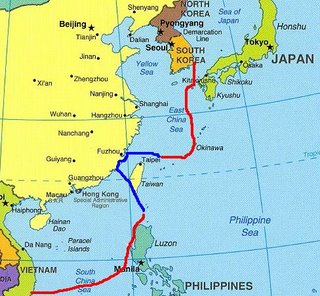
There is probably no more important reason to defend Taiwan than plain geography. The island of Taiwan is a major constrictive influence on China’s ability to project power in East Asia. The map above crudely demonstrates this effect. The red lines represent where China is hemmed in by nations other than Taiwan. The blue line shows where China is blocked by Taiwan alone. Losing Taiwan to China would have many deleterious results for U.S. strategy. As can be seen, China is currently prevented from having reliable access to blue water. Without Taiwan, the Chinese fleet (PLAN) would have direct access to the great ocean of the world. The U.S. and Japanese navies would be placed in the unenviable position of hunting down major Chinese surface ships across the vast Pacific Ocean. The Chinese would further be free to maneuver, combine, and divide their major fleets as they see fit in a time of war. Presently the Chinese are forced to divide their navy into two essentially independent fleets north and south of Taiwan. With warplanes and missiles on Taiwan it would be extremely risky for them to maneuver their fleet in the Taiwan Strait. The Chinese navy would thus start any war divided and halfway to being conquered. The reverse is also true; a Chinese Taiwan would form a protective bubble over the central part of the western Pacific that would be dangerous for the U.S. Navy to enter. The American fleet would be forced to either operate too far away to support operations or accept higher casualties. Lastly, Taiwan is an excellent location from which to launch air and missile attacks on China. It is the closest piece of land to China we would have, and is midway between Shanghai and Hong Kong.
The main military reason to defend Taiwan, aside from geography-influenced ones, is attritional. Classic attritional warfare is taking a geographic feature cheaply that the enemy must pay dearly to retake. One example of this is Southern General Longstreet’s desire to disengage and move around the Union army at Gettysburg to take a position between it and Washington, thus forcing the Federals to pay the high price of attacking the Confederates instead of the other way around. The Chinese have so indoctrinated themselves in the belief that Taiwan must be restored at any price, that they are, well, willing to pay any price to take it. Militarily then, Taiwan is a rock against which we can break the Chinese military. Even in a best case scenario, an invasion and occupation of Taiwan would be extremely costly to the Chinese military. Of course, the goal would be to prevent a successful result for China, but whether successful or not, we would be in a far better position versus China after they have blown themselves in their effort to retake Taiwan.
The Taiwan situation seems to me to be very similar to a prior contested island, Heligoland. Heligoland is a small island in the North Sea off the German coast. It had been a British territory since 1807 but Kaiser Wilhelm had given Britain a free hand in several East African kingdoms in exchange for the island in 1890. Though it appeared at the time that the British had received the better deal (one German critic groused that the Kaiser had “given away the coat for a button”), by World War I it was clear the Germans had. Heligoland proved invaluable for the German High Seas Fleet by forming a bubble in the southeastern corner of the North Sea that was inaccessible to the Royal Navy. The German fleet could make darting attacks from this secure area and then race back when caught by superior British forces. Had the British still possessed Heligoland in 1914, it is unlikely the Germans could have operated their fleet for long. British spotters and cruisers would have kept constant track of German movement allowing the British to be quickly destroy them if they attempted any action. The Germans possessing Heligoland was one factor that led them to believe the British would not risk their fleet and Empire to blockade Germany; a dangerous assumption of British intentions. It is likely that a China who controlled Taiwan would also assume that the United States would not risk her fleet and global preeminence in a confrontation over East Asian affairs.
The one weakness that we must concern ourselves with is the Taiwanese people. They seem to believe that we will simply save them from any Chinese attack, so no reason to prepare to defend themselves. They spend a pathetic 2.4% on defense, less than half of what they should spend. They have yet to agree to the major arms package President Bush offered them in 2001. Their military is only now beginning to think about reforming to face a 21st Century attack. Though they are still valuable to us, we are simply not going to blast the Chinese out of the mountain caves of Taiwan to liberate the island. Also, the amount China must pay to take the island is directly linked to how prepared the Taiwanese are to defend their island. Clearly, in any conflict we want the price to be as high as is possible. It is arguable that supporting Taiwan increases the odds of war with China. I do not agree with that, but even if it is true, it is better to have a greater chance of a war that is in our favor, than a lower chance of a war in China’s favor.
Saturday, June 24, 2006
Why we should all love Australia
Thursday, June 22, 2006
Alliances for the new Century Part 4 – Australia
 In keeping with the global power shift to the Far East, our most important Anglo ally is becoming Australia. They play a similar role to Britain, being a staunchly loyal and capable base off of Southeast Asia. Australia is not necessarily a powerhouse nation with only 20.3 million people, an economy of $640 billion, and a military budget of $17.8 billion. They rank around 15th in global power, or in the range of South Korea and Spain. What makes Australia so important is her location, excellent (if smallish) military, and relative power superiority in Southeast Asia.
I do not mean to sound belittling when I say Australia is mostly valuable for her location. The extreme difference in power between the United States and every other country in the world (with the possible exception of Japan) means that the most important asset of any of our allies is their location. There are many regional and global benefits to Australia’s location. Bases in Northern Australian (such as at Darwin) are great locations from which to launch operations throughout terrorist infected Southeast Asia. Australia’s location is also at the corner of the "V" formed by the ocean off the southern and eastern sides of Asia. As this map shows:
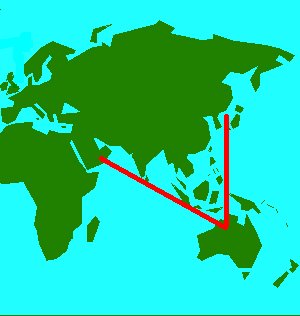
This means forces deployed there would be able to deploy as far a field as the Mideast, South Asia, and Northeast Asia in a reasonable amount of time. Add to this the central role in global spying and intelligence gathering Australia plays (as the Echelon program attests), and it is clear that Australia is a very valuable ally for all the most important regions.
A point that cannot be overlooked when examining Australia is the fact that her military is one of the few remaining militaries that can conduct offensive operations with us (in stark contrast to say, France and Germany). Although Australia only has 53,000 soldiers, they are amongst the best funded in the world at $335,000 per soldier. Much of the $17.8 billion defense budget is going to ensuring that Australia can, after falling behind a little, continue to work closely with the U.S. Billions upon billions are being spent to purchase Aegis destroyers, amphibious warships (essentially light aircraft carriers), F-35, and possibly F-22, fighter planes, large transport and refueling planes, and M1 tanks. Though the numbers are small compared to the U.S., 3 Aegis warships vs. 84, 100 F-35’s vs. ~2,800, 59 M1’s vs. ~1,600, they would be a valuable addition to any operation. In fact, compared to other countries in the world, this amount of deployable power is far above that of many much more powerful nations, much less those of Southeast Asia.
Australia is, unlike India, already very close to the U.S. We have an alliance through the ANZUS Treaty, Australia participates in the National Missile Defense program, they took part in both the Iraq War and occupation, and we have joint intelligence gathering and sharing. Our focus should be more on improving our alliance with a nation that is both ideally located and one of the last nations to be capable of operating with us militarily. As with Japan and India, this is exactly what the Bush administration has been doing. Of greatest significance, Bush has upgraded our alliance to the same level as Great Britain, a true honor. The President has made Australia one of the few countries with a free trade agreement with the U.S. (given how hard it is to get an FTA through Congress you could say that is a true honor also). We should also continue to not overreact to any ties between Australia and China. If there is any trouble in the future with China, Australia will side with us. There is no need angering them by trying to stop business deals between them and China now. I do not believe furthering our ties with Australia have conflicted with any of our European alliances for now. However, Australia is so important to us and the future power politics of Asia that we cannot let Europe come between us.
Tuesday, June 20, 2006
No Ko No Go
I just have a few points on North Korea now that Kim Jong-il has managed to get attention again by threatening to launch an ICBM capable of hitting the U.S. First, despite the Democrats wild-eyed cries for Bush to do anything besides deal with Iraq (well now Iran), there is not much the U.S can do with North Korea except make the situation worse. There are two ways to deal with foreign problems, diplomacy or force, and neither is a serious option for the U.S. with North Korea.
Diplomacy - For diplomacy to work, we have to have all the regional powers working with us. In the case of North Korea, only Japan is really supportive, but for historical reasons there is not much they can do. South Korea is neutral but moving slowly towards a more pro-North policy (think Sunshine). The major problem is the Chinese. They support North Korea diplomatically and by providing just enough food and fuel to keep the regime in power. Since there is no unified diplomatic front, and since China provides Kim with just enough to survive, there is no possibility of resolving the issue diplomatically at this time.
Military - While we have various military options for stopping North Korea, without the support of South Korea none of them are practical. South Korea will not support any as they all risk a war with North Korea which would be very expensive in lives, property, and money; none of which a South Korean economy still recovering from 1998 can handle. Further, any war would almost assuredly end with the collapse of North Korea and re-unification. Sounds good, but the South Koreans really do not want it because they don’t have the money or inclination to bring North Korea up to their level (compare to the problems Germany had, East Germany was ¼ the population of the West and ½ the income, North Korea is ½ the population of the South and around 1/15 the income).
Since it is too late to improve the situation, all we can do now is not make the situation any worse. We can avoid pass mistakes such as giving North Korean regime food and fuel aid that has allowed them to prolong their time in power. It was also probably a good idea to not have given them the nuclear technology that made it easier to develop nuclear weapons. All we are left with now is to continue building up missile defenses, prepare to give Japan or South Korea nuclear weapons, continue our pull out from South Korean so that fewer Americans die should the North Koreans start a war at the time of their own choosing, and keep up the anti-proliferation patrols around North Korea. Due to the mistakes of the Clinton Administration in dealing with this issue, we have little hope of starving them out or possibly forging a verifiable agreement. Essentially all we can can do is protect ourselves and make South Korea and China pay most of the price since they have prevented us from doing anything before they aquired nukes and ballistic missiles.
Diplomacy - For diplomacy to work, we have to have all the regional powers working with us. In the case of North Korea, only Japan is really supportive, but for historical reasons there is not much they can do. South Korea is neutral but moving slowly towards a more pro-North policy (think Sunshine). The major problem is the Chinese. They support North Korea diplomatically and by providing just enough food and fuel to keep the regime in power. Since there is no unified diplomatic front, and since China provides Kim with just enough to survive, there is no possibility of resolving the issue diplomatically at this time.
Military - While we have various military options for stopping North Korea, without the support of South Korea none of them are practical. South Korea will not support any as they all risk a war with North Korea which would be very expensive in lives, property, and money; none of which a South Korean economy still recovering from 1998 can handle. Further, any war would almost assuredly end with the collapse of North Korea and re-unification. Sounds good, but the South Koreans really do not want it because they don’t have the money or inclination to bring North Korea up to their level (compare to the problems Germany had, East Germany was ¼ the population of the West and ½ the income, North Korea is ½ the population of the South and around 1/15 the income).
Since it is too late to improve the situation, all we can do now is not make the situation any worse. We can avoid pass mistakes such as giving North Korean regime food and fuel aid that has allowed them to prolong their time in power. It was also probably a good idea to not have given them the nuclear technology that made it easier to develop nuclear weapons. All we are left with now is to continue building up missile defenses, prepare to give Japan or South Korea nuclear weapons, continue our pull out from South Korean so that fewer Americans die should the North Koreans start a war at the time of their own choosing, and keep up the anti-proliferation patrols around North Korea. Due to the mistakes of the Clinton Administration in dealing with this issue, we have little hope of starving them out or possibly forging a verifiable agreement. Essentially all we can can do is protect ourselves and make South Korea and China pay most of the price since they have prevented us from doing anything before they aquired nukes and ballistic missiles.
Saturday, June 10, 2006
Alliances for the new Century Part 2 – Japan
 As the world changes around us, where are America’s future interests and potential allies? In a word, Asia. Therefore, first and foremost amongst our newly important allies is Japan. Though Japan is in a similar downward spiral as Europe, they exercise little of their power today, so if they use any in the future it will be more than they do today. By all measures Japan is very powerful country with an economy of $4.8 trillion, a population of 127 million, and a military budget of $45 billion. She is the second most powerful nation in the world, and will stay in the top 4 for the foreseeable future. Japan is absolutely critical to us for multiple geopolitical, economic, and military reasons.
Clearly a nation the size of Japan carries a lot of heft around the world and especially in East Asia. It is very useful to have a second voice at times, the more so the more powerful that voice is. Our main geopolitical challenge in East Asia is obviously China. Our general goal is to form an alliance of countries surrounding China so as to limit her ability for trouble making. The Japanese are the most important part of that ring. Not only because they are by far the most powerful member of that group, but also because they can reach out to the other members. For example, after we sign a trade or technology deal with India the Japanese can follow us and sign similar deals to further sweeten the pot. In many cases, due to Japan’s closer proximity, they can offer a better deal that we can. Japan can also work more closely with nations, such as Vietnam or Laos, which are difficult for us to deal with. All of this also applies outside of East Asia. Japan is rich and strong enough to have influence in Africa or Latin America in a way other countries like say South Korea or Taiwan cannot. This includes the U.N. where Japan is a useful member and second largest contributor. Combined with our contribution, we make a team that the U.N. cannot operate without. These are useful attributes especially combined with Japan's wealth.
That Japan is a very wealthy country is well known. At $36,700 they are the only large country with a per-capita income near our $41,600. Not only that, but Japan is a well known nation of savers. They will save over $1.3 trillion this year while investing just under $1.2 trillion inside Japan. As they age, they need a better yet safe place to invest their money than Japan since it is oversaturated with investment. We need a source of large amounts of capital to invest in our ever growing country and economy. We’ll only save about $2 trillion this year while needing around $2.6 trillion for investment. What better combination for the future than the biggest saving country and the biggest investment country? We are also major trading partners with over $210 billion in trade last year. To further encourage this trade there is even talk of a U.S.-Japan Free Trade Agreement, but it is admittedly a long way off. However, it would do much to advance our alliance. In addition to the hundred billion in excess savings available for overseas investment, Japan provides around $9 billion in foreign aid per year. The geopolitical aspect of this is obvious.
Along with the diplomatic and economic reasons, Japan is a valuable ally from the military standpoint as well. Japan’s military budget is one of the largest in the world and has much room to grow in the future. With a budget of $45 billion and 240,000 soldiers, the Japanese have a good spending per soldier ratio of $188,000. They have focused on funding a small force that is almost trained and equipped to our standards. This allows for easy co-operation. It also allows for future expansion. Japan needs protection in their unruly neighborhood and we need an access point to and support in the very same neighborhood. We have recently made many strides in regards to our military relationship. We have agreed to a new defense treaty that resolves the longstanding issue of the Marines on Okinawa and has Japan take a great role in East Asian operations. They are also the largest partner in our missile defense program. The Japanese have agreed that a Chinese invasion of Taiwan is matter of national security. Ultimately, as China becomes a bigger issue in East Asia, we need a powerful military in the region that other countries trust will always stand up for them. Sadly, we do not have the best reputation for standing by allies (which the media driven panic over Iraq is doing nothing to assuage) and many East Asian nations suspect that we will sell them out to China in the end. They would not worry about a powerful and confidant Japan selling them out since Japan has no where to go should they do that.
Given the changes in the global power structure, it is critical that the U.S. government recognize and act on them. One of the changes is that Japan is now the most critical future ally we have and any responsible administration would place her above all others. That is exactly what President Bush is doing. We have become closer to Japan than at any time in our history (Except maybe in the decade after World War 2). So long as we continue giving Japan the attention they deserve even though it may be at the expense of Europe, we can look forward to a long fruitful friendship.
Subscribe to:
Posts (Atom)