Thursday, July 24, 2008


Thursday, June 29, 2006
Why developed nations are still the industrial nations
The best statistic to look at when considering the level of industrialization of a nation is not manufacturing’s share of GDP or number of manufacturing jobs, but manufacturing per person. A simple scenario explains why; in it Tom earns $5,000 a year from accounting work and $20,000 from other sources, while John earns $2,000 from accounting and $2,000 from other sources. Who would you determine to be more of an accountant? If you focus on accounting’s share of income then John at 50% is clearly the bigger accountant. However, when looked at by accounting per person, Tom obviously does more accounting than John. The same applies for the reason why the number of jobs does not matter; who cares if Tom has 2 workers making the $5,000 while John uses 5 workers to make $2,000? When adjusted for manufacturing output per person, the following table shows how it stacks up: (manufacturing output is in billions, manufacturing per capita is in thousands, and growth is from 1996, all stats are from the CIA World Factbook or Economagic.com, I also use a 5 year average for currencies, so Europe's output is slightly lower and Japan's higher than a straight current currency conversion would yield)

As can be seen, despite everything you hear about China’s manufacturing destroying the U.S. industrial base, we still produce nearly 13 times as much industrial output per person as China. We also produce almost 5 times as much as the world’s average. We have the third highest per capita manufacturing of the bigger countries, behind only Japan and Canada. To counter the argument that we are de-industrializing, I also included the growth of these various countries over the last 10 years. The U.S. actually grew faster than the world average during this period, 18.3% vs. 12.9%. There are several reasons for that since our growth was only average. Japan's output (third highest in the world) barely grew, and non-Japan/China East Asia was slammed by the 1998 economic crises. That's why Korea underperformed overall and Indonesia's production declined significantly. Western Europe and Latin America (check out Mexico, so much for that giant sucking sound) also underperformed last decade. To be fair to us, we also had to deal with the 2000-2001 recession that saw our industrial production decline 8% before recovering in 2003 and growing 12.5% since then.
While there are some real issues in continental Western Europe with industrial output (only 4.8% per capita growth!), they are still 4 times higher than the world’s average per capita output. The reason China's growth is so high is that it is coming off of an extremely low base of $335 per capita in 1996. In the last 10 years we have increased our output by almost $1,460 per American where as the Chinese have increased theirs by $405 per person. China's growth will inevitably slow as they become more industrial (or when their environment gives under the intense pollution). Also, I would expect that like the Soviets, the Chinese overstate their output to some extent. The last point about this chart is that it shows again how the world’s power structure is shifting. Manufacturing is only one part of a nation’s power, but it is linked to economic performance which in turn determines defense spending and population development. The regions performing best are first non-Japan East Asia, then India, and third the Anglo-sphere. These are the regions that will shape the future; we had better prepare for it.
As a side note, last years per capita growth rates were America 2%, W Europe 0.1%, E Europe ~4%, Japan 1.3%, China 8.3%, India 7%, non-Japan/China East Asia ~5%, Latin America ~2%., and the World ~2%.
Wednesday, June 21, 2006
Debt Myth 1 - Bush is drowning us in debt
This graph shows the mild rise and level of debt currently enjoyed by the U.S. (note for any chest beating libs out there, the debt to GDP ratio increased 8.1% under Clinton until 1998, 4 years after the Republicans took control of Congress, debt interest rates also rose from 6.374% to 6.631%).
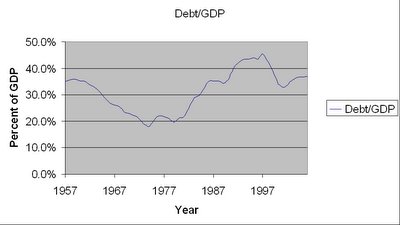
Economic info can be found here, and debt/interest rate info here.
Tuesday, May 23, 2006
Illegal Immigration - America's Latifundia
 The latifundia were the great Roman farming estates owned by the elites. They played a major role in keeping the economy of the western half of the Roman Republic and Empire underdeveloped and were perhaps one of the primary causes of its ultimate demise. As with all historical analogies, comparing these to modern illegal immigration is not exact. However, the broader trends are applicable.
The latifundia represent a trend in Roman agriculture that took several centuries to complete. It was first noticeable after the Second Punic War in the closing days of the 3rd Century BC. This was a war of a length and scale the Romans had never before fought. Prior to the war the Romans had rarely called up farmers for more than a campaign season at a time. After the campaign the farmer would return home at worse missing one crop. During the Second Punic War Roman farmers were called up for many years of continual campaigning. In addition to being away from their farms so long, Hannibal marched around Italia burning farms as he went. By the end of the war in 202 BC, the Roman farmers still alive had barren and/or destroyed farms. The wealthy in Rome were in contrast richer than ever from the spoils and plunder of the war. There were also plenty of slaves from all the defeated peoples. The wealthy Romans then began to purchase the smaller farms that were destroyed or no longer had an owner and used slaves to work them. It is impossible to compete with slave labor so this began the process of putting the remaining small farms out of business.
Despite not having a job, the small farmers still existed. They would mostly migrate to Rome to fill the teeming masses of unemployed in the Capital. As they did so they were no longer qualified to serve in the legions. This led to a steep decline in the number of potential soldiers and seriously affected Roman power in the late 2nd Century BC. It also changed the wealth distribution within Rome. Overall economic output was the same or possibly higher, but it was held by a few wealthy families. Where before there were 10 Roman farmers working 10 acres each, there was now one 100 acre farm owned by a single wealthy man and worked by slaves who made nothing. The 10 Roman farmers then had to go on the dole in Rome. The situation came to a head when the Gracchi brothers attempted to take some land from the wealthy latifundia and distribute it to the poor farmers in the city. The Senate opposed the plan so the Gracchi went to extraordinary constitutional means to get around the Senate. It was followed by a series of struggles, slave revolts, and civil wars that would last until Octavian established the Empire.
The solution that eventually solved the army's recruiting problem was Marius' reforms at the end of the 2nd Century BC. The army would now recruit from the urban unemployed and pay them a salary. While this solved the problem with the army and the urban unemployed, it created a new problem that would lead to the fall of the Empire. Since soldiers were no longer members of the state but now members of their legion they began to identify more with the general than the Senate. Over time they would be willing to fight other Romans to place their general on the throne. This instability, especially in the 4th and 5thCenturies AD would greatly sap the Empires vitality making it easy for the barbarians to overthrow it.
Clearly the illegal immigration problem is not as severe as this. Unlike America today, agriculture was the basis of the Roman economy and workforce. Nevertheless on a smaller scale we can see the same process at work. Low paid illegal workers are pricing low skilled American workers out of jobs which leaves them little to do but fill our prisons (which they are doing at a decent clip). Instead of using capital to increase productivity of American workers, many farms and factories are simply using illegal workers to lower costs. Like the latifundia this isn't affecting total output as much as redistributing wealth within the country. Instead of an owner and 2 American workers at a farm, and two at a factory making farm machines, there is the owner and 10 illegal workers. Essentially the income of the two farm workers is divided amongst the 10 illegals and the income of the 2 factory workers is kept by the farm owner. This is also causing a more limited kind of the social upheaval caused by the latifundia did. Just like Rome we have the elites and Senate working together to support illegal immigration while the people and the popular assembly (House of Representatives) are trying to do something about to limit it.
Again, not many American workers are directly affected by illegal immigration in the manner that Roman farmers were affected by latifundia. Nor does illegal immigration affect army recruiting. It also is not causing the mass social upheaval that accompanied the latifundia. However, it is affecting the lower classes directly, and is affect agriculture and some manufacturing. Whether severe or not, the civil strife illegal immigration is likely to cause is not something America needs. Lastly though, it has the potential to become something much more severe in the coming decades if it is not dealt with now; which is a topic for a future post.
Primary Source: The Punic Wars by Adrian Goldsworthy